Mortgage lead management is the process that gets maximum conversion out of every opportunity, whatever door it came through.
An inbound call off a direct mail piece. A lead from Bankrate. A referral from a realtor you play golf with. Those arrive completely differently and they all need the same thing. A process that moves them toward a closed loan. And automation carrying enough of the steps that the loan officer spends the day talking to borrowers. Not deciding what to do next.
Three parts make that work. Routing, prioritization, and response. Any one of them alone changes very little.
Understanding Mortgage Lead Management
The word “lead” is doing this subject a disservice.
Lead management covers every opportunity that enters your pipeline. Purchased records, inbound calls, web forms, realtor referrals, past clients coming back. A referral is not a lead in the way anyone means it. It still needs routing, a priority, and a response standard.
Lead generation puts an opportunity in front of you. Lead management is everything after that. Two different markets, and spending more on the first while ignoring the second is how budgets disappear here.
It also sits at a specific point in the loan. Intake is the first of four stages a borrower moves through. It is also the only one your CRM owns outright. We mapped the rest in where automation fits the loan lifecycle.
What Is Mortgage Lead Management?
Mortgage lead management is the system that decides who works each opportunity, in what order, and how quickly. Routing on arrival, prioritization once assigned, response cadence, and the reporting that tells you which sources produced funded loans.
It is not a feature. It is a set of rules your platform either enforces or leaves to whoever opens the queue first.
Why Lead Management Matters
Because a borrower does not go from interested to funded on their own.
Every opportunity has to move through the same sequence. Reached, then qualified, then applied, then funded. Each step has a way of stalling. Every stall looks identical from the outside. A record sitting in a pipeline with nothing scheduled against it.
Lead management is what keeps that sequence moving. Routing gets the opportunity to someone who can work it. Prioritization decides what gets attention today. Response, cadence and staying present while a borrower waits keep contact going until the borrower either applies or tells you no.
Two shops buying identical leads produce very different results, and the difference is almost never talent. One has a process that advances the file. The other has a queue.
The Three Parts of the Process
Routing, prioritization, and response. They only work together.
Perfect routing with no prioritization puts a $150 purchased lead in the same queue as fifty aged records. Both get the same treatment, which means the expensive one got the cheap one’s attention.
Perfect prioritization with no response standard produces a well-ordered list nobody works fast enough.
And those with no routing or prioritization sit unassigned while your team tries to decide whose it was.
The next three sections take them one at a time. Read them as one process.
Mortgage Lead Distribution and Routing
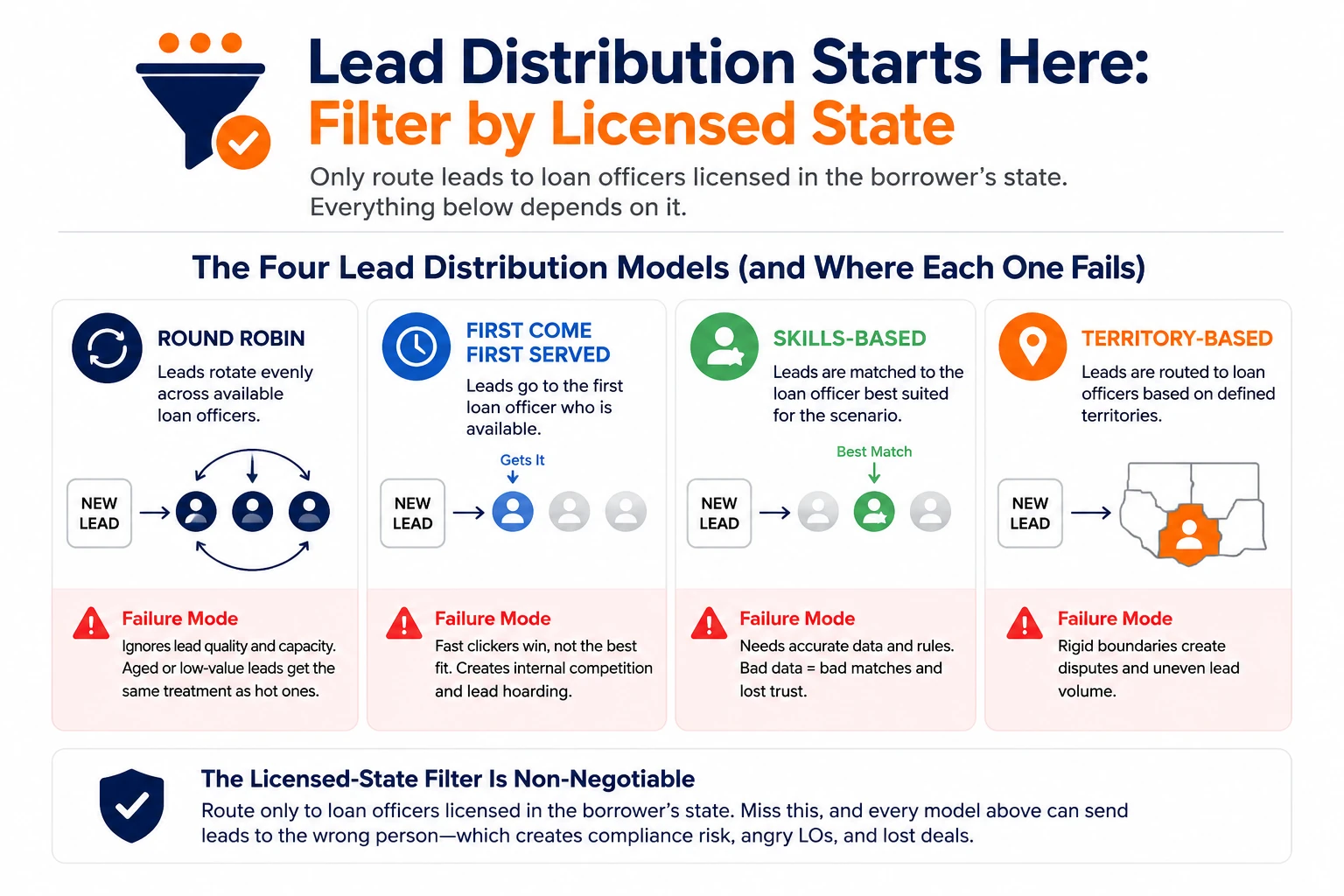
Who gets the opportunity, and on what basis. Lead routing mortgage teams actually use comes down to four models, each with a failure mode.
This is the summary. The full mechanics of who gets each lead, how, and what happens if nobody acts are in how to route leads and inbound calls.
Model
How it works
Where it breaks
Round robin
Equal counts across the team
Ignores capacity and skill. Your best closer gets the same volume as your newest hire
Priority-based
Best leads to best performers
Your top producer is the least available person in the shop
First-claim
Available officer takes it
Rewards whoever is at their desk, not whoever converts
Skill or product
Purchase to buyer specialists, refi to refi, non-QM to whoever knows it
Requires enough volume in each lane to keep people busy
The constraint nobody writes about: state licensing.
An officer taking a lead outside their licensed states is a compliance problem, not a routing preference. Any distribution rule has to filter on licensing before it does anything else.
That single requirement eliminates naive round robin for every multi-state shop. If your platform cannot filter assignment by licensed state, the routing logic is decorative. Somebody is fixing it manually at the worst possible moment.
Two follow-on requirements come with it. Licensing changes, so the filter has to read a current field rather than a list somebody typed once. And when nobody licensed in that state is available, the lead needs a defined destination rather than sitting unassigned.
Most platforms handle the first case and fail the second. Ask what happens to a Texas lead at 6pm when your two Texas-licensed officers are both on calls.
This is Shape’s operating read rather than legal guidance. Confirm your assignment rules with your own compliance officer.
Rotation only settles new leads. The neglected ones need a separate recovery pool, which is the round robin versus shark tank distinction.
Lead Prioritization for Loan Officers
Once assigned, what gets worked first. Lead prioritization loan officers default to is arrival order, which is the worst available option.
Three things should drive it.
Time since inquiry. This is where speed lives, and it only matters on the first contact.
CFPB research shows most borrowers seriously consider only one lender. That part is measured. What follows is our inference. Only one lender gets taken seriously. Being first to a real conversation is the best position to be that lender.
So getting to that conversation first is worth more than anything you do afterward.
After that first attempt, time since inquiry stops being the useful signal.
Engagement signals. Opened, clicked, replied, called back. A borrower who opened three emails and never answered a call is telling you which channel to use.
Loan purpose. A rate-lock deadline is a real clock. A cash-out refinance with no deadline is not.
Prioritization Is a Time-of-Day Problem
Real prioritization is not a ranked list. It is crafting touch points across days so you maximize the chance of actually connecting.
Two rules make most of the difference.
Call near the hour they inquired. Someone who filled out a form at 7:40pm was available at 7:40pm. That is your best window, and it is not the window a 9am call block hits.
Vary the time across the cadence. If the plan is ten calls in the first week, those ten should land at ten different times. Morning, midday, late afternoon, evening. You are casting a net, not repeating an attempt.
Here is the failure this prevents. A shop calls the same records at 9am every morning, gets nobody, and concludes the leads are bad. The leads were fine. The cadence only ever tested one hour of the day.
That is a lead management problem wearing a lead quality costume. It is also the most expensive misdiagnosis in this channel.
Static scoring versus a model that learns.
Nearly every platform describes lead scoring the same way: assign a numeric value based on behavior and demographics. That is a rule set somebody wrote once. It stays wrong in exactly the ways it was wrong on day one.
ShapeIQ trains on your ideal customer profile and keeps retraining on your own CRM outcomes. When your conversion pattern shifts, the model shifts. A static rule set does not.
That distinction is the whole difference between scoring that decays and scoring that improves.
Response Speed and Cadence
Prioritization set the order. Response is a different question. What standard you hold, and what makes it happen.
Set the standard per source. A purchased lead and a past-client referral do not deserve the same clock. One blended target means you are too slow on half your pipeline and spending urgency on the rest.
The speed research everyone quotes is cross-industry and measures contact rather than funded loans. It is sourced in mortgage CRM statistics. What it cannot tell you is where to set your own number.
Then decide what enforces it. This is the part lead management owns, and the part most shops skip.
A target nobody measures is a preference. A target enforced by a person is a preference with extra steps. That person is on another call when the opportunity lands. What holds is a first touch firing on creation and a cadence that generates its own tasks.
Response is a system property, not a discipline property. That is why it belongs here rather than in a coaching conversation.
Three questions for your own platform:
Does the first touch fire without anyone opening the record
Does the cadence keep generating tasks when an officer skips one
Can you see time to contact by source, not just an average
Mortgage-Specific CRM Solutions: Key Features to Look For
Six capabilities. Everything else is table stakes.
Capability
Why it decides the purchase
Assignment filtered by licensed state
Without it, every routing rule needs a manual check
Source stamped on arrival
The field every other decision depends on
Prioritization that learns rather than scores statically
A rule set written once decays from day one
Response automation by lead type
Shopped, referral, and inbound need different cadences
Inbound call handling that creates a record
A call with no record never happened as far as the pipeline knows
Reporting by source and lead type, not aggregate
Aggregate numbers hide which vendor works
Read that list as a shortlist filter rather than a wish list. A platform missing the first two cannot enforce the other four. Assignment and attribution are what the rest are built on.
That is the order mortgage lead management software has to be built in. Bolted onto a general CRM, the licensing filter and the source field are the two things that end up manual.
Why Generic CRMs Fail at This
Pages currently ranking for mortgage lead management recommend Pipedrive, monday.com, and Salesforce. One names a real estate platform and another names a private lending tool.
None of them filters assignment on NMLS licensing. None knows what a loan purpose is. None can prioritize on a rate lock expiring. They are competent sales CRMs being sold into a licensed industry with different rules.
That is not a Shape argument. It is a category observation, and it is the most common failure on this subject.
Getting Started With Mortgage Lead Management
Five things. None of them requires a new platform to start.
Track source on every opportunity. Automatically, stamped by the system at intake. Every rule below depends on it, and typed in manually the attribution is gone by month two. When somebody asks which source produced last quarter’s fundings, this is the field that answers.
Report on speed to contact. Not response time to a first attempt. Time to a live two-way conversation, measured by source. That number tells you where the process is actually failing.
Build a multi-touch cadence across phone, email, and text. All three, every time. You do not know how a borrower prefers to be reached. Guessing costs you the ones who answer a text and ignore three voicemails.
Give every officer a prioritized list. Not a pipeline they have to sort. A list, ordered, so nobody spends the first twenty minutes of the day deciding where to start.
Then manage the activity. Attempts, contacts, conversations. Those are the inputs you control, and production follows them.
That last one is the whole discipline. Loan officers who hit activity numbers close loans. The platform’s job is making that activity obvious rather than optional.
Mortgage Lead Management Strategies for Better Lead Quality
Most shops respond to a conversion problem by shopping for better leads. Usually the leads were fine.
Lead quality is two things wearing one name. There is what you bought, and there is what your process did with it. The second one is where the recoverable money is, because you already paid for the first.
The same source performs differently at two shops. That is the tell. A vendor producing funded loans for the shop down the street and dead records for you is not the variable.
Speed to contact is the biggest single lever. A record nobody reached is indistinguishable from a bad record on a report. Both show as no conversion. Only one of them was actually the vendor’s fault.
Cadence depth separates the two. A source written off after three attempts was never tested. Most opportunities convert after more contact than anyone expects. A shallow cadence makes every source look weak.
Attribution is what lets you tell the difference. Without source on the record and speed to contact by source, a quality argument is just two people trading opinions.
Fix the process first, then judge the source. Do it the other way and you replace a vendor that was working.
AI and Automation in Mortgage Lead Management
Two things AI does well here and one it does not.
Prioritization. A model trained on your own outcomes ranks a queue better than a rule set. It also keeps improving as the pattern shifts.
Coverage. An agent answering at 8pm and booking a time on the right officer’s calendar fills a gap a human cannot. Your best producers are the least available people in the shop, which is physics rather than discipline.
What it does not do. Judgment on a borrower’s situation. A decline. A credit event. A co-borrower dropping off the loan. Those are phone calls.
Automation also runs into consent. Automated calls and texts to a wireless number require prior express written consent. 10DLC registration is table stakes for A2P messaging. That is our operating read, and it belongs in front of your counsel before you turn anything on.
Where AI helps most is the gap between what a producing officer can cover and what the pipeline needs covered. That gap is not a discipline problem and it does not close with more effort.
Qualification is the piece with the most room. An agent texts a new opportunity and asks the questions that decide whether it is real. What it hands over is a scored conversation. Nobody was doing that at 9pm anyway. We covered that in AI SMS lead qualification.
Frequently Asked Questions
How does mortgage lead management differ from lead generation?+Lead generation is acquisition. Lead management is what happens to the record after: who works it, in what order, and how fast.
They are separate purchases and separate problems. Buying more leads without fixing management is the most expensive mistake in this channel. You pay for volume that dies in a queue.
What is the best lead distribution model for a mortgage team?+There is no single answer, but every model has to filter on licensed state first. That is a compliance requirement rather than a preference.
After that, round robin suits low volume and even skill levels. Priority-based suits teams with clear performance differences. Skill-based works once you have enough volume per lane to keep specialists busy.
How should loan officers prioritize leads?+By source cost, time since arrival, engagement signals, and loan purpose. Arrival order is the default and the worst option available.
The common version: a $150 exclusive lead sitting behind fifty aged records in one queue.
Does lead scoring actually work in mortgage?+It works when the model learns from your outcomes. Static scoring assigns a numeric value from fixed rules about behavior and demographics. It decays from the day it is written.
The test is whether your scoring changes when your conversion pattern changes. If it only changes when someone edits a rule, it is a rule rather than a score.
What should a mortgage CRM do that a general sales CRM cannot?+Filter assignment on NMLS licensed states. Understand loan purpose. Prioritize against a rate lock. Hold consent state on the borrower record.
Those are not preferences. They are the requirements of a licensed industry, and general sales CRMs were not built for them.
Kevin Benner is the Chief Revenue Officer at Shape Software, where he leads revenue, marketing, and customer growth. He brings over 23 years of experience in mortgage lead generation and sales technology.
Ask a shop how they nurture mortgage leads and you get a sequence. Ask when a lead leaves that sequence and the room goes quiet. That is the whole problem. Nurture gets built as a destination rather than a state with edges, so leads fall in and never come out. The list grows, engagement falls, […]
Lead distribution decides three things. Who gets the lead, how fast they get it, and what happens if they do nothing with it. Most software comparisons stop at the first one. The other two are where the money is. This page is about routing inside your own shop. If you came looking for ping-post, it […]
Speed to lead is the elapsed time between a borrower raising their hand and someone actually reaching them. Not the time to an auto-responder. Not the time to a first dial attempt. The time to a conversation. That distinction matters more than any benchmark. Most systems report the metric they can measure, not the one […]