How to Nurture Mortgage Leads: Entry, Cadence, and Exit
Ask a shop how they nurture mortgage leads and you get a sequence. Ask when a lead leaves that sequence and the room goes quiet.
That is the whole problem. Nurture gets built as a destination rather than a state with edges, so leads fall in and never come out. The list grows, engagement falls, and eventually somebody suggests a cleanup.
Entry and exit are the decisions. The content in between matters less than either.
Nurture vs follow-up, and where initial contact ends
Three things get called the same thing, and only two of them belong on this page.
Initial contact is the attempt to reach a new lead. Nobody has spoken to this person yet. That is a speed-to-lead problem and it has its own rules.
Follow-up is post-contact. You spoke, you agreed a time, you call back then. “Call me after the first of the month” produces a follow-up on the second. There is a conversation behind it and another one expected.
Nurture runs when something is blocking them. Credit needs work. They are still looking for a house. They are holding off until the kids finish the school year. The borrower is not avoiding you, and there is nothing for either of you to decide yet. The job is to still be there when the blocker clears.
Follow-up and nurture both require that a conversation happened. That is the thread. A lead nobody has reached is in neither. Treating it as though it were is how a nurture list goes bad.
The channels split the same way. Nurture runs on email, text and direct mail. Each lands without needing the borrower to be free when it arrives. That is the point when somebody is months from doing anything. Follow-up is a call at an agreed time. A nurture program built around dialing is not nurture, it is an attempt schedule with nothing behind it.
They are also not sequential and not on different clocks. They run alongside each other. A borrower waiting on credit repair sits in nurture for six months. They still get a follow-up call the week their score is re-pulled.
The error is running one where the other is owed. A scheduled callback replaced by a monthly email is a missed appointment. Nurture is the part of what to do with leads once they land that runs while the borrower waits.
When to nurture mortgage leads, and when not to
Nurture starts with a conversation. You spoke with the borrower, and you know why the loan did not close.
That is the whole test. Not whether they applied, not how long ago they inquired. Whether you know their reason.
Three shapes it takes.
An obstacle they are working on. Credit needs improving, savings are short, a co-borrower’s employment changes in March. The obstacle has a rough timeline and the timeline is the sequence.
A timeline they chose. They got tired of looking and decided to start again in spring. Nothing is wrong, they stopped. The date is the trigger.
An active search that has not landed. They applied, they are preapproved, they have not found a house. This is a nurture case. Most shops treat it as a pipeline case, so the borrower goes quiet in a stage nobody works.
That last one is why application is not the dividing line. A preapproved borrower six weeks into a search is exactly who nurture is for. They are usually the most valuable person on the list.
Without a conversation, you do not have a nurture case. A lead that never answered has given you no reason, no timeline and no concern to work with. Putting it in a sequence built for someone who said “spring” is guessing. The sequence then averages situations with nothing in common.
Those records get siloed instead, which is a different thing and covered further down. Separating the two at entry is easier when the score reflects it, which is what belongs in a lead score.
Build the cadence on the borrower’s clock
Most nurture schedules run on the sender’s calendar. Monthly, quarterly, first Tuesday. The borrower has their own dates and they are more useful than yours.
The shopping window is short, and you cannot see it. FICO folds multiple mortgage inquiries inside a window into one. That is 45 days on newer versions and 14 on older ones. Most borrowers finish comparing inside a couple of weeks. That window decides the loan.
It is also invisible to you. Credit pull alerts come from monitoring a portfolio you closed or service. The other route is buying trigger leads, which the Homebuyers Privacy Protection Act restricted in March 2026. For a prospect who inquired and never applied, you have no signal that they pulled credit at all.
That is the honest constraint on nurture, and it decides the cadence. You are not waiting for a trigger you will see. You are trying to be present when a window you cannot observe opens.
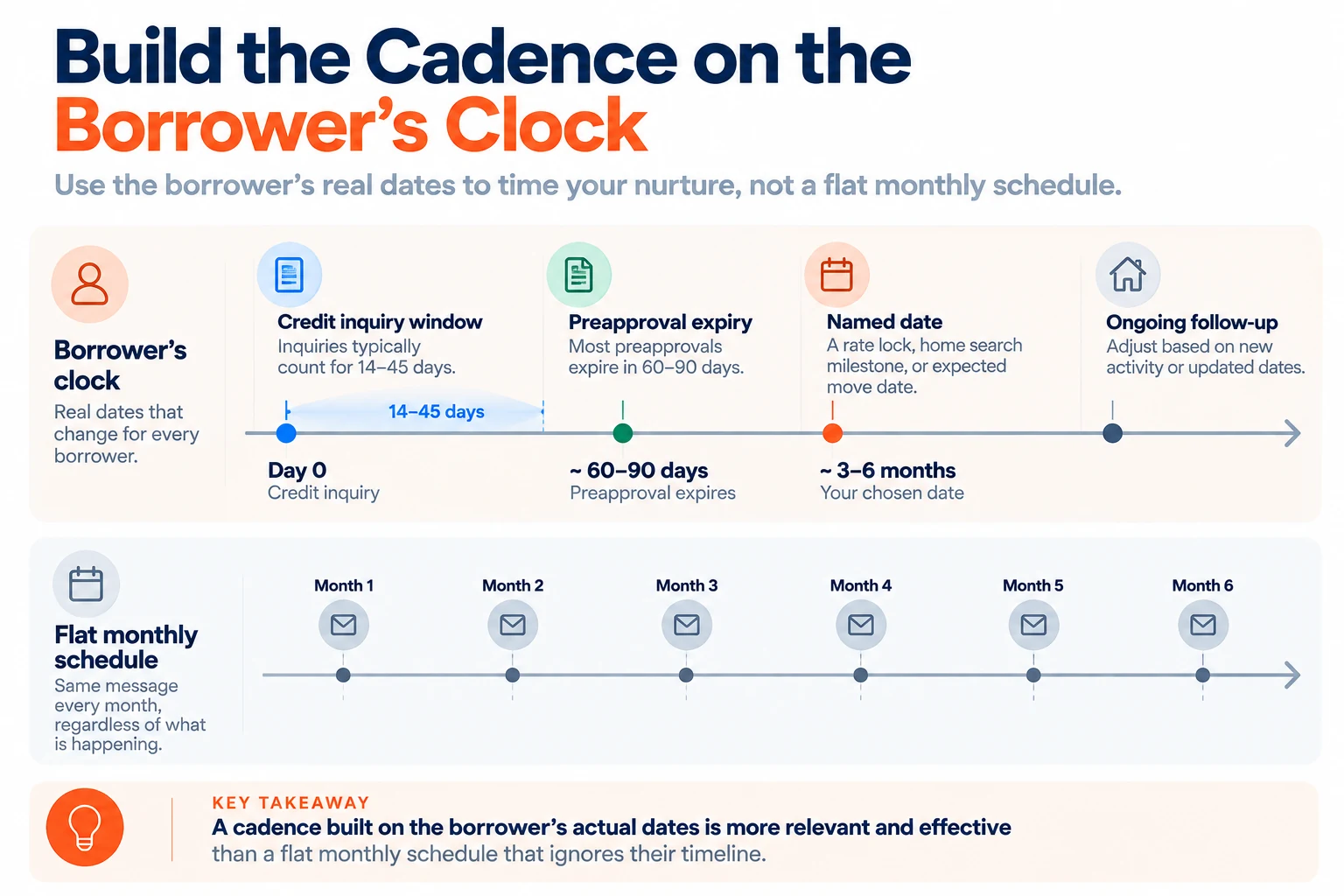
So build on the dates you do own.
A preapproval you issued has an expiry. Most run 60 to 90 days. That date is yours and it sits in your system. It is the only hard clock on a prospect you have not closed.
A named date is a countdown. “Buying in spring” means the sequence should intensify as spring arrives rather than running flat all year.
A named reason has a horizon. Credit repair, a lease ending, a bonus in March. Ask when, and the answer becomes the schedule.
Everything else is engagement, which is weaker evidence and still better than a calendar.
The borrower whose preapproval expired last week is a different lead from the one expiring in six weeks. The second is still in the game.
So cadence follows the reason, not the calendar. A credit-repair lead on a six-month horizon wants occasional, useful, low-pressure email. A preapproved borrower three weeks from expiry wants a piece of mail and a call booked. That is where nurture hands back to follow-up. Running four cadences by hand is what makes shops run one, which is what automated borrower follow-up tools are for.
When to stop nurturing a lead
Four exits. Each needs a rule and a destination, and most shops have written down none of them.
The loan closes. Not the application. A borrower who applied and is still searching stays in nurture. A sequence that stops at application abandons them mid-search.
The borrower opts out. Honor it across channels, not just the one they used.
The reason resolves or expires. The credit work finished, the lease ended, spring arrived. Either the borrower moves forward or the reason has changed, and somebody needs to ask what it is now. That conversation is the exit, not another email.
Engagement dies. No opens, no clicks, no replies, across a defined number of touches. This is the exit nobody writes and it is the one that decides whether the database stays usable.
The email mechanics of that last exit are a subject of their own. The decision here is larger. Not whether to stop a campaign, but whether you still know enough to keep talking.
Where leads go when nurture ends
Not deleted, and not left in the sequence forever. Those are the two defaults and both are wrong.
Deleting loses the record, and a borrower who went quiet in 2024 might buy in 2027. Leaving them in fills the list with people who stopped reading. That drags deliverability down for everyone still engaged.
The third state is a silo. Suppressed from active sequences, kept in the database, reachable by a deliberate campaign rather than an automated one. Every lead you never spoke to belongs here too, once it is clear the phone will not be answered.
What brings someone out of a silo is an event, not a calendar. They fill out another lead form. Their home goes on the market. They call in. A rate moves far enough that a deliberate campaign is worth running. Each of those is a reason to try again, and none of them is the first Tuesday of the month.
A shop that can report how many sit in that state, and how many returned, is running a program. A shop that cannot is running a mailing list with an unsubscribe link.
What to measure
Not opens.
The number that matters is how many leads exit nurture into an application, and at what rate by entry reason. That single cut answers three questions. Whether the credit-repair track is worth running. Whether named-date leads are reached at the right time. Whether the unreached pile should have gone back to the phone.
Track the state as well as the outcome. How many leads entered nurture this quarter, how many exited, and by which of the four exits. A program where entries exceed exits every quarter is accumulating, not nurturing. The question that surfaces when somebody finally looks is which steps should run without you.
Figures we left out, and why
Four numbers dominate the writing on this subject. None of them survives a check, and two invent the same source.
That nurture takes 8 to 12 touches per lead, with a first response under five minutes, cited to Harvard Business Review, 2024. No HBR study from 2024 says this, and the 8-to-12-touches number has no Harvard source at all. The five-minute part misuses a real paper. HBR did publish “The Short Life of Online Sales Leads,” but in 2011, about the speed of first contact with online sales leads in general, not an 8-to-12-touch mortgage nurture cadence. The version circulating in mortgage content invents the touch count and moves the date thirteen years.
That approximately 80% of mortgage leads require sustained engagement before deciding. No study, no sample, no definition of sustained.
That aged leads at 30 to 60 days convert at 6 to 12%. No source and no denominator. Convert to what, from what population, is never stated.
That companies excelling at lead nurturing generate 50% more sales-ready leads at 33% lower cost, attributed to Forrester Research. This one is everywhere. Every trace leads to a blog post, a slide deck or an infographic. Each cites “Forrester Research” with no report title and no year. The earliest instances date to roughly 2013, and the claim is about B2B marketing rather than mortgage.
We use the credit inquiry window and preapproval terms instead, because both are verifiable and both have dates attached. A number you can act on beats a number you can quote.
Frequently asked questions
Who owns the nurture list if a loan officer leaves?+
Whoever holds the contract and the data, which is usually the company rather than the officer. That answer matters most for nurture, because these are the contacts with the longest horizon and the least recent activity. Decide it before somebody resigns, not after. The technology side of that handover is its own subject, covered in the branch transition work.
Should purchased leads be nurtured the same way as inbound leads?+
No, and the difference is what you know. An inbound lead came to you and usually tells you why they are waiting. A purchased lead has often spoken to nobody. No reason on file means no nurture case yet. Work them for contact first. Without a conversation they belong in a silo, not a sequence.
Do I need new consent to keep contacting a lead in nurture?+
It depends on the channel. That makes this a compliance question to settle before you build the sequence, not after. Consent to text is not consent to call or email, and text consent may not hold indefinitely. If any part of the outreach is AI-driven, there are separate questions to answer first. Our operating read is to get a channel-by-channel position from your compliance team before a nurture campaign goes live.
How many leads can one loan officer realistically nurture?+
Nurture is not capped by an officer’s hours, because none of it puts them on the phone. Email, text and mail run the same whether the book is two hundred or five thousand. What is capped is the number of distinct tracks you build and maintain, plus the mail budget. An officer’s time gets spent at the handoff, when a blocker clears and the lead moves to follow-up.
{“@context”:”https://schema.org”,”@type”:”FAQPage”,”mainEntity”:[{“@type”:”Question”,”name”:”Who owns the nurture list if a loan officer leaves?”,”acceptedAnswer”:{“@type”:”Answer”,”text”:”Whoever holds the contract and the data, which is usually the company rather than the officer. That answer matters most for nurture, because these are the contacts with the longest horizon and the least recent activity. Decide it before somebody resigns, not after. The technology side of that handover is its own subject, covered in the branch transition work.”}},{“@type”:”Question”,”name”:”Should purchased leads be nurtured the same way as inbound leads?”,”acceptedAnswer”:{“@type”:”Answer”,”text”:”No, and the difference is what you know. An inbound lead came to you and usually tells you why they are waiting. A purchased lead has often spoken to nobody. No reason on file means no nurture case yet. Work them for contact first. Without a conversation they belong in a silo, not a sequence.”}},{“@type”:”Question”,”name”:”Do I need new consent to keep contacting a lead in nurture?”,”acceptedAnswer”:{“@type”:”Answer”,”text”:”It depends on the channel. That makes this a compliance question to settle before you build the sequence, not after. Consent to text is not consent to call or email, and text consent may not hold indefinitely. If any part of the outreach is AI-driven, there are separate questions to answer first. Our operating read is to get a channel-by-channel position from your compliance team before a nurture campaign goes live.”}},{“@type”:”Question”,”name”:”How many leads can one loan officer realistically nurture?”,”acceptedAnswer”:{“@type”:”Answer”,”text”:”Nurture is not capped by an officer’s hours, because none of it puts them on the phone. Email, text and mail run the same whether the book is two hundred or five thousand. What is capped is the number of distinct tracks you build and maintain, plus the mail budget. An officer’s time gets spent at the handoff, when a blocker clears and the lead moves to follow-up.”}}]}