Mortgage Lead Management Software: How to Choose
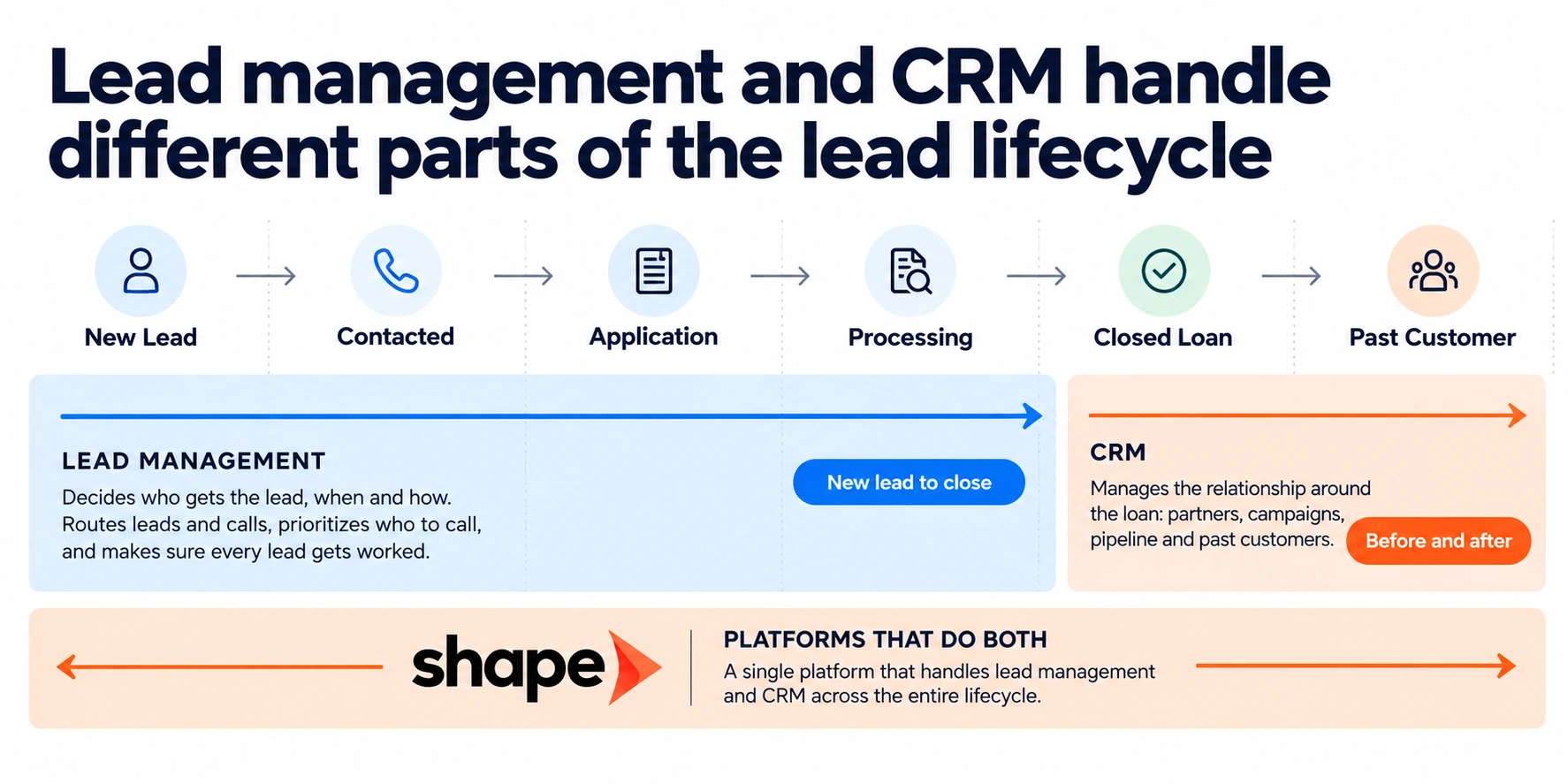
Mortgage lead management software decides who gets a lead and moves it from new lead to close. A CRM manages the relationship around it: partners, campaigns and past customers. They are two different services. Most mortgage sales and marketing platforms do one or the other, and very few do both.
Lead management and CRM handle different parts of the lead lifecycle
Lead management works the opportunity from new lead to close. CRM manages the relationship around it, before and after the loan.
They can be one purchase, if the platform is built to do both. The mistake is forcing one tool to do a job it was not built for. Too many lenders and brokerages run lead management inside a CRM that was not built for it. It has no routing engine, no call distribution and no prioritized queue.
- Lead management platforms decide who gets each lead and when. ICE’s Velocify pulls leads from integrated sources, distributes them, applies routing rules and reassigns leads nobody works. ClickPoint describes push, pull and inbound call routing. LeadMailbox sells lead management as its own category.
- Mortgage CRMs manage the borrower over time: campaigns, partners, the pipeline and past customers. Shape, Insellerate and Aidium are built around that relationship.
Some lenders run one of each and connect them. That works if the handoff is clean. It breaks when a lead lives in two systems and two loan officers call the same borrower. Shape does both in one platform, which is the exception in this category, not the rule. Full CRMs get a wider set of checks, and how we evaluated these platforms lays them out.
Lead management software for mortgage routes leads and calls
Source tracking is table stakes. The real job is getting a web lead and a ringing phone to the right loan officer in seconds.
Ask how the software distributes inbound calls, not just form fills. A borrower who calls is further along than one who filled out a form. Shape distributes both, with round-robin assignment, QuickFire call distribution that rings the loan officer and the lead together, and rules. Our guide on how to route leads and inbound calls covers the rule choices in detail.
State and skill-based routing
Fast routing to the wrong person is still wrong. Most lenders route only to loan officers licensed in the borrower’s state. Skill-based routing goes further. A VA lead goes to the officer who closes VA loans. A Spanish-speaking borrower goes to an officer who speaks Spanish.
The goal is more than coverage. It puts each lead with the officer most likely to close it. Then it makes sure the lead gets worked properly once it lands.
Intelligent prioritization in mortgage lead management software
A list sorted by status tells a loan officer what happened. A prioritized queue tells them who to call next, and it reorders itself as borrowers act. Four examples:
- A new, uncontacted lead goes to the top.
- A missed inbound call moves the borrower up while they are still reachable.
- An email click surfaces a borrower showing interest right now.
- A stalled application triggers a call to push it to completion.
The first three reach a lead. The fourth finishes one. A status list shows that application as “in progress” until someone happens to notice it has not moved.
These are examples, not the full list. Any signal that predicts a conversion belongs in the queue.
Shape scores every lead with ShapeIQ and builds queues that update as leads engage. Scoring is one input to that queue. For the model behind it, see how lead scoring decides who gets called first.
Structured cadences turn leads into a short task list
Lead management does not stop at assignment. Its job is to move an opportunity from new lead to closed loan. That runs on a structured call cadence, with email and text drips coordinated around it.
The calls carry the conversation. The drips keep the borrower engaged between calls, and they stop the moment the borrower replies.
The point is simplicity. Converting a lead is a complex job. Good lead management software builds the best practices in. Then it hands the loan officer a small set of repeatable tasks each day. The officer works the list. The system decides what is on it.
Pull programs so no lead is neglected
Assignment alone leaves a gap. A loan officer gets a lead, gets busy, and the lead sits. Pull programs close it. Get-lead lets a free loan officer pull the top of the live priority queue. Shark tank opens a neglected lead to the next available officer.
Pair that with redistribution. If a lead is not worked in time, the software should reassign it on its own. A mortgage lead management system without both is a list with good intentions.
Your past borrowers are leads too
In a high-rate market, retention matters more than ever. Lead management should flag when a past customer is in the market again. Then it should push them into the queue like any new lead.
Three signals are worth watching:
- The house just went on the market. That points to a purchase loan.
- High debt and growing equity, but little benefit from a cash-out refinance. A HELOC may be the better fit.
- The borrower is searching online for a mortgage. On its own, that is interest.
One signal is a reason to watch. Two together are a reason to call today. A past borrower with growing equity who is also shopping online is a hand-raiser showing high intent.
Mortgage lead tracking software: how to test it
Run five tests on any mortgage lead management software before you sign:
- Post a test lead and time how long it takes to reach a licensed officer.
- Call the demo number and watch where the call rings.
- Leave a lead untouched and see what happens when the clock runs out.
- Click a test email and check whether the lead moves up the queue.
- Stall a test application and see whether anyone is told.
Then ask how the software reports results. Contact rate is the start. Cost per funded loan by lead source is the number that decides your budget.
Ask for pricing with lead management included. A mortgage CRM pricing quote that treats routing as an add-on tells you which service the vendor actually built.