Blog

Mortgage Broker Website Essentials: 7 Must-Haves for Converting Leads

Introduction

In today’s digital-first world, your mortgage broker website is much more than an online business card; it’s your most powerful tool for lead generation. A strong online presence is no longer optional – it’s the primary way potential clients find, evaluate, and decide to trust you with their financing needs. Is your website actively converting visitors into qualified leads? or is it letting potential business slip away? This guide outlines seven essential features to transform your site into a lead-generating machine.

Why a High-Performing Website Matters

The mortgage industry has decisively shifted online. Prospective homebuyers now begin their journey on search engines, not by walking into an office. Your website is often the first interaction a potential client has with your brand, making its performance a critical component of your overall marketing strategy.

A great user experience can be the deciding factor between securing a new client and losing them to a competitor. A professional, efficient, and trustworthy online presence is fundamental for modern mortgage lead generation. Below, we explore the specific features that create this high-converting experience.

Impact on Lead Generation and Client Trust

Your website’s primary function is lead generation. A well-structured site guides prospective clients on a clear path; from learning about their options to submitting their contact information. When visitors can easily find what they need, they are more likely to take the next step and inquire about your services.

Your website must include trust signals that make visitors feel secure. This includes showcasing social proof like customer reviews, displaying professional credentials, and maintaining a polished, error-free design. These elements reassure visitors that you are a credible and reliable professional.

Trust is the currency of conversion. When prospective clients trust your brand, they feel more comfortable sharing personal information and beginning the mortgage process with you. A high converting website seamlessly blends effective lead generation tactics with strong signals of credibility.

Evolving Expectations of Digital Mortgage Clients

Today’s clients expect a digital user experience as seamless and intuitive as the apps they use every day. They have little patience for slow, confusing, or outdated websites. A professional, modern design immediately conveys competence and makes the mortgage process feel more approachable.

Your online presence directly reflects your professionalism. Design elements like a clean layout, high-quality images, consistent branding, and easy to read fonts make your website look trustworthy. These details signal that you are an established, organized, and client focused broker.

Think of your website as your digital office. Is it welcoming? Is it easy to find what you’re looking for? Meeting these evolving expectations isn’t just about looking good, it’s about delivering a superior customer experience from the very first click.

1

Intuitive Site Structure and Clear Navigation

Nothing frustrates visitors more than not finding what they’re looking for. An intuitive site structure is the foundation of a positive user experience. Loan options, educational resources, and contact information should be accessible in just a few clicks.

Your site’s navigation is the roadmap. It should create clear lead paths that guide users logically from one page to the next, ultimately leading them to a conversion point. This clarity prevents confusion and reduces drop-offs.

Designing Easy-to-Follow Menus

Your menu structure should be simple, logical, and predictable. Avoid the “fluff”, use clear terms such as “Home Purchase Loans” or “Refinance”.

Current design trends emphasize minimalism and clarity. A cluttered menu overwhelms visitors, so stick to essential categories and use drop downs for sub pages.

Here are a few tips for an effective menu structure:

  • Logical Hierarchy: Group related pages under broad categories (e.g., “Loan Programs”, “Resources”).
  • Clear Labels: Use simple, descriptive names.
  • Limited Options: Keep top-level menu items to 5-7.
  • Prominent Contact: Always include a visible “Contact Us” button.

Your menu is a key component of your website design. A clean, user-friendly menu not only improves navigation but also reinforces professionalism, making lead conversion easier.

Optimizing for Seamless User Journeys

A user journey is the path a visitor takes through your website. Top mortgage brokers stand out by intentionally designing these journeys to be as seamless and frictionless as possible. Instead of hoping visitors will find their way to a contact form, they create clear lead paths that guide them there.

For example, a visitor might arrive on a blog post about FHA loans. A seamless user journey would include a clear call-to-action within that post, directing them to a dedicated FHA loan landing page. That landing page would then provide more details and feature a simple form to request more information, effortlessly converting a reader into one of your leads.

By anticipating your visitors’ needs and creating the logical next steps, you significantly enhance the user experience. Every page on your site, from the homepage to a blog post, should have a purpose and guide the user toward a specific action.

1

Mobile Optimization and Responsive Design

A majority of your website traffic will come from a mobile phone. If your site isn’t easy to use on a small screen, you are actively turning away potential clients. Mobile optimization is no longer a “nice-to-have” feature, it’s an absolute necessity for a high-converting website.

Any new website must be built with responsive design, which allows the layout to automatically adjust to fit any screen size. Google also uses mobile-first indexing, meaning it prioritizes the mobile version of your site for ranking in search results. A poor mobile user experience will not only frustrate visitors but also harm your visibility.

Ensuring Accessibility Across All Devices

Mobile optimization isn’t just about making your site fit on a small screen. It’s about ensuring every element is easy to use on any device. That means large, tappable buttons, simple forms that work well on mobile, and text that’s clear and readable without zooming. A smooth mobile experience not only improves usability but also drives more lead conversions.

Accessibility is just as important. A modern website should be usable by everyone, including people with disabilities such as visual impairments. Prioritizing accessibility expands your audience, shows professionalism, and ensures your business is inclusive. Simple adjustments can dramatically improve the experience for all users.

Best practices for accessibility include:

  • Adequate Color Contrast: Make text stand out clearly from the background.
  • Alt Tags for Images: Add descriptions so screen readers can interpret visuals.
  • Keyboard Navigation: Allow users to navigate without a mouse.
  • Resizable Text: Let visitors adjust font size for better readability.

Mobile-First Features Buyers Now Expect

A mobile-first approach means designing your mortgage website for the smallest screen first and then scaling up to larger devices. This ensures that the most critical information and functions are prioritized for the majority of users (today’s buyers expect this level of convenience).

Essential mobile-first features include “click to call” buttons for your phone number, making it effortless for a user to contact you directly from their device. Forms should be simplified for mobile entry, perhaps using progressive fields that ask one question at a time to avoid overwhelming the user on a small screen.

Your online presence is strengthened when valuable resources like mortgage calculators are designed to be fully functional and easy to use on a mobile phone. By meeting these expectations, you provide a superior experience that makes potential clients more likely to engage with your brand.

1

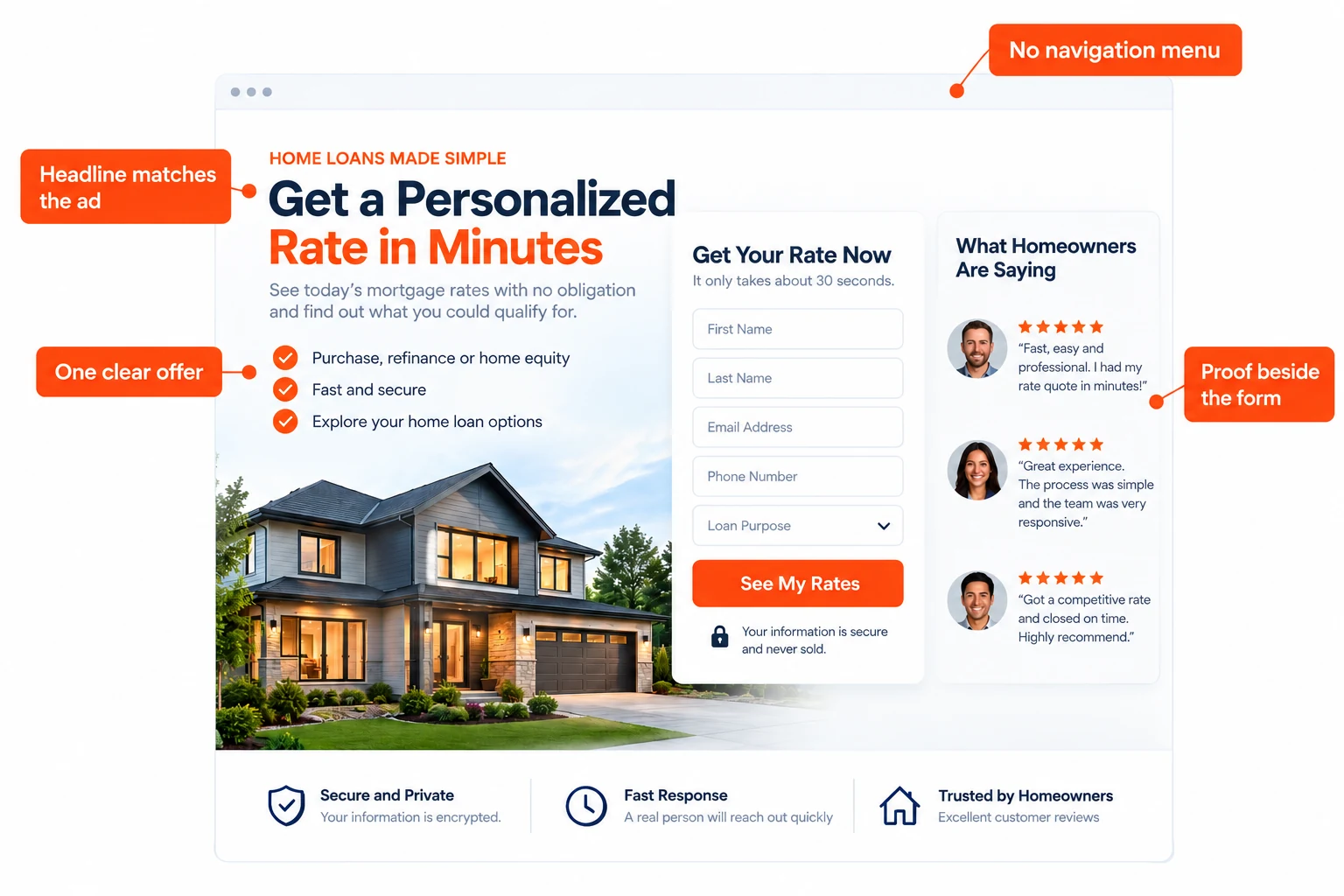
Effective Lead Capture Forms and Calls-to-Action

Your website can attract thousands of visitors, but if it doesn’t capture their information, it’s not generating leads. Effective lead capture is achieved through well-designed contact forms and compelling calls-to-action (CTAs). These elements work together to turn anonymous visitors into named prospects.

A strong CTA prompts the user to take a specific action, such as “Apply Now” or “Download our First-Time Buyer’s Guide.” The guide in this example would be a lead magnet, a valuable piece of content offered in exchange for contact details. These tools are the engines of lead generation for your website.

Building Forms That Maximize Submissions

The design of your contact forms has a direct impact on your submission rate. Long, complicated forms often overwhelm visitors and cause them to drop off. The key to a high-converting form is keeping it simple and easy to complete.

Progressive forms are a smart option. They break the process into smaller steps by asking just one question at a time, which feels less intimidating than a long form. After submission, always show a “thank you” page to confirm the form was received, this small step gives the users a peace of mind.

Best practices for high-converting forms:

  • Keep it Short: Ask only for essentials (name, email, phone number).
  • Use a Clear CTA Button: Use action oriented text, like “Get My Free Quote”.
  • Set Expectations: Briefly state what will happen after they submit the form.
  • Make it Mobile Friendly: Forms should be quick and easy to complete on a phone.
  • Stick to One Column: A single column is easier to scan and fill out than multiple columns.

Placing and Designing Powerful CTAs

Calls-to-action are the signposts that tell website visitors what to do next. To be effective, they must be strategically placed where the user’s intent is highest. For example, a CTA to “Calculate Your Payments” is perfect on a page about mortgage rates, while a “Contact Us” CTA should be on every page.

The design of your CTAs is just as important as their placement. They should stand out visually from the rest of the page using contrasting colors, a clear button shape, and compelling, action-oriented language. Vague phrases like “Click Here” are far less effective than specific commands like “Start your Pre-Approval” or “Schedule a Consultation.”

Powerful CTAs are a cornerstone of effective mortgage marketing. By guiding your website visitors and making their next step obvious, you improve their experience and dramatically increase the likelihood that they will convert into a lead. Don’t make your visitors guess what to do, guide them.

Showcasing Social Proof and Client Testimonials

In an industry built on trust, social proof is one of your most persuasive assets. When potential clients see that others had a positive experience with you, it builds instant credibility. Showcasing testimonials and customer reviews are a powerful way to build client trust, before you’ve even spoken.

For a loan officer, positive feedback validates your expertise and commitment to service. This social proof acts as a third-party endorsement, reassuring visitors that they are making a wise choice by considering your services. It’s a key design element that makes your website look professional and trustworthy.

Strategic Placement of Reviews and Ratings

How you display social proof is as important as having it. Top brokers don’t hide their best customer reviews on a forgotten page, they integrate them strategically throughout their website. Placing a powerful testimonial directly on your homepage can immediately capture a visitor’s attention.

Consider sprinkling relevant reviews on your service pages. For example, a testimonial from a happy first-time homebuyer would be highly effective on your page about FHA or USDA loans. This contextual placement reinforces the value you provide at the exact moment a visitor is considering that specific service.

Don’t forget to add social proof near key conversion points, such as your contact page. Seeing a positive review right before they are about to submit their information can be the final nudge a client needs to move forward. This strategic use of social proof is a key way top brokers are able to stand out.

Using Success Stories to Build Credibility

While short testimonials are great for quick-hitting impact, longer-form success stories or case studies can build even deeper credibility. These stories allow you to go beyond a simple quote and detail how you helped a specific client overcome challenges to achieve their dreams.

Success stories add a powerful personal touch. They transform a faceless transaction into a relatable human experience, allowing potential clients to see themselves in the story. Detailing the situation, the solution you provided, and the positive outcome demonstrates your problem solving skills and dedication.

This type of content is invaluable. Including a few detailed success stories on your website is an excellent strategy for creating a high-converting platform that resonates emotionally with your audience.

Essential Local SEO Strategies for Mortgage Brokers

Most mortgage brokers generate the majority of their business from local clients. That’s why local search engine optimization (SEO) is so important. It ensures your business shows up when people nearby search for mortgage services. In fact, it’s one of the most effective ways to attract new leads online.

Local SEO focuses on using keywords with geographic modifiers (like “mortgage broker in Laguna Beach”) and keeping your Google Business Profile up to date. Done right, these efforts help you connect with qualified borrowers in your community who are actively looking for a mortgage professional.

Targeting Local Search to Reach Qualified Buyers

To generate more leads, your business needs to appear when potential clients are actively searching for mortgage services in your area. This is the core of local search optimization, making sure your website ranks for queries with clear local intent.

A practical way to achieve this is by creating content tailored to your specific market. For example, you could publish a guide to first-time homebuyer programs in Orange County or write blog posts about housing trends in Huntington Beach, Newport Beach, or Costa Mesa. This type of content not only provides value to readers but also signals to search engines that you are a trusted authority in your local market.

By consistently targeting local keywords, you can narrow your visibility to the most relevant prospects.

Here are some examples of how to structure keywords to attract local buyers:

Keyword TypeExample
Service + City"Mortgage broker in Huntington Beach"
Service + Neighborhood"Home loans in Newport Beach"
Loan Type + City"FHA loan lender in Costa Mesa"
Near Me Queries"Best mortgage lenders near me"
Service + County"Mortgage broker in Orange County"
Loan Type + County"VA loan specialist in San Diego County"

Optimizing Google Business Profile and Local Listings

Your Google Business Profile is one of the most important tools for local search engine optimization. It’s often the first impression a potential client will have of your business, appearing in Google Maps and the local search results pack. A complete and optimized profile is essential.

Ensure all your contact information – name, address, and phone number, is accurate and consistent across all local listings and directories. Fully detail your services, add high quality photos of you and your team, and actively encourage satisfied clients to leave reviews. Responding to reviews shows that you are an engaged and attentive mortgage professional.

From a compliance perspective, it’s critical that all information, especially your NMLS number and licensing details, are accurate and clearly displayed on your website and profile. Maintaining accurate local listings not only boosts your SEO and credibility, it shows adherence to industry regulations.

1

Compliance, Security, and Trust Signals

When visitors are asked to share sensitive financial information, trust becomes the top priority. Your website must have strong security features and clear trust signals that make clients feel safe. This isn’t optional, it’s a fundamental part of building a professional website.

Compliance with industry regulations also plays a big role. Beyond meeting legal requirements, disclosures and licensing details show you’re transparent and professional.

Must-Have Legal Disclosures and Privacy Pages

To make your mortgage site compliant, you must include several key legal pages. These pages inform website visitors about how you handle their data and operate your business, which is essential for meeting regulatory requirements. A clear and easily accessible privacy policy is the most important of these.

Your privacy policy should detail what personal information you collect, how you use it, and how you protect it. In addition to a privacy policy, you may need other legal disclosures depending on state and federal laws, including fair lending notices and licensing information. These pages are typically linked in the website footer and provide transparency that reassures visitors while meeting state and federal regulations.

To stay compliant, your website should include a few key legal pages:

  • Privacy Policy: Explains what personal data you collect, how it’s used, and how it’s protected.
  • Terms of Service: Outlines the rules for using your website.
  • Licensing Information: Clearly displays your NMLS ID and any state licenses.
  • Equal Housing Opportunity: Includes the Equal Housing Lender logo and statement.

Security Features That Reassure Visitors

Beyond legal pages, visible security features act as powerful trust signals that put website visitors at ease. The most important of these is an SSL certificate. SSL encrypts the data transferred between a user’s browser and your website, protecting sensitive information from being intercepted.

You can recognize a secure site by the “https://” in its URL and the padlock icon in the browser address bar. Modern browsers now warn users if a site isn’t secure, which can quickly drive potential leads away. That’s why having an SSL certificate isn’t optional – it’s a must-have for any professional mortgage website.

Additional trust signals include security badges (such as McAfee Secure) and Better Business Bureau (BBB) accreditation. These third-party validations reinforce your site’s security and your business’s credibility, reassuring visitors that it’s safe to engage with you online.

1

Fast Performance and Modern Website Technology

In the digital world, speed is king. A slow website is a major conversion killer. Modern web design prioritizes fast performance, ensuring that pages load almost instantly. Your site’s load time is one of the first impressions you make, and a slow experience suggests an outdated or unprofessional operation.

The website technology and platform you choose play a significant role in your site’s performance. When building a new website, selecting a platform known for speed and reliability, such as WordPress with quality hosting or a specialized mortgage website builder, is a critical decision that will impact user experience and conversions.

Importance of Quick Load Times for Conversion

A slow load time is one of the fastest ways to lose a potential lead. Studies from Google show that as page load time goes from one to three seconds, the probability of a visitor bouncing (leaving your site) increases by 32%. So, for every extra second your site takes to load, you are losing website visitors.

This is because a slow website creates a frustrating user experience. It tests the visitor’s patience and can make your business seem inefficient or behind in technology. Now, a site that loads quickly feels professional, responsive, and respectful of the user’s time.

Improving your site’s load time is a direct way to improve lead generation. By optimizing images, using efficient code, and choosing a good hosting provider, you can decrease your bounce rate and keep visitors on your site long enough for them to engage with your content and convert into leads.

Selecting the Right Website Platform and Architecture

Choosing the right website platform is a foundational decision that will affect your mortgage website’s flexibility, performance, and ease of management. While there are many options, some platforms are better suited for the needs of mortgage brokers than others. WordPress is a popular and versatile choice, offering a vast ecosystem of themes and plugins.

Specialized mortgage website builders are another excellent option, as they often come with built-in features like mortgage calculators, loan application forms, and compliance tools. The underlying architecture of your site – how it’s built and hosted – is just as important as the platform itself. A clean, modern architecture will be faster and more secure.

When selecting a platform, consider the following factors:

  • Ease of Use: How easy is it for you or your team to update content?
  • SEO-Friendly: Does the platform have built-in SEO tools and allow for customization?
  • Scalability: Can the platform grow with your business?
  • Mobile Responsiveness: Does it easily support mobile-first design? Pair your platform with a memorable domain name and a reliable hosting provider to ensure your site is fast and accessible.

Conclusion

Creating a high-performing website is crucial for converting leads in today’s competitive landscape. By incorporating essential features such as clear navigation, mobile optimization, effective lead capture forms, and strong local SEO strategies, you can significantly enhance the user experience and build trust with potential clients. Remember to showcase social proof through client testimonials and ensure your site adheres to compliance and security standards. Take action today! Start refining your website essentials and watch your leads grow! For a more personalized approach, don’t hesitate to reach out for a consultation.

Frequently Asked Questions

What features are essential for a mortgage broker website in 2025?

Integration with CRM & Marketing Tools; you’ll need to add pages, content, or features over time. Use a scalable, easy-to-update CMS platform that lets you make updates.

How can I make my mortgage site secure and compliant with regulations?

To secure your mortgage site, install an SSL certificate (https) and display trust seals. For compliance, ensure you have easily accessible legal disclosures and privacy pages that clearly state your NMLS ID and data handling practices. These security features and pages are critical for meeting legal standards.

What strategies help my mortgage broker website generate more leads?

To boost lead generation, optimize your website with simple contact forms and compelling calls-to-action. Implement a content marketing strategy by writing helpful blog posts about the mortgage process. This mortgage marketing approach attracts qualified traffic and guides visitors toward becoming leads.

Social:

get started shape software woman pointing

Get started with Shape today