Most mortgage drip campaigns fail because they run on a calendar instead of a loan file. Ten emails go out on a fixed timer. The borrower who was ready stopped opening after email two. The one who was not ready got the same sequence anyway.
Below are twelve mortgage drip campaign templates you can paste and send today. Each one carries a subject line, the body copy, the trigger that fires it, and the condition that stops it. That last part matters more than the copy does.
How long should a mortgage drip campaign run?
Wrong question. Duration is not the variable you control.
A drip runs until one of three things happens. The borrower converts. The borrower opts out. Or the trigger condition expires. A new-lead sequence built around a fourteen-day speed window ends on day fifteen whether or not the borrower replied. A post-close sequence runs for years, because the trigger is the anniversary of a funded loan.
If you set a fixed length, you are guessing. Set exit conditions instead and the length answers itself.
One number worth holding on to. Across 15+ years of Shape platform data, converting an opportunity takes 17 attempts on average. That counts calls, texts and email together, across every industry Shape serves. Nobody makes 17 attempts by hand on every lead. A drip makes the attempts you would otherwise skip.
We left out the widely quoted claim that 78% of borrowers pick the first lender to respond. It traces to a general sales study, not to mortgage lending.
The five mortgage email drip campaigns that carry a pipeline
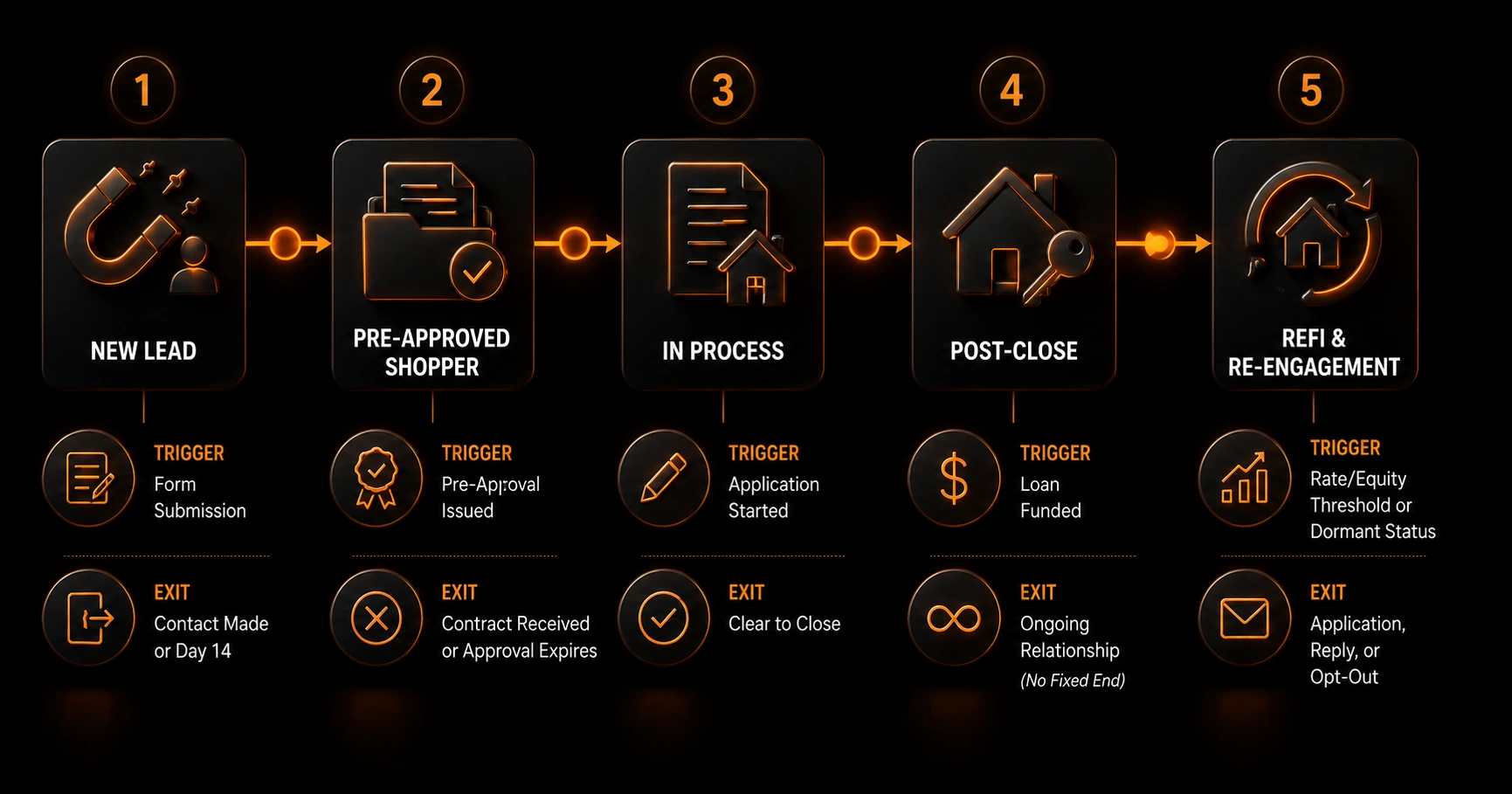
Segmentation is the whole game and most shops get it backwards. Organize by loan-file state, not by borrower persona. Persona-based segments go stale the moment a situation changes. File state updates itself.
New lead. Fires on form submission. Runs 14 days. Exits on contact.
Pre-approved shopper. Fires on pre-approval issued. Runs until contract or expiration.
In process. Fires on application. Runs to clear-to-close.
Post-close. Fires on funding. Runs indefinitely.
Refi and re-engagement. Fires on a rate or equity threshold, not a date.
Everything below sits inside one of those five.
Every template below uses merge fields. That is the floor for personalization, not the ceiling. Real personalization references something only you know. The property they asked about. The program they qualified for. The objection they raised on the first call.
Sequence 1: New lead
Template 1: Instant response
Of the loan officer email templates here, this is the one that matters most.
Trigger: Form submission. Send inside two minutes.
Exit: Any reply, or a completed call.
Subject: Your rate question, [First Name]
[First Name],
Got your request. I am [Your Name], a loan officer with [Company], [NMLS #].
Two things I need to give you a real number instead of a range: the purchase price you are targeting and your rough credit range. Reply with those and I will send scenarios today.
If it is easier to talk, I am at [Phone]. Ten minutes is usually enough.
[Your Name]
Template 2: Day 2 value
Trigger: 48 hours after Template 1, no reply.
Exit: Any reply.
Subject: What lenders actually look at
[First Name],
Following up on your request. While you are deciding, here is what matters on your file and what does not.
Matters: your credit score, your debt-to-income ratio, and how long your income has been documented.
Does not matter as much as people think: how many lenders you talk to. Rate shopping inside a short window counts as one inquiry on your credit.
Talk to a few. Just do it close together. Happy to be one of them.
[Your Name] · [Phone]
Template 3: Day 9 direct ask
Trigger: Day 9, no reply to Templates 1 or 2.
Exit: Any reply. Sequence ends day 14 regardless.
Subject: Still shopping, or did you go another direction?
[First Name],
Straight question. Are you still looking, or did you already get this handled?
Either answer is fine. If you are done, I will stop emailing. If you are still looking, reply with a price range and I will send numbers.
[Your Name]
Sequence 2: Pre-approved shopper
Template 4: Pre-approval issued
Trigger: Pre-approval letter generated.
Exit: Contract received.
Subject: You are pre-approved. Here is what happens next.
[First Name],
Your pre-approval letter is attached. Good through [Expiration Date].
Three things to know while you shop.
Do not open new credit. Not a card, not a car, not furniture financing. It changes your qualification.
Send me the address before you write an offer. I will get you a property-specific letter, which agents take more seriously.
Your rate is not locked yet. It locks when you are under contract.
Send listings anytime and I will run the payment.
[Your Name] · [Phone]
Template 5: Shopping check-in
Trigger: Every 10 days while pre-approved, no contract.
Exit: Contract received, or letter expires.
Subject: Anything under contract yet?
[First Name],
Checking in. Any offers out, or still looking?
If your price range has shifted, tell me. I can reissue the letter at a different number in about an hour.
Your letter expires [Expiration Date]. I will refresh it before then, no action needed on your end.
[Your Name]
Template 6: Rate moved while shopping
Trigger: Rate change beyond your set threshold, borrower pre-approved and not under contract.
Exit: Contract received.
Subject: Rates moved. Your number changed.
[First Name],
Rates shifted since we ran your pre-approval. At [Purchase Price], your estimated payment is now roughly [New Payment] instead of [Old Payment].
That is a [Difference] change per month. It might move your target price, or it might not matter at all.
Want me to rerun a few scenarios? Reply and I will have them over today.
[Your Name]
Sequence 3: In process
Template 7: Document request
Trigger: Underwriting conditions issued.
Exit: All documents received.
Subject: [Number] items needed to keep your file moving
[First Name],
Underwriting came back. They need [Number] things:
[Document 1]
[Document 2]
[Document 3]
Upload them here: [Secure Portal Link]
Why it matters: your closing date holds only if these land by [Date]. Everything after this is waiting on these.
Stuck on any of them? Call me and we will figure out a substitute.
[Your Name] · [Phone]
Template 8: Milestone update
Trigger: File stage change. Send on every change, no exceptions.
Exit: Clear to close.
Subject: Update on your loan: [Stage]
[First Name],
Your file just moved to [Stage].
What that means: [One sentence, plain English].
What happens next: [Next Stage], expected around [Date].
What I need from you right now: [Nothing, or the specific item].
You will hear from me at every step. If you do not, call me.
[Your Name]
Send this even when nothing is wrong. Borrowers do not call because they are curious. They call because they are anxious, and silence is what makes them anxious.
Sequence 4: Post-close
Template 9: Post-close thank you and referral ask
Trigger: 7 days after funding.
Exit: None. Single send.
Subject: Congratulations, [First Name]
[First Name],
Keys in hand. Congratulations.
A few housekeeping items. Your first payment is due [Date] to [Servicer]. Keep your closing disclosure somewhere you can find it at tax time.
I am not going anywhere. If a rate drop makes a refinance worth looking at, I will be the one who calls you.
One ask. If someone you know is starting a home search, send them my way. Most of my business comes that way and it is the best compliment there is.
[Your Name] · [Phone]
Template 10: Annual mortgage review
Trigger: Loan anniversary, every year.
Exit: None. Runs indefinitely.
Subject: Your [Year]-year mortgage checkup
[First Name],
It has been [Number] years on [Property Address]. Quick annual look.
Your rate: [Rate]. Current market: [Market Rate]. Estimated equity: [Equity].
Based on those numbers, [refinancing is worth a conversation / you are in good shape and I would not touch it].
I would rather tell you to do nothing than sell you something you do not need. This year, [recommendation].
Fifteen minutes if you want to go through it.
[Your Name]
The “do nothing” version of this email is the one that earns the next loan. Send it in the years when there is no deal in it for you.
Sequence 5: Refi and re-engagement
Template 11: Rate-drop trigger
Trigger: Market rate falls a set number of basis points below the borrower’s note rate.
Exit: Application started, or opt-out.
Subject: Rates hit [Rate]. Worth a look on your loan.
[First Name],
Market rates dropped to roughly [Market Rate]. You are at [Current Rate] on [Property Address].
Rough math: refinancing could move your payment from [Current Payment] to about [New Payment]. Closing costs run [Estimated Costs], so you would break even around month [Breakeven Month].
If you plan to stay past that, it is worth running. If you are moving sooner, it is not.
Want the real numbers? Reply and I will pull them.
[Your Name]
Set the threshold by borrower, not globally. A borrower at 7.5% and a borrower at 5.5% do not want the same alert.
Template 12: Dormant lead reactivation
Trigger: No engagement for 180 days.
Exit: Any reply, or a second non-response. Two sends maximum.
Subject: Closing your file
[First Name],
We talked about a mortgage a while back and it went quiet. That happens.
I am cleaning up my pipeline. If you are still thinking about buying or refinancing in the next year, reply with one word and I will keep you on my list.
If not, no reply needed. I will take you off and stop the emails.
[Your Name]
Do not run this more than twice. A third attempt on a cold contact is how you earn spam complaints.
Exit rules, which matter more than the copy
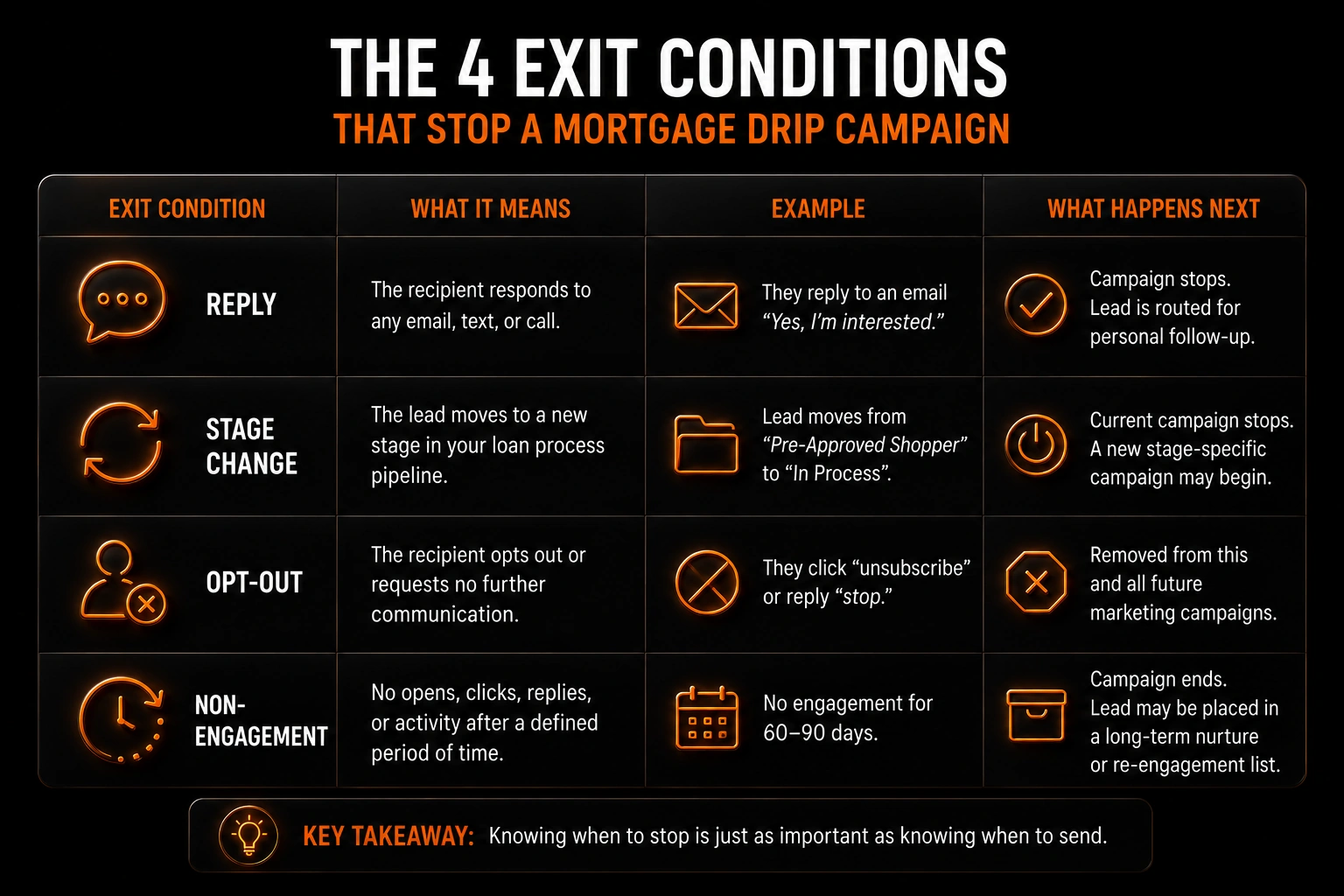
Every sequence above stops on four conditions. Build all four or the campaign will eventually embarrass you.
Reply. Any inbound response kills the automation immediately. Nothing looks worse than an automated nudge arriving an hour after a human conversation.
Stage change. A borrower who submits an application should not still be receiving new-lead emails.
Opt-out. Unsubscribes, STOP replies, and do-not-contact requests suppress every channel. Not just the one they arrived on.
Non-engagement. No opens across a set number of sends means the address is dead or the person is gone. Continuing to send hurts your deliverability for everyone else on your list.
That fourth one is where most shops fail. Sending to people who never open is what moves your whole domain toward the spam folder.
What your CRM has to do to run this
Mortgage drip campaign software is not the same thing as email software. The difference is whether the campaign can read the loan file.
Every trigger above depends on data an email tool does not hold. Pre-approval status. Underwriting conditions. Funding date. Note rate. Property address. If your campaign platform cannot see those fields, you are back to sending on a timer.
Two requirements matter more for drips than for email in general.
Rate and equity monitoring. The refi trigger only works if something watches the market against each borrower’s note rate.
Reply detection. Inbound anything stops the sequence, without a human remembering to switch it off.
Loan-stage triggers and cross-channel suppression matter too. Every exit rule above depends on them. A mortgage CRM with automated marketing runs all four from the loan file. An email tool with a template pack cannot see the file.
Text belongs in this architecture too, on the short and urgent messages. It runs under stricter consent rules than email, covered in the compliance section below.
If you are building the wider system rather than a single sequence, start with the architecture instead of the copy. Our guide to automating your mortgage pipeline covers how these triggers connect to the rest of the file.
Compliance when a sequence runs on two channels
Email and text sit under different rules, and the text steps in a mixed drip carry the stricter one.
Email falls under CAN-SPAM, which is an opt-out regime. We cover what CAN-SPAM actually requires in our email marketing guide. Text falls under the TCPA. Under 47 CFR 64.1200, marketing texts sent by autodialer require prior express written consent.
That split decides how you build a sequence. An email-only drip can start on a form fill. A text step needs consent captured before it fires. States add requirements above both federal floors. Check yours.
None of this is legal advice. Have counsel review your sequences before they go live, and again every six months.
What to measure
Measure a sequence template by template, not as a whole. A sequence average hides the one email doing the damage.
Reply rate per template. The only signal that a human engaged.
Application starts attributed to sequence. The number that pays.
Exit reason distribution. If most contacts exit on non-engagement rather than conversion, the targeting is wrong, not the copy.
Unsubscribes by template. One template driving most of your unsubscribes tells you exactly which one to cut.
Frequently Asked Questions
What should you do with a loan officer’s active drip campaigns when they leave?+Reassign the contacts first. Then confirm the sender, signature and phone fields follow the new owner.
Should a borrower be in more than one mortgage drip campaign at once?+No. One borrower gets one active sequence, set by the current file state. Overlap happens most with past clients who start a new purchase. The post-close sequence keeps running while new-lead emails begin. The newest file should win. Pause the post-close sequence while the new loan is active and restart it on funding.
What is the difference between a drip campaign and a nurture campaign?+A drip is a mechanism. Nurture is a stage. A drip is any pre-written sequence fired by a trigger, and it can run at any point in the file. Nurture is the stage after a conversation, when you know what is blocking the borrower and are waiting for it to clear. Nurture usually runs on drips. A new-lead drip is not nurture, because nobody has spoken to the lead yet.
Who should approve mortgage drip campaign templates before they send?+Whoever signs off on advertising at the lender, usually compliance or marketing. A template is written once and sent thousands of times, so an error repeats at scale. Loan officers should control the personal fields, not the approved copy. Any template stating a rate, payment or loan term needs a compliance read before it goes live.
Kevin Benner is the Chief Revenue Officer at Shape Software, where he leads revenue, marketing, and customer growth. He brings over 23 years of experience in mortgage lead generation and sales technology.
The best YouTube audience for a loan officer is people who already know you. A short video puts your name back in front of past clients and recent site visitors. In our experience, that is where YouTube ads for loan officers return the most, with local awareness close behind. Google limits who else a mortgage […]
A mortgage website has one job: turn a visit into a lead in your CRM. It has to land fast enough to call while the borrower still cares. Good mortgage website design is the part of that job a visitor sees. Providers differ less on looks than on how they build, where the form fill […]
Meta is the easiest way to put a mortgage offer in front of a million people. It is also the easiest way to fill a pipeline with leads who never meant to talk to you. Which one you get depends on three things: who sees the ad, what it says, and how fast someone calls. […]