Most loan officer email programs fail in the delivery layer, not the copy layer. The subject line gets blamed. The real problem is that the message never reached the inbox.
Mortgage email marketing works. It is the only channel where you own the audience and the cost per contact stays near zero. But the sequence of operations matters. Authentication and list health come first. Content comes second. Doing it the other way around is why so many loan officers conclude email is dead.
This page covers the infrastructure. For the sequences themselves, see our guide to mortgage drip campaigns. It carries twelve templates and the trigger logic behind them.
The order of operations
A mortgage email marketing strategy has four layers and they only work in sequence. Deliverability. List health. Segmentation. Content.
Most guides to email marketing for loan officers start at layer four and never mention layer one. That is backwards. Perfect copy sent from an unauthenticated domain does not get read, because it never arrives.
The same applies to email marketing for mortgage brokers running their own domain instead of a lender’s. Brokers control more of the stack, which cuts both ways. You own the reputation and you own the failure.
Work bottom up. Fix authentication first, then the list, then segments, then what you send.
Mortgage email deliverability: why your emails are not landing
In October 2023, Google and Yahoo announced sender requirements that took effect in February 2024. They changed the floor for anyone sending volume email, and most mortgage shops never adjusted.
Per Google’s sender guidelines, senders above roughly 5,000 daily messages to Gmail face four requirements:
Authenticate with both SPF and DKIM
Publish a DMARC record
Offer one-click unsubscribe
Keep user-reported spam rates low
Google states that bulk senders above a 0.3% spam rate lose eligibility for mitigation. Practitioners target well below that.
Three things follow for loan officers specifically.
You probably do not control your sending domain. If you send from an @lender.com address, your deliverability is tied to every other originator at the company. One branch buying a list can put your emails in spam. Ask your marketing team who owns the DMARC record. Most loan officers have never asked.
Authentication is not optional anymore. SPF, DKIM, and DMARC used to be best practice. They are now the entry requirement. A message that fails authentication does not land in spam. It gets rejected.
Complaint rate is the metric that ends programs. Spam complaints are cumulative and they are slow to recover from. A single blast to a stale list can suppress your domain for weeks.
List health beats list size
The instinct is to build the biggest list possible. That instinct is what kills deliverability.
Mortgage databases decay faster than most. Borrowers change jobs, change addresses, and abandon the email they used to shop for a house. An address collected three years ago has meaningful odds of being dead or converted to a spam trap.
Four rules that hold.
Never buy a list. Purchased mortgage lists are the single fastest way to a domain reputation problem. They also carry consent risk you cannot document.
Suppress non-openers. Set a threshold. No opens across a defined number of sends means the address stops receiving. Continuing to send to dead addresses damages delivery for the contacts who do engage.
Re-permission old data. Anything older than eighteen months gets one re-engagement attempt. If it fails, suppress it.
Watch bounces daily, not monthly. A rising hard bounce rate is the earliest signal that a data source has gone bad.
A small list that opens beats a large one that complains.
Segmentation at the strategy level
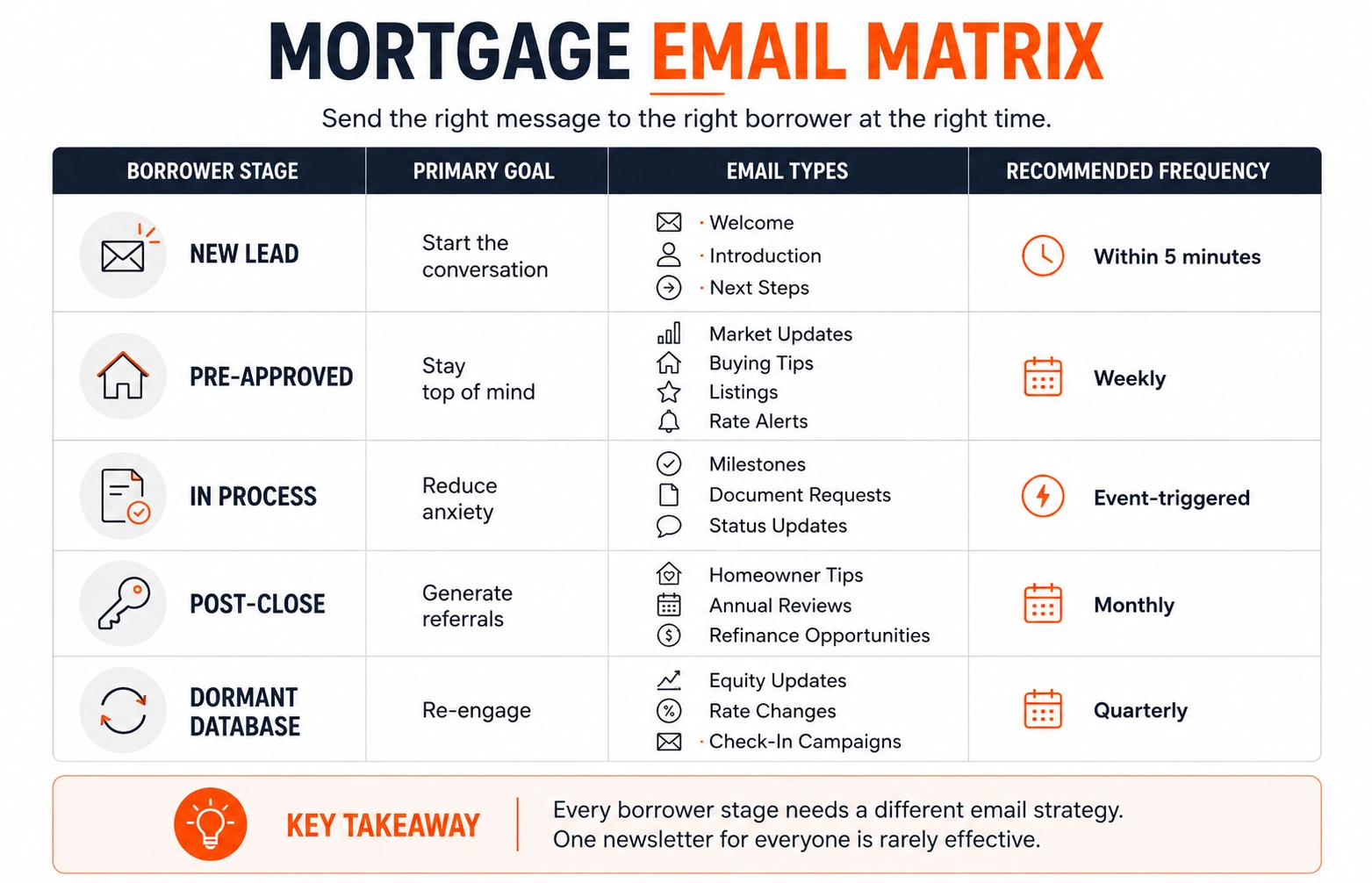
Segmentation is where most mortgage email programs stop thinking. They split the list into buyers and past clients, then send the same two newsletters forever.
The segments that carry a pipeline map to loan-file state rather than persona.
Unqualified inquiries. No credit pull, no application. Education only.
Pre-approved and shopping. Active, time-boxed, and highly responsive.
In process. Status communication, not marketing.
Funded. Retention and referral.
Dormant equity. Past borrowers who become prospects when rates move.
Those five segments want different frequencies and different content. Sending the same cadence to all of them produces the unsubscribe pattern most loan officers mistake for email fatigue.
Segments should update themselves when the file moves. That is workflow automation for lenders, not a weekly list export.
Compliance: what CAN-SPAM actually requires
There is a persistent myth that CAN-SPAM requires opt-in consent before you email someone. It does not.
CAN-SPAM is an opt-out regime. Per the FTC’s compliance guide, the law sets rules for commercial email. It gives recipients the right to make you stop. Your obligations are six:
Accurate header information
A subject line that matches the message
Identification of the message as an ad
A valid physical postal address
A working opt-out method
Opt-outs honored within 10 business days
Prior consent is not on that list.
Two things change the picture. First, texting falls under the TCPA, not CAN-SPAM, and a compliant SMS cadence runs on different rules. That rule requires prior express written consent for marketing texts sent by autodialer. Second, states impose requirements above the federal floor. Check yours.
None of this is legal advice. Have counsel review your program before it goes live, then again every six months.
What to measure
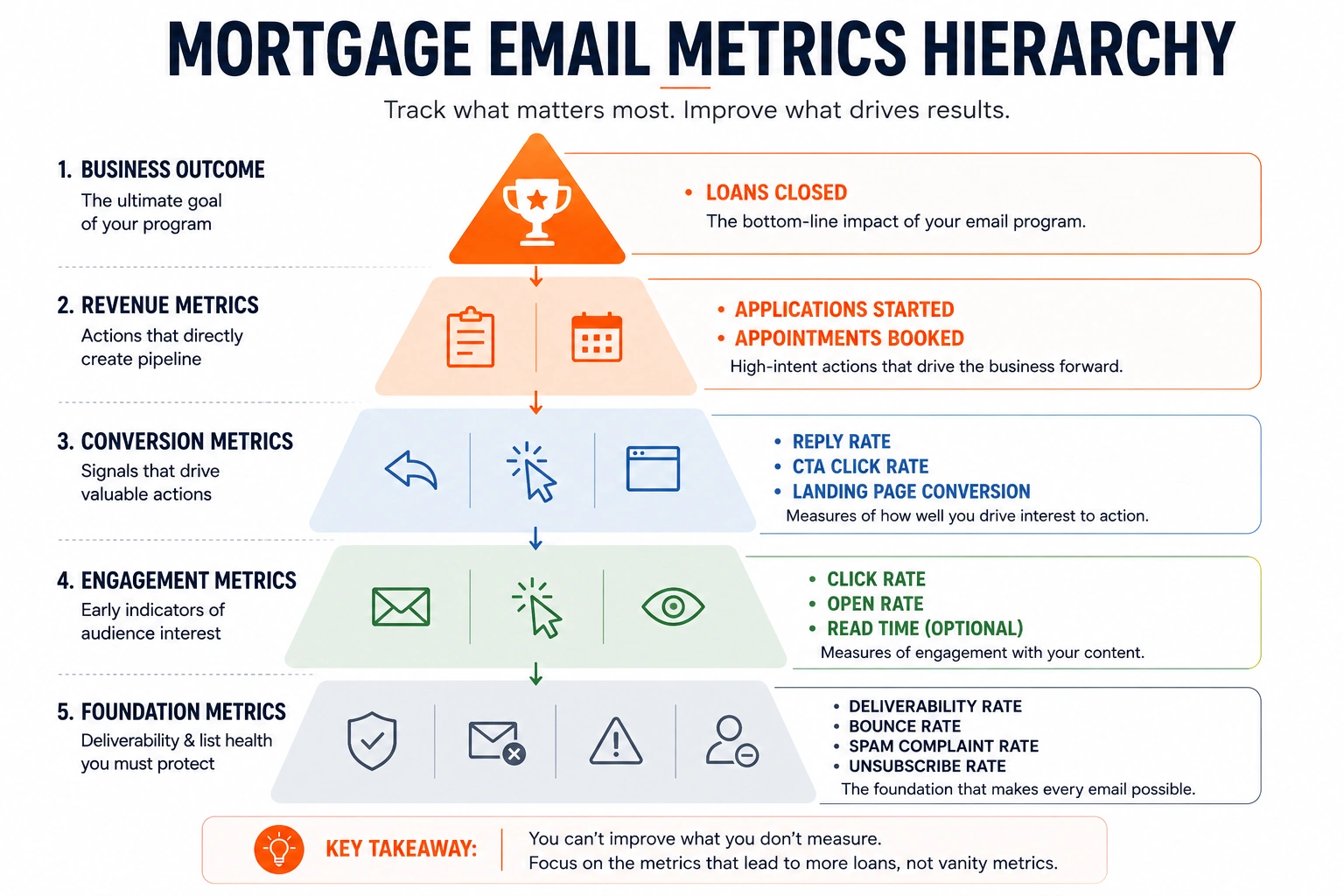
Open rate is the metric everyone reports and the one that tells you least. Apple Mail Privacy Protection inflates it. A high open rate on a program that produces no applications is not a win.
Watch these instead.
Inbox placement. Whether the message arrived at all. This is the number the whole program depends on and almost nobody tracks it.
Complaint rate. Track it daily against the thresholds above. This is a compliance and deliverability metric before it is a marketing one.
Reply rate. The only signal that a human engaged.
Applications attributed to email. The number that pays.
List growth net of suppression. Gross adds hide a shrinking active audience.
Choosing a platform
The question is not which email tool has the best templates. It is whether the tool can see the loan file.
A general email platform sends to lists. A mortgage CRM sends on file state. That difference decides whether your emails are timely or merely scheduled.
Four requirements, in order of how often they get skipped.
Loan-stage triggers. Sends fire on file events, not on list membership.
Authentication support. The platform handles SPF, DKIM, and DMARC alignment for your sending domain, and tells you when something breaks.
Cross-channel suppression. An opt-out in one channel suppresses every channel.
Engagement data at the contact level. You cannot suppress non-openers if the system does not track opens per contact.
Those four requirements are why mortgage CRM with automated marketing sends differently than an email platform does. One reads the loan file. The other reads a list.
Loan-stage triggers are one decision inside a wider question about what to automate and what not to.
Email is one channel among several. Building the wider program? Our roundup of loan officer marketing ideas covers where email fits against referral, local, and social.
Frequently Asked Questions
Does mortgage email marketing still work?+Yes, and it remains the highest-control channel available to a loan officer. Shape’s position is that email underperforms for most originators because of deliverability failures rather than content failures. Authentication, list hygiene, and complaint-rate management determine results more than subject lines do.
Do I need permission before emailing mortgage leads?+Not under CAN-SPAM, which is an opt-out regime and does not require prior consent. You must honor opt-outs within 10 business days and meet the FTC’s other requirements. Text messages are different. The TCPA requires prior express written consent for marketing texts sent by autodialer.
How often should loan officers email their database?+Frequency should follow loan-file state, not a single schedule. Active pre-approved borrowers warrant contact every week or two. Past clients warrant a handful of touches per year. A single cadence applied to the whole database is the most common cause of unsubscribes.
What is a good spam complaint rate for mortgage email?+Google’s published ceiling for bulk senders is 0.3%, above which senders lose eligibility for delivery mitigation. Shape recommends treating anything approaching 0.1% as an emergency and auditing the list source immediately.
Kevin Benner is the Chief Revenue Officer at Shape Software, where he leads revenue, marketing, and customer growth. He brings over 23 years of experience in mortgage lead generation and sales technology.
A mortgage website has one job: turn a visit into a lead in your CRM. It has to land fast enough to call while the borrower still cares. Good mortgage website design is the part of that job a visitor sees. Providers differ less on looks than on how they build, where the form fill […]
Meta is the easiest way to put a mortgage offer in front of a million people. It is also the easiest way to fill a pipeline with leads who never meant to talk to you. Which one you get depends on three things: who sees the ad, what it says, and how fast someone calls. […]
A one-person brokerage can now reach the same feed as Rocket or loanDepot. That is the real change social media brought to mortgage. A national lender buys attention with ad budgets and brand campaigns. On social, a broker or loan officer earns it with a face, a voice and a weekly habit. That is what […]