Loan Anniversary Campaigns That Book Calls
Most anniversary campaigns are a card nobody answers, sent because the CRM had a date on file.
That is not a criticism of the idea. It is a criticism of what the idea has turned into. Every guide lists the anniversary touch, tells you to automate it, and moves on. None says what the message is for. That is why the standard version achieves nothing and goes out anyway.
Loan anniversary campaigns that book calls work when the date is an excuse rather than the content.
Why Most Loan Anniversary Campaigns Produce Nothing
Open the average anniversary email and it congratulates the borrower on a year of homeownership. There is no question in it and nothing to reply to.
A touch with no ask is not outreach. It is a notification. The borrower reads it, feels vaguely warm for four seconds, and does nothing. You gave them nothing to do.
That is worth knowing before you spend a year sending them.
The Date Is the Excuse, Not the Campaign
Here is what makes the anniversary valuable, and it has nothing to do with sentiment.
It is the only date in the relationship you can predict a year in advance. A rate crossing arrives when the market moves. An equity threshold arrives when values move. A listing signal arrives without warning. The anniversary arrives on a day you knew about at closing.
That predictability is the whole asset. It gives you one scheduled slot per borrower per year, and there are exactly two things worth putting in it. Both are things with no natural trigger of their own.
Which borrowers get which version depends on how the book is cut. Mortgage database management covers the rest of what those segments feed.
The Two Asks That Have Nowhere Else to Live
The Referral Ask
Referrals have no trigger. Nothing happens in a borrower’s life that tells you to ask them for one.
So it either happens on a schedule or it does not happen. The anniversary is that schedule. It beats a random Tuesday, because the borrower is already thinking about the house.
Ask for something specific. “Do you know anyone looking this spring” beats “keep me in mind.” The second makes them do the remembering.
The Annual Review
This is the one most originators skip and it is the one that books calls.
Offer to look at their rate, balance, value estimate and mortgage insurance position against where they are now. That is a service, not a pitch. It is also a reason to call that does not require anything to have changed.
It also surfaces things the borrower would never raise themselves. Mortgage insurance they could drop. An early payoff window worth watching. Our post on what an EPO window costs you covers that timing in detail.
STRATMOR found that in 2018, a combined 28 percent of borrowers chose their lender on an existing relationship. That was with the company, the loan officer, or both. Note the year. It is the most recent figure of its kind we could source. The relationship drives where the next loan goes, and an annual review is the cheapest way to keep one alive.
Who Gets a Call and Who Gets a Send
Anniversaries do not decay, so they do not need to jump the queue in front of segments that do. That does not mean they never earn a dial.
Call the ones where the relationship warrants it. Or where the loan size justifies the time, or the borrower prefers the phone. Everyone else gets the send.
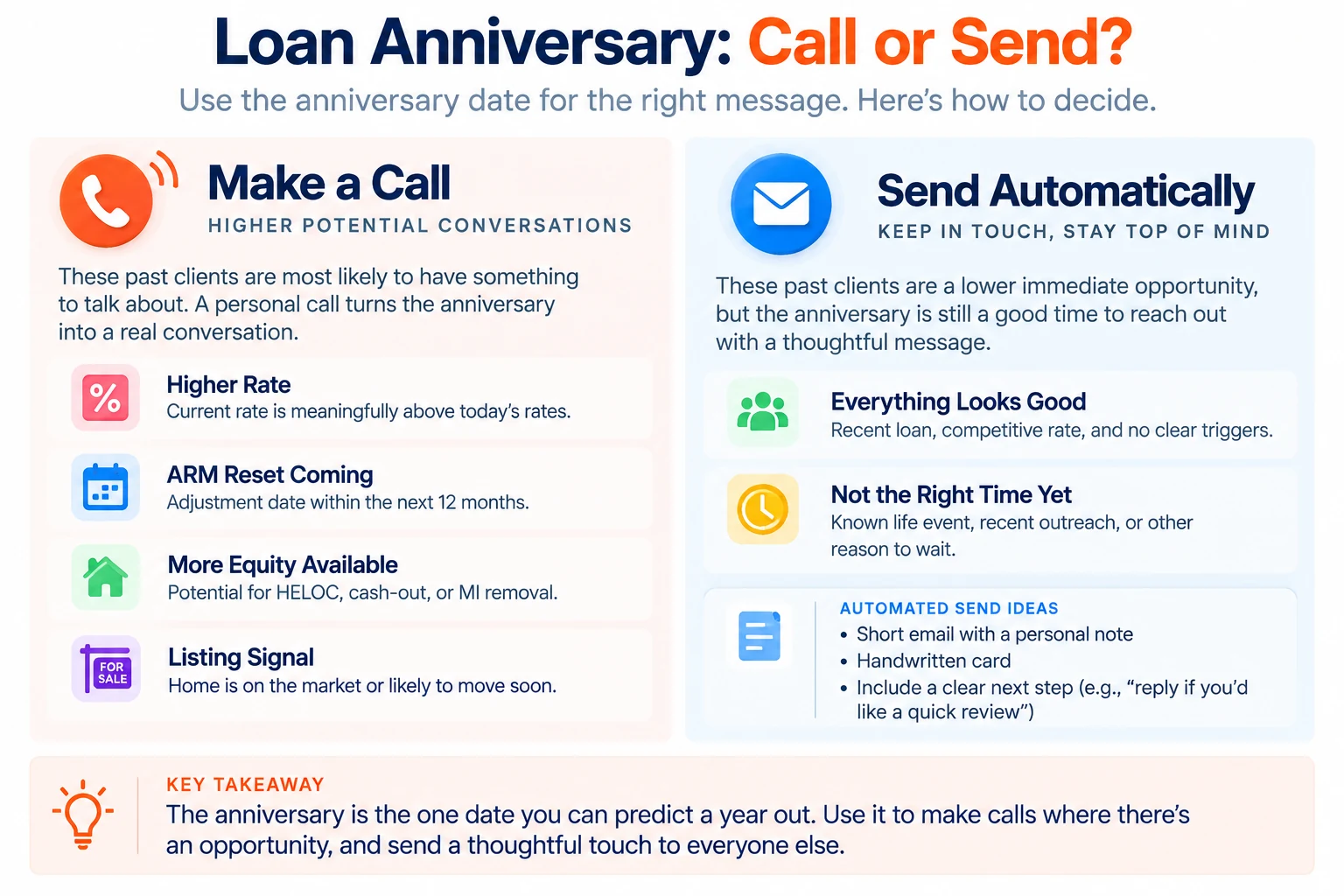
Working out which is which is a segmentation job. How to cut a database into segments covers the cuts that decide it.
One compliance note, and the constraint is the technology rather than the relationship. An established business relationship plus a manual dial is one risk profile. An autodialer or an AI agent working the same list is another. If any part of this is automated onto a phone, that is the part to take to your counsel. This is Shape’s operating read, not legal advice.
Anniversary Outreach, Mortgage Edition: What to Send
Short. One ask. A reply that takes ten seconds to write.
The long personalized letter performs worse than a three-line email. The short one looks like it came from a person. The letter looks like it came from a system.
Two things not to send. A market update, because they get those from everyone. And a discount, because there is nothing to discount on a loan they already have.
Most loan anniversary email ideas you will find are variations on the card. Past client anniversary touchpoints are worth more when they carry a question.
If nobody replies, that is information. A borrower who ignores three consecutive annual touches is not a warm relationship and should stop being counted as one. Move them to the passive list and spend the attention somewhere it produces.
Building It So It Runs Without You
This should be entirely automated except the calls.
The trigger is the closing date, which is already on the record. The send fires on the anniversary. The referral ask and the review offer alternate year on year. The call list is a filtered view, not a separate process.
That is what automated borrower follow-up tools are for. If your system cannot fire on a date field and branch on loan size, it becomes a manual job. Somebody stops doing it in March.
Build the exit too. A reply routes to you and stops the sequence. A borrower who answers, then gets another automated message a year on, has learned the first one was not real.
Whether a platform does this well is a real buying criterion. The platforms loan officers actually run compares them on it.
Figures We Left Out
Two numbers circulate on this subject and neither appears here.
One is a database reactivation rate of 10 to 20 percent at one to five dollars per contact. It is published as industry data with no study named and no denominator. The other says a five percent lift in retention raises profits by 25 to 95 percent. That traces to a general business book, not to anything about mortgage.
The STRATMOR figure above is dated and we said so. That is the standard.
Frequently Asked Questions
What should a loan anniversary campaign actually say?+
One ask, in three lines. Either a specific referral request or an offer to review their rate, balance and mortgage insurance position. A message that only congratulates them gives the borrower nothing to reply to. That is why the standard version produces no calls.
Should you call past clients on their loan anniversary?+
Call the ones where the loan size or the relationship justifies the time, or where the borrower prefers the phone. Automate the rest. The anniversary does not decay, so it should not take the hours that time-sensitive segments need.
How often should you contact past clients besides the anniversary?+
Monthly at most for a general send, and separately whenever something changes in their own situation. Event-driven outreach has no schedule, because it fires on a rate crossing or an ARM reset rather than a date. The anniversary is the floor, not the whole program.