How to Segment a Mortgage Database
Most loan officers never segment their database, and it is not because it takes long. It takes an afternoon. It is because the way it gets taught produces lists nobody calls.
Ask how to segment a mortgage database and every answer sorts by who people are. Past clients here, pre-approvals that fell through there, realtor partners in a third bucket, old leads in a fourth. It is tidy and it is useless. Knowing someone is a past client tells you nothing about whether to ring them today.
Sort by what changed instead. Four cuts do it, and every one is built from records you already hold.
Why Relationship Segments Do Not Produce Calls
A past-client list is 400 people with one thing in common: you closed their loan. That is a fact about history, not about now.
Open that list on a Tuesday and you have no idea who to start with. So you start at the top, get through eleven, and never open it again. The list did not fail. It was never built to tell you anything.
Contact segmentation for loan officers is worth doing only if each segment answers one question. Why am I calling this person this week?
Segmenting is the first job, not the whole job. What to do with the book you already have covers the campaigns each cut feeds once it exists.
Mortgage Database Segmentation: The Four Cuts, in Order
Current Rate Against Today’s Rate
Pull everyone whose note rate sits meaningfully above where the market is now. Their original rate is in your file.
This rebuilds itself every time the market moves, which is the point. It is the only segment that changes without you touching it.
Set the threshold by savings, not by rate difference. A half point on a $600,000 loan is a conversation. The same half point on $140,000 is not worth either of your time.
Loan Type and ARM Reset Date
Every ARM in your book has a first adjustment date, and that date is in the file.
This is the most predictable calendar you will ever be handed. You know months ahead who has a payment change coming and roughly what it will look like. Nobody else calling that borrower knows the date.
Fixed-rate loans split by product too. FHA borrowers past the mortgage insurance threshold are a different conversation from conventional borrowers at the same equity.
Estimated Equity Position
Original loan amount against a current value estimate, by address. This is your HELOC, cash-out and mortgage insurance removal list.
The estimate does not need to be exact. You are deciding who to call, not what to quote.
Closing Date and Cohort
Two uses. Anniversary timing, and the cohort question, which matters more.
People who closed inside one quarter share a rate, a market and a set of problems. Everyone who closed in a single high-rate stretch is one conversation, not four hundred individual ones.
What to Do When the Field Is Missing
Here is the part no guide covers. Half your records are missing the field a cut depends on, and the reason matters more than the gap.
Original rate and original loan amount go missing most often. Loan type survives but the ARM adjustment date rarely does. Address usually survives, which matters because it is what lets you attach a value estimate later.
Fix the Integration Before You Fix the Records
Every field these four cuts need already exists in the loan file. Rate, amount, product, adjustment date, property address, closing date. Your POS collected them and your LOS holds them.
If they are not on the CRM record, the integration is not writing them back. That is the actual problem, and backfilling by hand does not solve it. Clean up 400 records today and the same gap reopens on every loan you close next month.
So the first question is not how to fill the field. It is which fields your LOS integration maps and which it drops. Most originators have never looked, because nobody looks at a field that is empty.
This is what separates contact management software for loan originators from a list. A contact record that inherits the loan file is segmentable. One that inherits a name and a phone number is not.
Get that mapping right and segmentation stops being a project. The cuts populate themselves as loans close, which is what makes the rate segment rebuild without you.
Then Deal With the Backlog
Records that predate the integration, or came through a migration, still need filling. Three options.
Pull them from the LOS. Your loan files have everything and this is the authoritative source. Tedious, and it is a one-time job if the mapping is fixed.
Pull them from public records. Recorded deeds carry loan amount and date. Covers the equity cut, will not give you a rate.
Segment on what you have and flag the rest. A cut built on 60% of the book still produces calls. A cut you never build produces none.
What you should not do is wait until the data is clean. Nobody finishes that project.
Building a Prioritized List, Not Four Lists
Four cuts give you four lists and a new problem. Which one gets Tuesday morning. These are the database segments that drive campaigns, and they are not equal.
Order by Decay Rate, Not Segment Size
The instinct is to work the biggest list first. That is backwards.
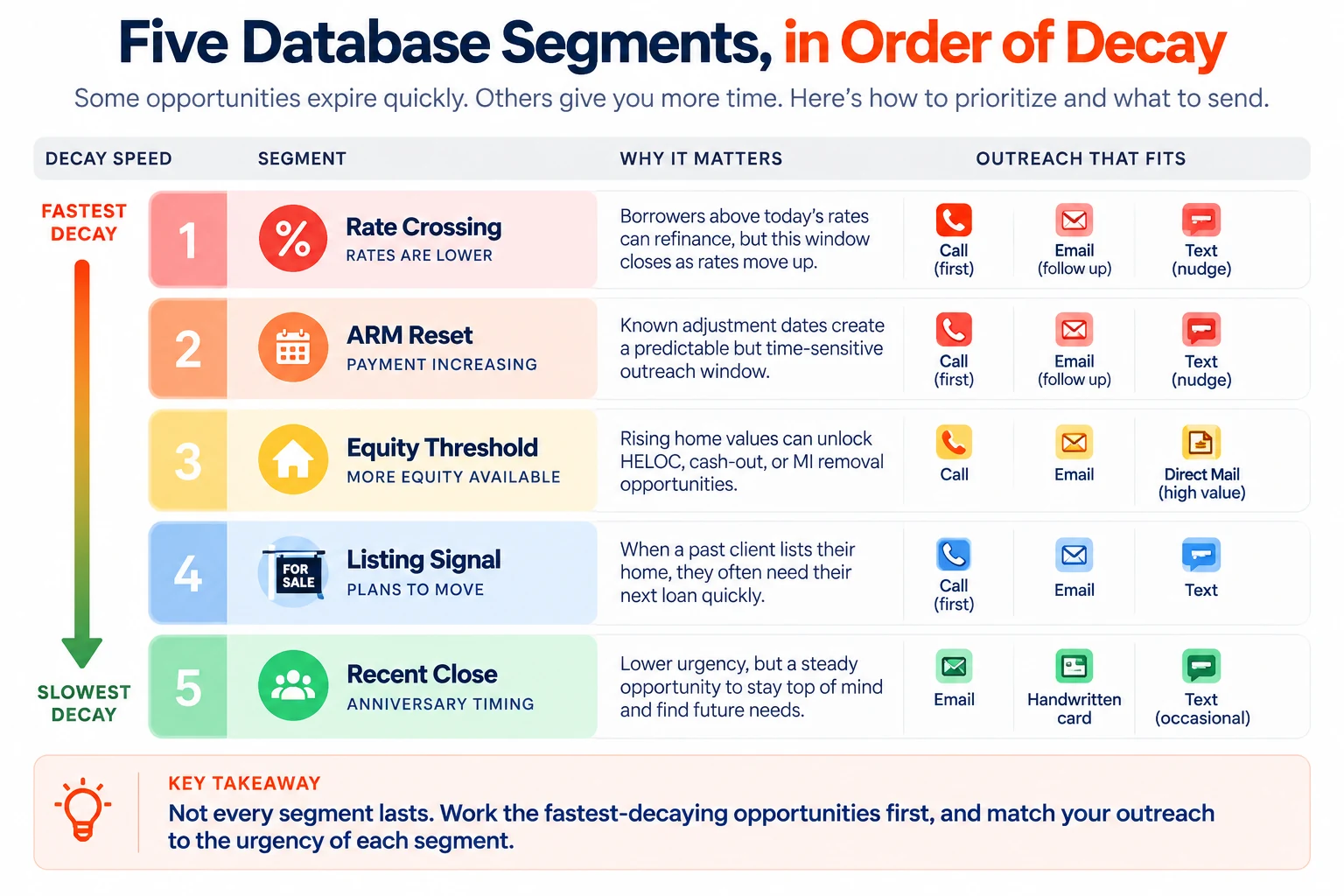
Order by how fast the opportunity disappears. A borrower about to list their house is gone in days. A borrower sitting on equity will still be sitting on it in March.
That gives you an order that has nothing to do with headcount. Pre-listing signals first, rate crossings second, ARM resets by date, equity last.
Where Value and Urgency Disagree
Sometimes the biggest loan is the least urgent, and that is fine. Work the decaying one first and put the valuable one on a date.
Build these as saved searches rather than exported lists. A static list is wrong the day after you pull it. The rate cut in particular is meant to repopulate itself. Not every system runs a saved search against live loan fields, and mortgage CRMs compared side by side covers which ones do.
What Each Segment Warrants
Channel follows decay, not headcount. The faster the opportunity disappears, the more direct the outreach has to be.
The Three That Earn a Call
Pre-listing signals. Days. Call the same afternoon. By the time an email gets opened they have an agent.
Rate crossings. Weeks. Call, because a borrower who is in the money is being worked by every lender with a list.
ARM resets. Months of lead time, which changes the shape rather than the channel. Start a sequence early, escalate as the date approaches, finish with a call. The lead time is also what makes mail work here, because you are not racing anyone.
The Ones That Should Run Without You
Equity thresholds. Barely decay. Run them automated and reserve a call for the top slice by loan size.
Anniversaries. Do not decay at all, so they do not need to jump the queue. Automate the touch and call the ones where the relationship warrants it, or where the borrower has told you they prefer the phone. What you should not do is let a date-driven list eat the hours the decaying segments need. Our post on giving the anniversary call a reason to exist covers how to make that touch worth something anyway.
One compliance line applies and it is not about mail. Calls and texts to past clients still sit under the TCPA. The established business relationship exception is narrower than most originators assume. Check consent state before the phone, not after.
Whether any of this is working shows up in one number. Our post on what a recapture rate actually measures covers how to calculate it without fooling yourself.
Frequently Asked Questions
How should a loan officer segment a mortgage database?+
By what changed, not by who people are. Four cuts: current rate against today’s rate, loan type and ARM reset date, estimated equity position, and closing date. Each produces a reason to call attached to a specific borrower. Relationship-type segments like past clients or old leads produce lists nobody works.
What if my CRM is missing the data these segments need?+
Segment on what you have and flag the rest. Original rate and ARM adjustment dates go missing most often, usually in a migration. Fill them from the LOS where it matters, or from recorded deeds for loan amount and date. A cut built on 60% of the book still produces calls.
Which segment should you work first?+
The one that decays fastest, not the biggest. A borrower about to list is gone in days. A borrower sitting on equity will still be there in three months. That puts pre-listing signals first and equity last, regardless of how many contacts each list holds.