Direct mail wins or loses on the list, and the rate environment decides how good the list can be. Mortgage direct mail marketing works for acquisition and for retention, in the right market. A mortgage direct mail campaign is mostly a data decision. The design matters less than anyone selling design will tell you.
How a mortgage direct mail campaign actually runs
Three parties do three jobs. A full-service mail shop procures the data, prints the pieces and drops them. Your loan officers answer the response. Your CRM holds the record that tells you whether any of it paid.
Most guides on this subject come from the mail shop, so they stop at the drop. The expensive part starts after it. Mail is one play in the loan officer marketing playbook. It is the play where the gap between sending and measuring costs the most.
When direct mail works, and when it does not
Response follows rates. When rates are high, fewer borrowers have anything to gain from a new loan. The same list, the same piece and the same offer pull fewer calls. In a high-rate market, mail is a harder channel than the mail shops admit.
When rates drop, whole pools of borrowers gain a benefit. Three move first:
VA IRRRL. Veterans holding a VA loan above the new market rate.
FHA Streamline. FHA borrowers who can lower their payment through a streamlined refinance.
Cash-out refinance. Owners with equity who were waiting for a rate worth trading into.
Rates move fast. A lender with those borrowers already in the CRM is ready the moment rates move. Wait a few days and the opportunity can disappear altogether.
The list is most of the campaign
Start with your own past borrowers who are in market. They know your name, and the data costs you nothing. Signals such as how listing alerts flag past clients in market tell you who to mail first.
When that list cannot produce the call volume you need, the mail shop builds one. It models the borrower you want from property, mortgage and credit data. Loan program, note rate, origination date and equity do most of the work. Program seasoning rules decide which origination dates belong on an IRRRL or Streamline list. The goal is a list of people with a real benefit who most likely qualify.
A credit-filtered list brings in the FCRA
Filtering on credit data can turn the piece into a prescreened offer under the FCRA. Regulation V sets out a firm-offer requirement and a short and long opt-out notice for those. Have your counsel review the piece before the first drop.
What the trigger ban did to trigger mailers
Trigger mailers were a staple product for mail shops. Public Law 119-36 took effect 180 days after its September 5 2025 signing, on March 4 2026. A bureau now furnishes a mortgage trigger only for a firm offer. The recipient must be the borrower’s current originator or servicer. A bank or credit union holding their account also qualifies, as does a party with their certified authorization. For most outside lenders, triggers are no longer an acquisition source. For your own borrowers, they are now a retention signal.
Mortgage mailers are built to make the phone ring
Most borrowers call, because that is what they are used to. Format is mostly a cost choice, and what postcards cost next to email for farming is a separate question.
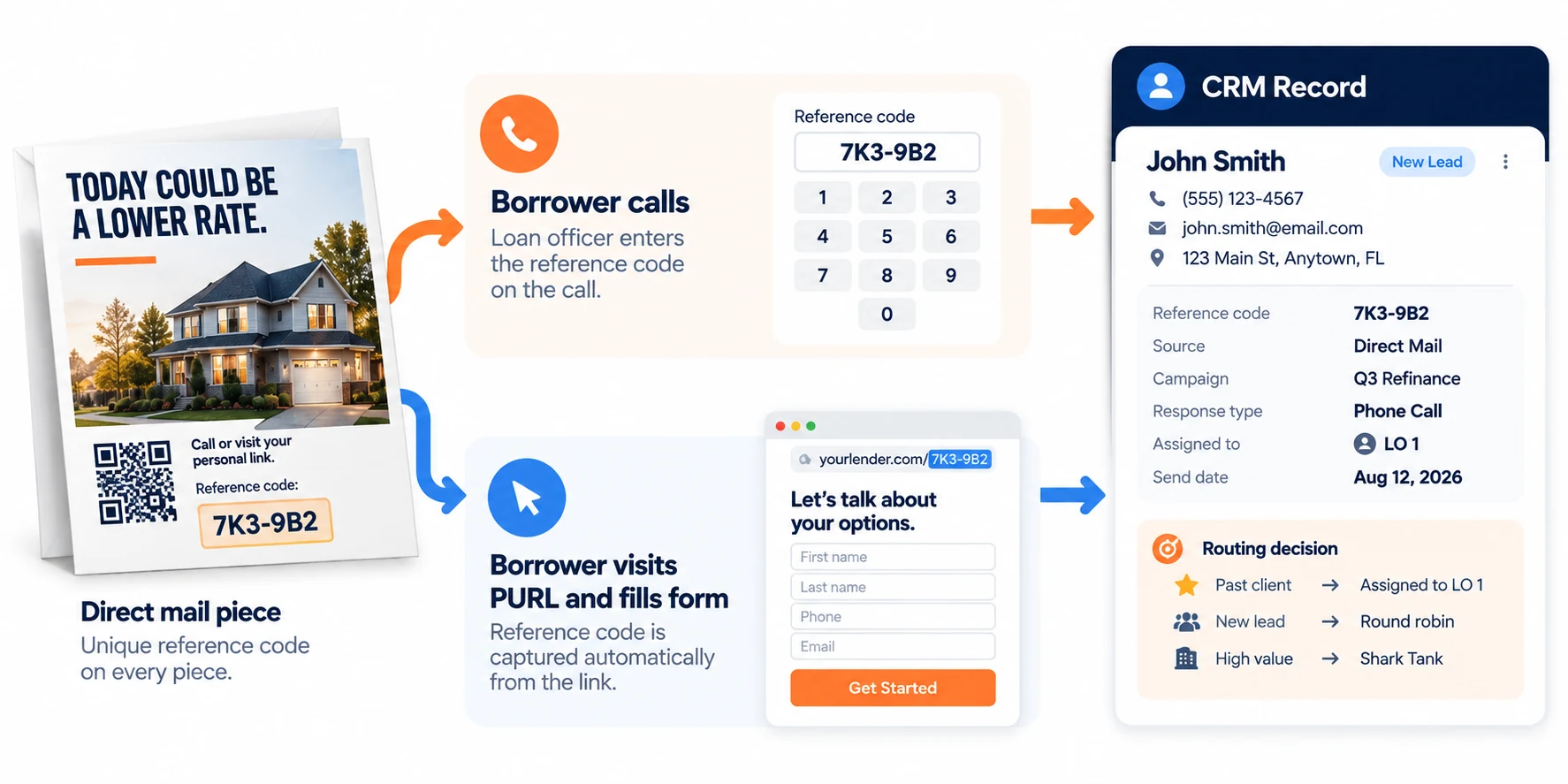
Every piece carries a reference code. The borrower reads it to the loan officer, who pulls up the record with the borrower’s data already on it.
A VA or FHA piece that looks like a government notice can run afoul of Regulation Z’s advertising rules. The CFPB has already pursued a lender over FHA streamline mailers dressed up as government notices.
The call is where the campaign is won. At a lender I worked for before Shape, we took up to 1,200 direct mail calls a day. Across more than 100,000 of them, one thing mattered more than any other. A call answered live the first time funded at least three times as often as every other path. That held whether the borrower called back, we returned a voicemail, or a third-party call center booked the callback. That is one operation’s record, not a study. It is also 100,000 calls of it.
A drop produces a call spike no floor absorbs. AI agents native to the platform answer the overflow and the calls that land when nobody is free. They transfer the caller into the call queue or book a callback. Fewer calls die unanswered, and those are the most expensive calls you lose.
A PURL is a landing page for every piece
Some borrowers will not pick up the phone. A PURL, the personal web address printed on the piece, catches them. It opens a page prefilled with their details, and a QR code gets them there in one scan. The fill enters Shape as a lead, with the reference code passed in the post.
Attribution is an architecture problem, not a mail problem
Mail vendors describe attribution as the channel’s weak spot. It is weak when the phone system, the call routing and the lead data don’t sit in one platform. Someone then has to join a call log, a routing report and a drop list after the fact. The joins break.
Put them in one place and the gap closes. In Shape, they land on one record. That covers the call on the reference code, the PURL lead, the routing decision and the send. The drop itself runs as a webhook step inside a drip, so the send sits on that record too. The same webhook fires bulk sends to past borrowers who show up as in market. That is what a mortgage CRM with automated marketing does with mail that a stack of separate tools cannot.
How to measure direct mail for mortgage companies
Track four rates on every mortgage direct mail campaign: response rate, answer rate on calls, application rate and funded rate. Add the cost of the drop, and you can back into what each call, application and funded loan cost.
The answer rate does the most work. Take the funded rate on answered calls and apply it to the calls you missed. That is the revenue the missed calls cost you. Set it against the cost of covering them, and you know whether filling that hole pays.
Response rates we did not use. One mail shop puts targeted mortgage mail at 3 to 5%. A lead seller says 1 to 2%, at 75 cents to $1.50 a piece. An ICE blog post claims 5 to 9%, with a 90% open rate. A CRM vendor’s page once claimed a 161% return for house-list mail. None names a study, and most come from companies selling mail.
Frequently asked questions
Does the TCPA apply to mortgage direct mail?+Not to the mail. The TCPA governs calls and texts, and the callback is a call. A borrower calls, nobody answers, and no voicemail is left. Does that missed call imply consent to call back? Your counsel decides, and most may say no. Answering the first call avoids the question.
What should you ask a mortgage direct mail shop before the first drop?+Four things. Where the data comes from, and how they model eligibility. Whether every piece carries a unique reference code. Whether PURL fills post into your CRM with that code attached. And who reviews each piece against the prescreen notice and government-look rules before it prints.
Kevin Benner is the Chief Revenue Officer at Shape Software, where he leads revenue, marketing, and customer growth. He brings over 23 years of experience in mortgage lead generation and sales technology.
Your past client is not forgetting you. They are refinancing before you thought they would. Client retention for loan officers gets taught on a purchase cycle of five to seven years. Send a newsletter, mail a card, call at the anniversary, stay top of mind until they move house. Client retention gets treated as a […]
The referral ask almost always comes too late, and usually arrives bundled with a review request that competes with it. Those are two different asks and they belong at two different moments. Get the order wrong and you get neither. That is why most loan officers fail to turn closings into referrals. Why Loan Officers […]
Most anniversary campaigns are a card nobody answers, sent because the CRM had a date on file. That is not a criticism of the idea. It is a criticism of what the idea has turned into. Every guide lists the anniversary touch, tells you to automate it, and moves on. None says what the message […]