Loan Officer Marketing Ideas: 12 That Build a Name Worth Referring
Marketing does not fill your pipeline. It decides whether the people already choosing pick you.
That distinction runs through every loan officer marketing idea below. A borrower comparing three lenders. An agent deciding who gets the buyer. A past client asked for a name at a dinner party. The decision is already happening and you are not in the room. What you built beforehand speaks for you. The loan officer marketing ideas below are grouped by what each one builds. The advertising rules that govern several of them come after.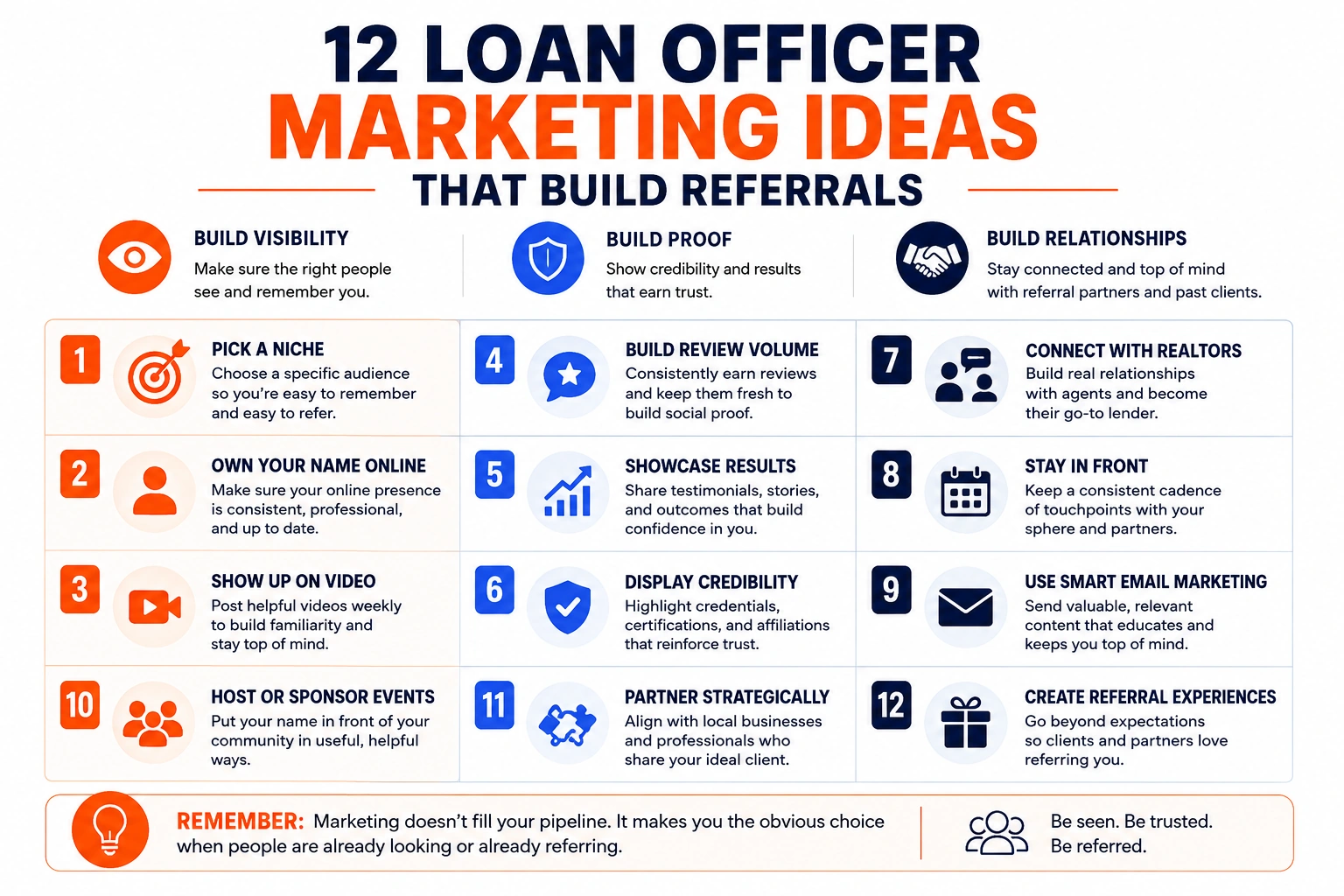
Marketing is not lead generation
Worth separating, because almost every list of marketing ideas for loan officers conflates the two. Lead generation produces contacts who did not know you existed. Marketing makes you the obvious answer for people already looking or already referring. Different work, different timelines, different measurement. You need both. Running them as one job is why marketing budgets get judged on lead counts. The counts disappoint, and the budget gets cut. If pipeline is what you need this quarter, start with mortgage lead generation strategies instead. Come back here when you want referrals arriving without you asking.Ideas that build visibility
1. Pick a niche narrow enough to be remembered for
Being the lender for everyone makes you memorable to no one. That is the most common mistake on this list. Pick a lane you can be introduced as. Self-employed borrowers. VA. Physicians. First-time buyers in one school district. Construction-to-perm. The test is whether a referral partner can describe you in one sentence without using your company name. Narrow feels like it costs volume. It buys introductions instead, because a specific problem produces a specific recommendation. Nobody says “call my mortgage guy” with any urgency. People do say “she handles self-employed borrowers, call her.” Pick something you have already closed more than a few of. A niche you cannot execute is a positioning exercise, not a marketing idea.2. Own your name everywhere someone checks it
Anyone who hears about you will search your name before they call. What they find should be consistent. Same headshot, same bio, same NMLS ID, same phone number across your website, LinkedIn, Google profile, and your company page. Mismatched details read as carelessness, and carelessness is expensive in a business built on handling other people’s money. Check what actually ranks for your name. Old company profiles, dead branch pages, a LinkedIn photo from two employers ago. All of it is sitting there for anyone who looks. This costs an afternoon once, then almost nothing to maintain. It is the highest return per hour of anything here.3. Show up on video every week
Consistency beats production quality every time. A phone-recorded market update posted weekly outperforms a quarterly professional shoot. Video builds familiarity faster than anything else because people hear your tone before they call. By the time a borrower reaches out, part of the trust work is done. The catch is that video rarely produces a lead you can trace. That makes it easy to quit in month two and easy to undervalue in a spreadsheet. Judge it on whether people mention it, not on attribution. If being on camera makes you wince, do not force it. Pick something else here and do it well. A channel you abandon returns nothing.Ideas that build proof
4. Build review volume, then keep it current
Reviews are the closest thing a loan officer has to a public credit score. Volume and recency move them, in that order. A profile carrying six reviews does not compete with one carrying sixty. Ask at closing while the relief is fresh, by text, with a direct link. Anything depending on you to remember later will not happen after the hard files. Those are the ones where you earned it most. Build the ask into the closing checklist so it stops being a decision. Review volume is also the largest input to local search visibility. Our guide to local SEO for mortgage brokers covers that in depth.5. Publish client stories, not testimonials
A testimonial says you were great. A story says what the problem was and what you did about it. Only one of those is useful to the next borrower. Self-employed borrower turned down elsewhere, two years of returns, closed in 27 days. That story works on the next self-employed borrower. It also works on the agent who has one across the desk right now. Get written permission, keep the details real, and do not round the numbers in your favor. One verifiable story beats five polished ones. Three or four stories covering your niche is enough. This is not a content calendar.6. Put the proof where the decision happens
Reviews sitting on Google do nothing for a borrower reading your website. Stories buried in a blog do nothing for an agent scanning your LinkedIn. Move proof to where people actually decide. Your profile, your quote page, your email signature, the one-pager an agent hands a client at a showing. Most originators collect proof and then leave it where it was collected. Placement is the part that gets skipped, and it is the part that converts.Ideas that build relationships
7. Co-market with agents, correctly
Still the highest-quality purchase pipeline in the business. NAR’s 2025 buyer profile puts 88% of buyers purchasing through an agent or broker. Agents sit upstream of almost every purchase loan. Most originators work this passively. They meet an agent, ask for business, and wait to be remembered. The ones who win bring something the agent cannot get elsewhere. Co-branded content. A first-time buyer class you host together. Quick videos explaining financing on their listings. Pre-approvals that come back on a Saturday. Pick five agents, not fifty. Expect to lose most of the ones you court. Five real relationships outproduce fifty business cards. Read the rules section below before spending a dollar here. Co-marketing is where RESPA lives, and the exposure is real.8. Build referral partners who are not agents
Agents are the obvious partner and the most competed-for. The unobvious ones convert better because nobody else is calling. Financial planners, CPAs, divorce attorneys, builders, relocation coordinators, HR benefits managers at large local employers. Every one of them sits next to people who will need financing inside a year. The approach is the same as with agents and the competition is a fraction of it. Most of these professionals have never had a loan officer offer to explain financing to their clients. Start with the two closest to your niche. A CPA is the obvious first call if you work self-employed borrowers.9. Teach something in public
Homebuyer seminars, a lunch-and-learn for an agent’s team, a class at the local credit union or a large employer. Teaching puts you in a room as the person with the answer. That is a different position from the person asking for business. It also solves your content problem. One seminar becomes a video series, six social posts, and an email sequence. The work you did once keeps producing. Co-hosting with an agent doubles the room and halves the effort. It also puts you inside RESPA’s scope, so read the section below first.Ideas that keep you known after the loan closes
10. Run a post-close cadence you do not have to remember
The relationship either continues on a schedule or it stops at the closing table. There is no middle version where you stay in touch when you think of it. Set the cadence once. Something useful at 30 days, again at 90, then quarterly. The content matters less than the fact that it arrives. This is the idea with the widest gap between how obvious it is and how rarely it runs. Almost every originator agrees with it. Almost none has it automated.11. Reach out on the anniversary and when the numbers change
Home anniversary notes work because so few people send them. Equity check-ins work because the number genuinely changed and the borrower has no idea. Both give you a reason to make contact that is not a pitch, which is exactly why they get answered. A rate-drop note to someone 18 months in is a service, not a solicitation. Trigger these off loan data rather than a calendar. Anniversary date, original rate, original balance, and current estimated value are enough to run all of it.12. Send something monthly worth opening
A short newsletter with a real market read beats a template with a stock photo. Write it the way you would explain rates to a client on the phone. Two hundred words of what actually happened and what it means for someone buying in your market. That is the whole format. Anything longer will not get read and anything vaguer will not get remembered. The point is not the newsletter. The point is being the name that surfaces at that dinner party.The advertising rules behind these ideas
Every list of mortgage marketing ideas tells loan officers to co-market with agents and advertise rates. Almost none mentions that both are regulated. Here is what the instruments say. Take your own situation to your own counsel. RESPA Section 8 governs co-marketing. Under 12 CFR 1024.14, no person shall give or accept a fee, kickback, or thing of value. That applies under any agreement to refer settlement service business. A referral is not a compensable service. Subsection (d) defines “thing of value” broadly. Subsection (g)(1) permits payment for goods or facilities actually furnished, or services actually performed. That is the line co-marketing sits on. Paying your share of an ad you genuinely appear in is one thing. Paying for the referrals it produces is another. The practical version is documentation. What did you receive, what was it worth, and what did you pay. Ideas 7 and 9 both land here. Regulation N governs what you claim. 12 CFR Part 1014 prohibits misrepresentations in commercial communications about mortgage credit products. Section 1014.3 covers rates, fees, costs, payment amounts, and terms. Part 1014 also carries a recordkeeping requirement at section 1014.5. Advertising is not something you post and forget about. NMLS ID display is mostly a state matter. Most states require your NMLS ID on advertising and the requirements differ. Check your own state regulator rather than assuming a federal rule covers it. Idea 2 is where this shows up. None of this puts any idea on this list off limits. It changes how you document them.How to pick and how to measure
Pick two loan officer marketing ideas. Not twelve. The right two loan officer marketing ideas match how you already work. If your business comes from agents, deepen that before starting a video habit. If you have closed volume behind you, retention beats anything you would start from scratch. A mortgage marketing plan that fights your own temperament loses to one that does less and survives. Measuring this is harder than measuring lead generation, and the wrong measure does real damage. Marketing does not produce a trackable form fill. It produces a higher close rate on leads you already get, plus referrals arriving with no source attached. Two things worth tracking. The share of funded volume that came by referral, measured quarterly. And whether new borrowers mention seeing something of yours before they called. Neither is a dashboard metric. Both tell you more than clicks. Attribution is where most of this falls apart, and it is a systems problem rather than a marketing one. Referral source has to be a required field captured at intake, not reconstructed from memory at closing. Getting that right is one reason we built a CRM built for mortgage teams instead of adapting a generic one.Frequently Asked Questions
What is the difference between marketing and lead generation for a loan officer?+
Lead generation produces contacts who did not know you existed. Marketing makes you the obvious choice for people already looking or already referring. Shape’s view is that most originators run these as one activity. Marketing then gets judged on lead counts, disappoints, and gets cut.How many loan officer marketing ideas should you actually run?+
Two, chosen to match how you already work. Twelve run badly produces less than two run consistently. Deepening the channel that already feeds you almost always beats starting one you have never tried.Is co-marketing with a real estate agent allowed?+
Yes. It is standard practice across the industry and RESPA contemplates it directly. The question is never whether you can co-market. It is how you structure and document it.
12 CFR 1024.14 prohibits giving or accepting anything of value under an agreement to refer settlement business. Subsection (g)(1) permits payment for goods or services actually furnished or performed. So you pay your fair share of what you actually receive, at fair market value. You do not pay for referrals.
Keep records of what you got, what it was worth, and what you paid. Whether a specific arrangement clears the line is a question for your counsel, not a reason to avoid the channel.