How to Be a Successful Loan Officer: What Actually Separates Top Producers
Top producers are not working harder than you.
That is the part nobody says. Every list of tips on this subject sells effort, attitude and hustle. The people writing them have never carried a pipeline.
Two things separate a new loan officer from someone doing volume. Time, which nobody gets more of. And consistency, which does not survive being remembered.
Everything below is one of those two.
Where Your Time Actually Goes
You do not have a work ethic problem. You have a distribution problem, and the units are hours.
Count what a normal Tuesday actually contains. Re-keying a borrower’s details into a second system because the first one does not talk to it. Hunting for a paystub in an email thread. Rebuilding a picture of your pipeline because it lives in your head and your head was in a closing yesterday. Trying to remember who you owe a call.
None of that originates a loan. All of it feels like work, which is why it survives.
A top producer has the same twenty-four hours and spends fewer of them on that list. Not through discipline. Through not having the list.
The test is simple and uncomfortable. For one week, write down every task you do that a borrower would not pay for. Most originators are shocked by the total.
Consistency Is a System Problem, Not a Character Problem
Follow-up that depends on you remembering it fails exactly when it matters.
Think about when you drop a lead. Not on a quiet Thursday. You drop it in the week you had three files going to closing. A rate lock about to expire. An agent calling twice a day. The busy week is the week you lose things. It is also the week you have the most in play.
That is not a character flaw. It is what memory does under load.
So the question is not how to be more disciplined. It is what still happens on your worst week. If the answer is nothing, you do not have a follow-up process. You have intentions.
A new lead gets a call within minutes whether or not you are in a closing. A pre-approval that goes quiet gets chased on day three whether or not you noticed. A past client hits their two-year mark and hears from you whether or not you remembered the date.
Those are not habits. Habits break. Those are triggers, and the difference is whether they survive you being busy.
I have watched originators with better instincts lose to people who were simply still there on day nine. Consistency is boring and it wins.
How You Will Generate Business Is the First Real Decision
Before any of the tactical advice matters, you pick a model. There are two and they do not mix well.
Relationships and referrals. Agents, builders, CPAs, past clients. You build a small number of sources who send you business repeatedly. It starts slowly and it compounds. It survives rate cycles, because a referral is not shopping. The cost is patience, and you are riding somebody else’s volume. What that actually takes is in our guide to earning agent referrals.
Direct response. Buying leads, publishing content that generates them, running paid traffic to your own landing page, or mailing to generate inbound calls. It starts faster and it scales with spend. It lives or dies on speed and follow-up, because you are not the only lender holding that record. The cost is cash, and it stops the month you stop paying. The channels and who each one suits are covered in where mortgage leads come from.
Both work. Plenty of people making real money do each one.
What does not work is both at once in your first year. You do not have the hours to build agent relationships properly and run a lead program properly. Half of each produces neither.
Most originators never actually make this choice. They copy whoever trained them. That is not the worst default, because it comes with a working example and someone to ask. But inheriting a model is different from picking one, and the two routes suit different people. If you hate cold outreach, a bought-lead program will grind you down no matter how good the leads are.
Pick the one you can still run on your worst week. That is the same test as everything above.
Whichever route you take, prospecting has its own discipline. The full treatment lives in our guide to prospecting methods that fill a pipeline.
What to Fix in Your First Ninety Days
If you are new, do these in order. Skipping ahead is how people end up busy and broke.
Work your chosen route the same way for ninety days. Not three routes. One. You cannot tell whether something works until you have run it unchanged, and switching hides the answer.
Decide your attempt standard before you need it. How many times you call a new lead, over how many days, and at what hours. Write it down. The number you pick matters less than having one.
Get your database out of your head. Every borrower, every agent, every past client, in one place with dates attached. This is dull and it pays back more than anything else you do in year one.
Ask for the referral at closing, every time. Not later. At the table, when the borrower is happiest with you they will ever be.
Track contact rate, not activity. Dials are not the metric. Conversations are. Two hundred dials that reach nobody is a bad day that looks productive.
When Manual Stops Working
There is a point where the way you have been working stops scaling. It arrives sooner than most people expect.
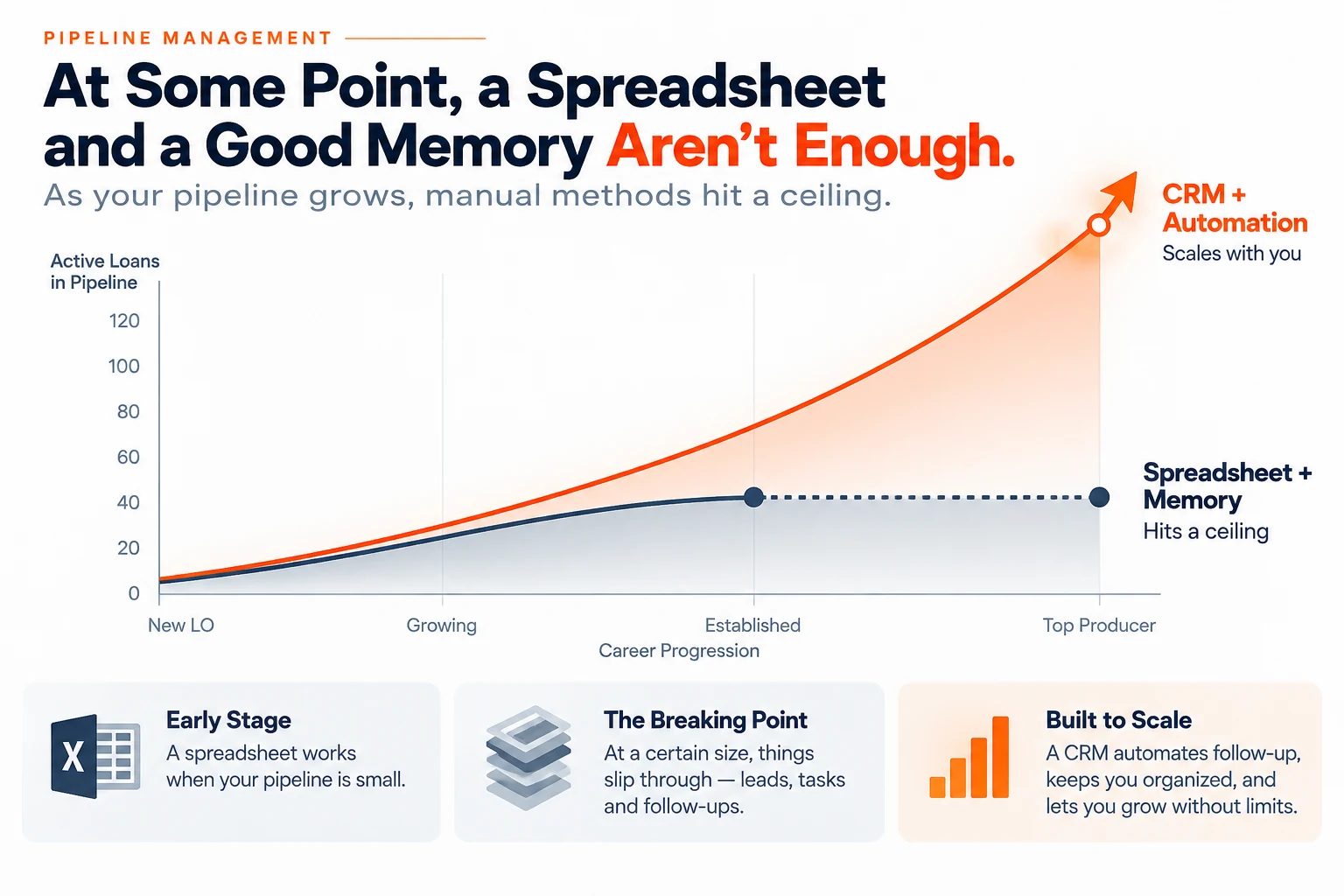
It is not tenure. It is pipeline size. A spreadsheet and a good memory handle fifteen active borrowers. They do not handle sixty, and the failure is not gradual. One week you are fine and the next you have missed two things you would never normally miss.
Watch for the tells. You start finding follow-ups you should have made three days ago. You cannot answer how many people are waiting on you right now without opening four things. You have stopped calling past clients entirely, because the live files eat the day.
That is the ceiling, and effort does not raise it. A loan officer CRM system exists to move the work that does not need you off your plate. The hours then go where only you can go.
Buying Your Own Tools When the Shop Will Not
Nobody writes this section, and plenty of originators are living it.
Two situations. Some independent brokerages expect their loan officers to buy their own CRM, so it was always your call. Others provide one that does not help you sell. Officers buy their own anyway and run the corporate system as a compliance obligation.
Both are common and neither is disloyal. A branch does the same thing one tier up. It buys its own platform because the corporate one does not help it grow.
If that is you, a few things to check before you pay for anything.
Does it dial, text and email without another subscription. Three tools that sync is not one tool. It is three bills and a support problem.
Does follow-up run on triggers or on reminders. A reminder is a to-do list wearing a costume. It still needs you to act.
Can you get your data out. You will change firms. Your database is yours and it should leave with you.
What does it cost when your pipeline doubles. Per-user pricing is simple. Per-contact pricing punishes exactly the growth you are paying for.
What a mortgage CRM has to do covers how the main platforms handle this.
What the Numbers Say
Two figures are worth knowing and both cut against the way this job gets taught.
The CFPB found 77% of mortgage borrowers apply to only one lender. Almost half seriously consider only one before applying. Most borrowers do not shop. They pick someone and stop looking.
That is the whole argument for being early and being present. Not for being cheapest.
The second is about persistence. Shape’s platform data runs to about 17 attempts to convert an opportunity. That covers calls, texts and email, over fifteen years, across every industry we serve. It is not mortgage-specific and we do not present it as one.
Hold it next to your own standard. Most originators stop at three or four, which is well short of where contact actually happens.
Frequently Asked Questions
What does it take to be a successful loan officer?+
Two things, and neither is effort. Protecting the hours that only you can spend, which means moving everything else off your plate. And follow-up that runs on triggers rather than memory, so it survives the weeks when you are busiest.
Those are the weeks you have the most in play and the weeks most deals get dropped.
How long does it take to become a top producing loan officer?+
Longer than the coaching content suggests, and the variable is not talent. It is how early you build a repeatable process. Originators who spend their first year working leads by memory tend to plateau.
The ceiling is pipeline size rather than tenure. Fixing it later means unpicking habits rather than forming them.
Should a loan officer buy their own CRM?+
Often yes. Some independent brokerages expect it. Others provide a platform built for corporate reporting rather than for selling, and officers buy their own anyway.
Check three things. That it dials, texts and emails without a second subscription. That follow-up runs on triggers. That you can export your database when you change firms.
What do top producing loan officers do differently?+
They are still there on day nine. Most originators call a lead twice and move on, and most deals are not lost to rate or rapport. They are lost to silence.
A top producer’s follow-up runs whether or not they remember it. That is why theirs holds up during the weeks everyone else drops things.