Mortgage point of sale software has converged. Nine platforms, near-identical feature lists, and the differences that decide the purchase are not on the feature list.
Do you need a separate POS if your CRM or LOS already has a borrower portal?
Often you do not. Most originators already pay for software that could carry the borrower experience. The real question is which system should.
Three answers, depending on where you sit.
If your LOS ships a portal and you run a broker shop, you probably do not need a second vendor. Check whether the included portal is any good before you accept that answer. Some are built as a checkbox.
If your CRM carries the portal, the same logic holds, and you get something extra. The lead source, the campaign history, and the application all sit on one record. Getting there is a question of mortgage CRM integrations, the CRM wired to your LOS and pricing engine so a borrower’s data moves without a second front end.
If you are at enterprise scale, you likely need a dedicated POS. Automated document classification and disclosure delivery are not what most CRM or LOS front ends were built for.
The nine platforms below are sorted on that basis. Each sits in the tier it fits best, not the only tier it serves. Vendors overlap in this market and the entries say where.
What every mortgage POS does now
Mortgage point of sale software has standardized on a common feature set. These are table stakes in 2026 and none of them should decide your purchase:
Branded borrower application, mobile and desktop
Document requests with automated reminders
Milestone tracking the borrower can check
Status notifications
Pre-approval letter generation
Push of collected documents into the LOS
Referral partner access is close behind. It is not universal, but enough platforms offer some version that it no longer separates the field on its own.
Vendor pages present all of this as differentiation. It is not. Read past it.
What actually separates them
Two things.
How the POS is sold. Standalone, bundled with an LOS, bundled with a CRM, or bundled with a website and marketing platform. This decides what else you are buying, what you can drop, and who you call when something breaks. It is the axis most comparison pages skip.
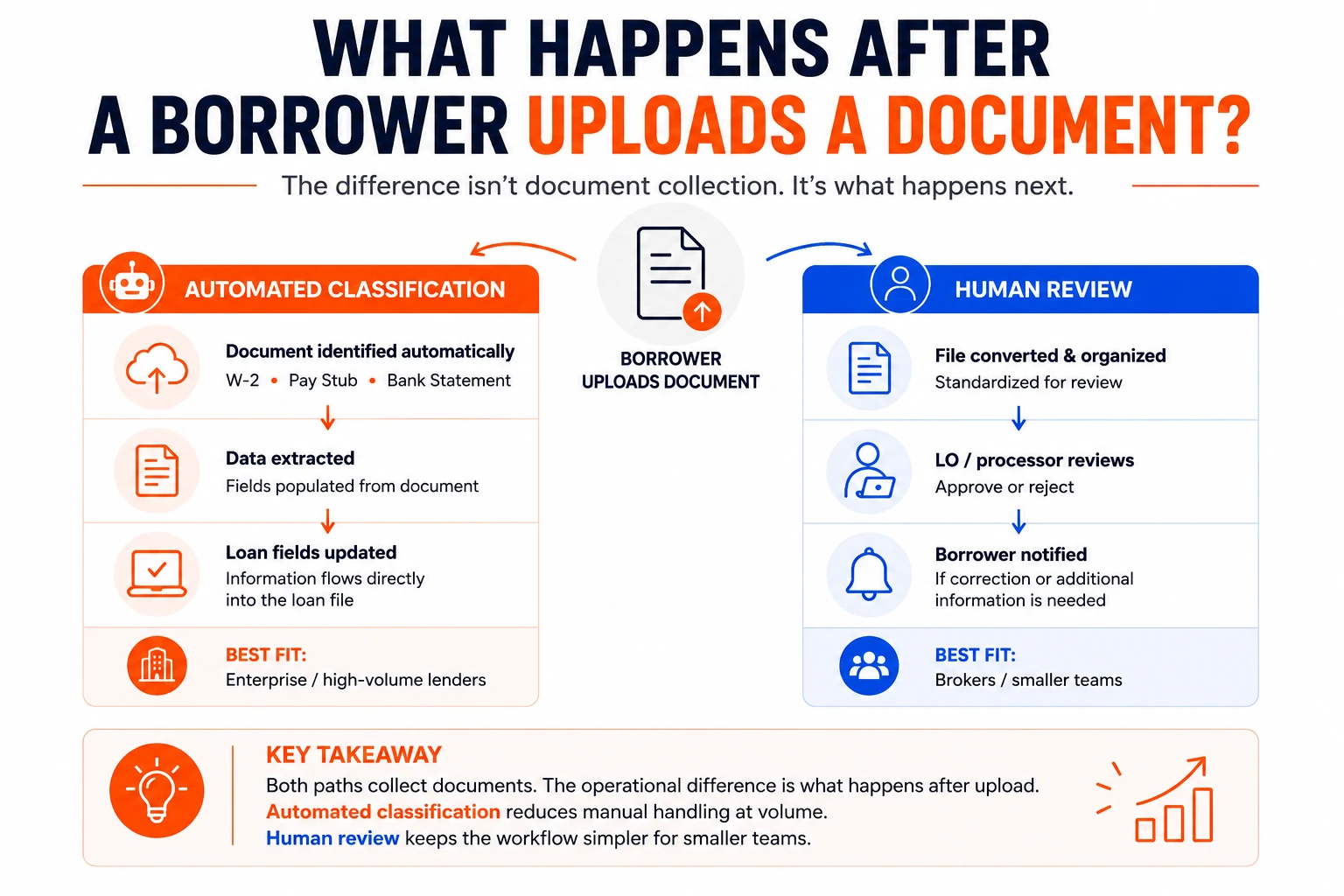
What happens to a document after upload. Some platforms classify the file automatically and populate loan fields from it. Others convert the format and route it to a person who approves or rejects it. That is a staffing difference dressed up as a feature difference.
The second one tracks loosely with tier. Enterprise platforms classify. Broker platforms convert and route. Mid-size varies by platform, so ask the question directly on a demo.
Best mortgage POS for brokers and small shops
This tier is buying a borrower-facing front end without taking on a second vendor relationship. Price and setup time outrank configurability, because nobody on staff administers software. Realtor co-branding carries real weight here, since referral flow is the pipeline.
1. Shape
Shape is the only platform here where the POS runs on a full CRM. That is the reason to consider it and the reason to rule it out.
The portal is an add-on to Shape CRM, not a standalone product. Price it that way. If you want a POS and nothing else, look elsewhere on this list.
Running both puts everything on one record. The application, the lead source, the campaign that produced it, and every follow-up attempt. A document upload can advance the pipeline stage and trigger the next task. Nothing syncs between systems because there is no second system.
Capabilities:
Branded secure login
Document requests with automated reminders
Digital applications pre-filled from CRM data, with e-sign
Automatic PDF conversion on upload
Real-time progress tracking
A borrower can photograph a driver’s license and the file arrives as a PDF.
Document review is human. The LO approves in the portal and pushes to the LOS. Or rejects with a reason, and the borrower gets notified. Wrong tax year on a W-2 is the case this handles well.
Realtor partners get co-branded landing pages and a light login. They see where their referrals stand, pull pre-approval letters, and leave a note for the LO. The LO can attach a note back.
Shape’s AI runs on the CRM side, not inside the application flow. Lead scoring, calling, and texting are CRM features. The portal does not classify documents.
Security: SOC 2, HIPAA, PCI.
Pricing: $47 per user per month for the point of sale. The CRM is priced separately, which is the part to model before you compare against a standalone POS.
Fits: broker shops and small teams that want a POS native to the CRM. Skip if: you need a standalone POS or automated document classification.
Shape’s portal is one piece of a larger platform, and the platform is the real decision. If you are earlier in that evaluation, compare the top mortgage CRMs for loan officers first.
2. ARIVE
ARIVE bundles the LOS, the POS, and a pricing engine, with a lender marketplace attached. It is built for independent brokers and non-delegated correspondents, and it is wholesale channel only.
Two plans, Broker and Non-Del. Pricing is per seat with a free trial and no setup fee. Seats are bought and then assigned, so a shop pays for licensed originators and support staff separately.
This is the strongest bundled case on the list. One vendor, one login, borrower application through to lender submission.
Fits: independent brokers who want to consolidate five tools into one. Skip if: you originate outside the wholesale channel.
Pricing engine access changes how a broker quotes, and the engines vary more than the POS layer does. We covered the pricing engines lenders run rates through separately.
3. LendingPad
LendingPad is an LOS first, and it says so about its own POS. The broker page describes the POS as complimentary and points brokers toward POS partners as an alternative.
Take that seriously. A vendor calling its own POS complimentary is telling you where the engineering went. Brokers running LendingPad often pair it with Floify or another front end.
Use the included POS if your volume is low and the borrower experience is not your differentiator. Budget for a real POS if it is.
Fits: brokers who want a strong LOS and treat the portal as a bonus. Skip if: the borrower experience is how you win business.
4. Loanzify
Loanzify comes from LenderHomePage and ships inside their website plans rather than as a standalone POS. You are buying a website, lead funnels, social tools, and the POS together.
That bundle is the point for a broker with no web presence. It is dead weight for one who already has a site they like.
Capabilities: branded 1003 applications, document collection, milestone tracking, pre-approval letters, and borrower and agent communication in one place. Co-branded realtor apps are a named plan feature. A native mobile app sits alongside the POS, and applications started there feed the same workflow.
Fits: brokers building their digital presence from scratch. Skip if: you already own your website and marketing stack.
Best mortgage POS for mid-size IMBs
This tier is buying consistency across a growing LO count. The concern moves off cost and onto whether the process holds when thirty people run it instead of five. Per-loan pricing and integration depth start to matter.
Document handling is the question to press here. Some platforms in this tier classify documents automatically and some route them to a person. Ask which on the demo.
5. Floify
Floify sells two separately badged products, which is why it lands in more than one conversation.
Broker Edition launched in December 2023 at a broker price point. It integrates with Lender Price, so 1003 data syncs to the pricing engine. It also syncs loans and 1003 data to the UWM portal. Floify says it can serve as your main LOS or work alongside one.
Lender Edition followed in March 2024 with per-loan pricing, aimed at independent mortgage banks, banks, and credit unions. It carries verification of income and employment waterfall functionality.
Per-loan pricing is the thing to look at. It converts a fixed software cost into a variable one, which matters in a low-volume quarter.
Fits: IMBs that want a proven standalone POS and flexible pricing. Skip if: you want the POS and LOS from one vendor.
The Broker Edition question is really an LOS question, since it can replace one. Worth reading how the major loan origination systems compare before you decide the POS.
6. BeSmartee
BeSmartee sells Bright POS with LOS integration, automated verification, and letter generation. A native mobile app serves originators, referral partners, and borrowers. There is a separate broker-facing product for wholesale lenders.
BeSmartee positions itself for the largest lenders and brands. That puts it near the top of this tier. Configurability is the selling point, and configurability means someone has to configure it.
Fits: IMBs and banks with an admin who owns the platform. Skip if: nobody on staff will own configuration.
7. Maxwell
Maxwell sells a POS alongside a business intelligence product and fulfillment services. It targets small and mid-size lenders, and the platform is built around the loan officer, borrower, and referral partner relationship.
Maxwell publishes less verifiable detail than the others here, so evaluate it on a demo rather than on documentation. Ask specifically what the POS does with a document at upload.
Fits: IMBs and credit unions that want origination software and outsourced capacity from one vendor. Skip if: you want a POS only.
Best mortgage POS for enterprise lenders and banks
This tier is buying compliance posture and integration into systems already chosen. The POS decision is usually downstream of the LOS, the pricing engine, and the verification stack. Configurability and audit trail outrank borrower experience polish.
Automated document classification is standard at this tier. Both platforms below do it.
8. Blend
Blend serves banks, credit unions, and IMBs across mortgage and consumer lending. It runs an AI agent that reviews documents and generates needs lists as loans move.
Blend positions itself past POS as a platform, which is accurate and also a warning. You are buying into an ecosystem, including digital closing and consumer banking products. That works in your favor if you want one vendor across products. It is dead weight if you only want a mortgage front end.
Implementation is the real variable. Connecting Blend to an older LOS or core banking system takes engineering time. Plan for it if your environment is heavily customized.
Fits: banks and large IMBs consolidating mortgage and consumer lending. Skip if: you want a mortgage POS and nothing more.
9. nCino Mortgage Suite, formerly SimpleNexus
nCino rebranded SimpleNexus to the Mortgage Suite in 2023. If you are comparing against a 2022 shortlist, this is the same product line under a new name.
Doc Validation classifies documents and populates loan fields automatically. That is the capability broker-tier platforms do not have. It is the reason a lender with volume ends up here.
Agents, title, and settlement partners get real-time milestone visibility, with mobile pre-approval letters and automated status updates. Mortgage Advisor handles borrower conversations against the loan’s own data. The suite also covers incentive compensation and analytics, so the POS arrives as part of a larger platform decision.
nCino integrates with Encompass and other origination systems. You do not have to move the LOS to adopt the mortgage point of sale software.
Fits: IMBs, banks, and credit unions with the volume to justify document automation. Skip if: you are a small shop. The platform is more than you need.
Most enterprise buyers land on nCino or Blend with Encompass already in place. The connection between systems is what to scrutinize. We wrote about connecting your CRM to Encompass and the same questions apply to a POS.
How to choose
Three questions get you to a short list.
Which system owns the borrower-facing experience? Your CRM, your LOS, or a standalone POS. The LOS stays the system of record either way; this decides where the front end lives. Answer this first. It eliminates most of the list.
Who administers it? If the answer is nobody, buy the platform with the shortest setup and the fewest options. Configurability you never configure is a cost.
Do you need documents classified or reviewed? Automated classification pays off at volume. Below that, structured human review with a clear rejection reason moves files just as fast and costs less.
Frequently Asked Questions
What is the best mortgage POS for a small lender?+Shape suits small lenders that want the POS to sit natively inside the CRM, so the application, lead source, and follow-up all live in one place. ARIVE suits independent brokers who want the LOS, POS, and pricing engine from one vendor. Both price accessibly for small teams. Skip the enterprise platforms; the setup burden outweighs the benefit below meaningful volume.
How do I choose a mortgage POS system?+Decide which system owns the borrower record before you compare mortgage point of sale software on features. The feature sets have converged, so intake, document requests, status tracking, and LOS push are common across the category. What differs is how the POS is sold and whether documents are classified by software or reviewed by a person.
What is the best mortgage POS software for a community bank?+Blend and nCino both serve banks and credit unions, and both handle automated document classification. Choose on what you already run. If Encompass is in place, confirm the integration depth before anything else. If you are also modernizing consumer lending, Blend covers both.
Which mortgage POS platforms send automated status updates to borrowers?+All nine here do. Status notifications and milestone tracking are table stakes in 2026 and should not decide a purchase. The differences are in who else sees the status. nCino extends real-time visibility to agents, title, and settlement. Shape gives realtor partners a light login with referral status.
Which mortgage POS systems validate documents when borrowers upload them?+nCino and Blend do. nCino’s Doc Validation classifies documents and populates loan fields. Blend runs an AI agent that reviews documents and generates needs lists. Broker-tier platforms handle this differently. Shape converts uploads to PDF automatically, then the LO approves or rejects with a reason and the borrower is notified. Mid-size platforms vary, so confirm it on the demo rather than assuming.
What is the best mortgage POS for Encompass users?+nCino integrates with Encompass and adds automated document classification on top. Floify integrates with Encompass and costs less. BeSmartee integrates and offers more configuration. Ask each vendor which fields sync in both directions, not just whether an integration exists.
What are the best mortgage POS systems available right now?+For brokers: Shape, ARIVE, LendingPad, Loanzify. For mid-size IMBs: Floify, BeSmartee, Maxwell. For enterprise lenders and banks: Blend, nCino Mortgage Suite. Placement reflects best fit, not exclusive availability. Several of these sell into more than one tier.
Kevin Benner is the Chief Revenue Officer at Shape Software, where he leads revenue, marketing, and customer growth. He brings over 23 years of experience in mortgage lead generation and sales technology.
Mortgage texting software is judged by what happens after the borrower replies, not by how many texts it can send. Any tool can send. The ones worth paying for put the reply on the borrower’s record and stop the automation. Then they show a loan officer who needs an answer. Everything else is a bulk […]
Most lenders reading about the Encompass SDK transition deadline have nothing to migrate. That is not what the coverage suggests. The subject has produced a steady run of posts about an Encompass SDK sunset, an end-of-life, a cutover. Several carry a countdown clock. Some of it is written by firms that sell migration work. Here […]
Most lists of the best CRM for banks and credit unions are general mortgage CRM lists. Each entry gets a sentence about members added to it. That misses what actually separates these platforms for a depository. Your mortgage division runs like any mortgage shop, so the mortgage capability has to be real. But you also […]