Mortgage Automation in 2026: The Full Loan Lifecycle
Mortgage automation is not one thing you buy. It runs across four stages of the borrower relationship, and three systems split them.
Most guides pick a single stage and call it the subject. The lead software companies write about response time. The document software companies write about underwriting. Both are describing a quarter of the problem.
Here is the whole thing, stage by stage, and what to ask before you buy anything.
Which system owns which stage of mortgage automation
Get this straight first, because most stack problems come from expecting one system to do another’s job.
| Stage | System that owns it |
|---|---|
| Intake | CRM |
| Application | POS |
| Loan process | LOS |
| Post-close | CRM |
Read that column again. Three systems, four stages, and the CRM appears twice.
Your CRM bookends the relationship. It owns the borrower before a loan file exists and after that file closes. Your LOS owns the middle and nothing else. It starts when there is a loan and it stops at funding.
That is where money leaks. Your LOS has no opinion about a lead that never applied. It has no memory of a borrower who funded two years ago. Those are the two stages where repeat business is won or lost. The system holding the loan file is absent from both.
The handoffs matter as much as the ownership.
That split creates three handoffs. Intake to application. Application to loan file. Loan file back to the CRM at funding.
Every one of those is a place the borrower experience breaks. A borrower who filled out an application and then hears nothing has hit the first handoff. A file that funds without the CRM knowing has hit the third. That is why the thank-you never sends and nobody asks for the referral.
Automation inside one system is the easy part. Automation that survives the handoff is the whole job. We broke down the boundaries in detail in how the major loan origination systems compare.
Stage 1. Intake
Three kinds of first contact, three different jobs. Treating them the same is the most common mistake here.
A shopped lead. Five lenders got the same form. CFPB research found 77% of borrowers apply to only one lender, and almost half seriously consider only one. Being in that conversation is the whole job, and speed decides whether you are.
A referral. Somebody the borrower trusts already vouched for you. They are not shopping and they will wait. Automation here is consistency, not speed. What loses a referral is silence, not delay.
An inbound call. They are on the line right now. There is no response window.
Speed matters on shopped leads and almost nowhere else
The research on response time is cross-industry and it measures contact and qualification, not funded loans. Read it that way.
In the only large audit of real response times, 23% of firms never responded to a test lead at all. Only 37% got there inside an hour. That was 2011 and nobody has run it again.
Calling inside that first hour instead of the next one makes you 7 times more likely to qualify the lead. Against a full day, 60 times. At five minutes instead of thirty, reaching the person at all is 100 times more likely.
On a purchased lead the standard is immediate, not fast. An aggregator sells the same record to four or five lenders at the same second. A human does not beat four competitors who bought the same lead.
We laid out the full cadence in the mortgage lead follow-up playbook.
Inbound calls are an availability problem
Your best originators are the least available. A producing LO is on another call or sitting in a closing. That is physics, not discipline.
So the question is not whether your team answers the phone. It is what happens during the hours they cannot.
Across ten industries, 56% of calls to businesses reach a person. Filter to calls over 30 seconds and it rises to 71%. Of the calls that do get answered, 64% of businesses never ask the caller to buy or book anything.
Voicemail is not a safety net. A borrower shopping lenders does not leave a message and wait.
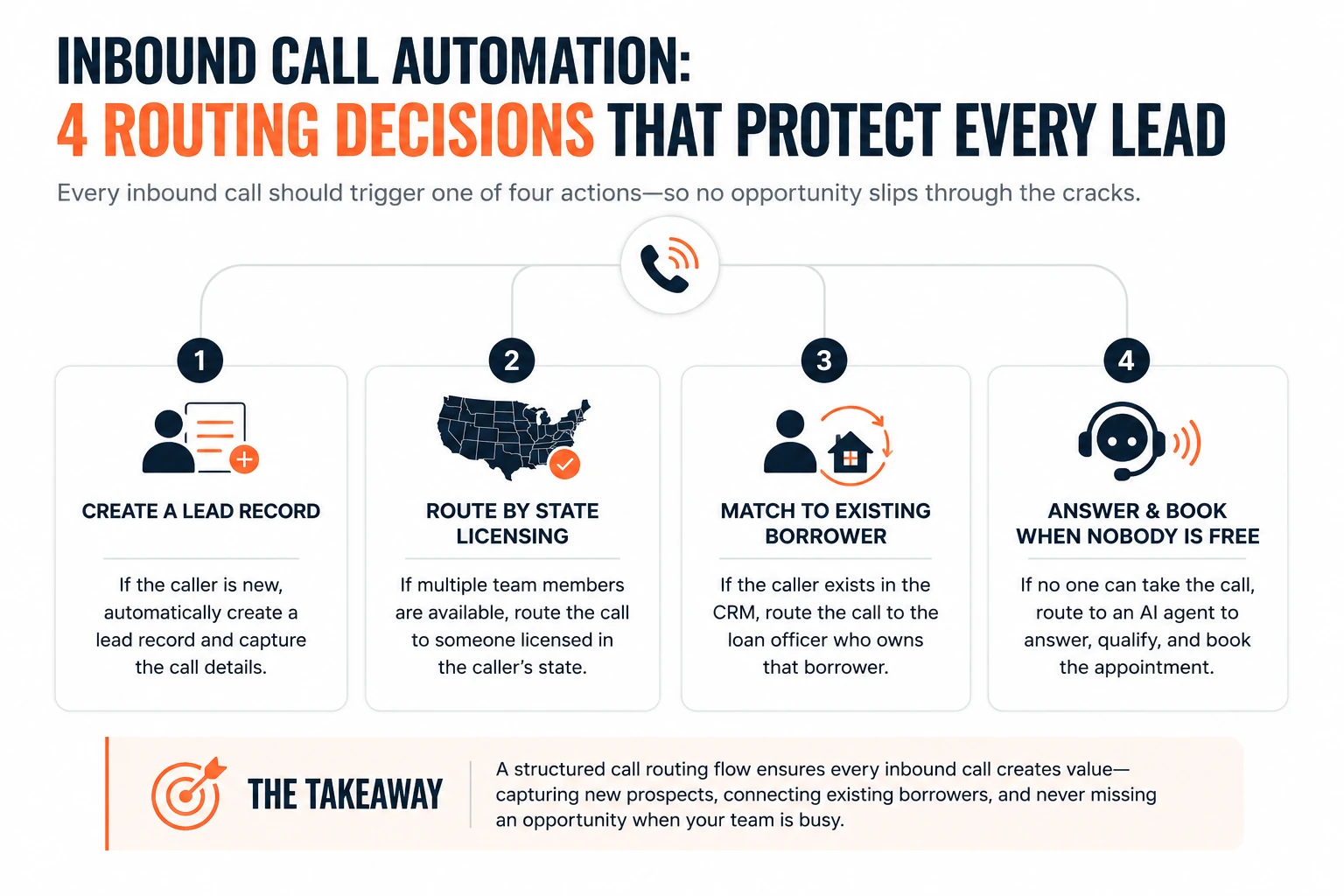
Four questions to ask on any demo:
Does an inbound call create a lead record? If not, the call never happened as far as your pipeline is concerned. No task, no source attribution, nothing to measure at month end.
Can the call route to an LO licensed in the caller’s state? An unlicensed LO taking that call is a compliance problem, not a routing preference.
If the number already exists, does it reach the LO who owns the record? A borrower mid-file lands in a general queue and re-explains their situation. That is a retention problem wearing a phone problem’s clothes.
The first three are routing questions, and lead management is where those rules live. Ask to see them configured, not described.
Is there an agent that answers and books when nobody can pick up? Not a recording. Something that qualifies and puts a time on the calendar.
We put numbers to the gap in the cost of missed calls for loan officers. What an AI agent does about it is covered in the mortgage AI agent.
Stage 2. Application
The gap between interested and a submitted 1003. Abandonment lives here and most teams cannot see it.
What breaks is simple. The borrower starts the application, hits a document they do not have on hand, and stops. Nobody notices because the half-finished record sits in the POS while the follow-up lives in the CRM.
What automation does about it:
- Document requests that fire on the missing item rather than a calendar
- Reminders that stop the moment the item arrives
- Status visibility so the borrower does not go quiet wondering whether anything happened
- Automatic format conversion, so a phone photo of a license arrives as a usable file
One distinction the rest of the internet blurs. Chasing a document during application is sales automation when your CRM does it. It is operations automation when your LOS does it. Different system, different owner, and a very different outcome when it fails.
If your CRM does it, an abandoned application becomes a follow-up task. If your LOS does it, an abandoned application is invisible, because there is no loan file yet.
The borrower-facing half of this is the POS. We compared nine of them in the best mortgage POS systems. Shape’s own portal is documented at the customer portal.
Stage 3. Loan process
Application to funding. This is the stage everybody complains about and almost nobody automates.
What breaks: the borrower submits and then hears nothing. So they call. The referring agent calls too, because they heard nothing either. Both calls land on the LO who is working the next file.
What automation does about it:
- Status updates that fire from LOS milestones rather than a person remembering
- Itemized condition requests, so the borrower knows exactly what is outstanding
- The referring agent copied on key milestones without anyone forwarding an email
- Documents pushed to the LOS on approval, not rekeyed
Vendors like to attach a percentage to this. You will see claims that automated updates cut status calls by half. Nobody has published a study behind that number, so treat the mechanism as the argument and measure your own.
The mechanism is not complicated. Every status call is a borrower asking a question your system already knows the answer to.
Mortgage workflow automation does the heavy lifting at this stage. It deserves its own treatment. We wrote up how workflow automation handles the file separately.
An automated mortgage workflow here is not a marketing sequence. It is a set of triggers reading loan status and acting on it.
Stage 4. Post-close retention
The biggest automation gap in the business, and the easiest to measure.
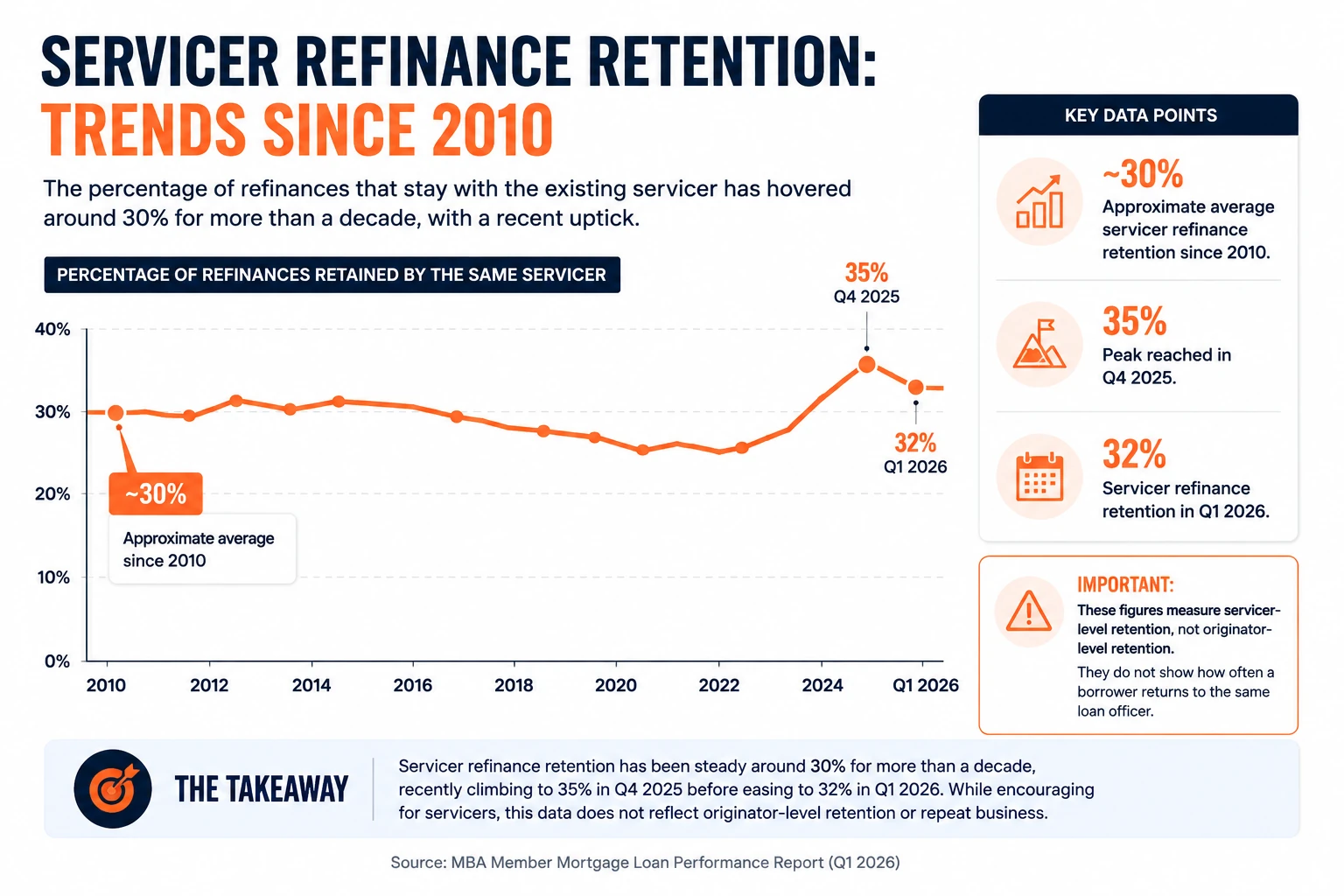
ICE data shows servicers have retained roughly 30% of refinancing borrowers since 2010. Two out of three go somewhere else. Retention peaked at 35% in Q4 2025 and fell back to 32% in Q1 2026. Refinance volume hit a four-year high in that same quarter. More opportunity, worse conversion on it.
Retention also peaks in the year after closing and declines from there. If your follow-up starts at the one-year anniversary, you started late.
One caveat that matters. Those figures measure whether a borrower refinances with the same servicer. They do not measure whether a borrower comes back to the same loan officer. Nobody measures that. There is no published number for originator-level retention, so treat the servicer data as directional.
What breaks: the relationship ends at the closing table unless something schedules it. There is no middle version where you stay in touch when you think of it.
What automation does about it:
- A cadence set once. Something useful at 30 days, again at 90, then quarterly
- Anniversary contact fired off the closing date, not a calendar reminder
- Equity check-ins driven by original balance and current estimated value
- Rate-drop alerts that fire when the number actually changes
The last two are the ones worth building first. A rate-drop note to a borrower 18 months in is a service, not a solicitation. That is why it gets answered.
All of it runs off loan data you already have. Closing date, original rate, original balance, estimated value. Four fields.
Set once, in campaigns, and it runs for years without anyone touching it.
What automation should not do
Nobody selling this software writes this section, so here it is.
Anything requiring judgment about a borrower’s situation. A declined file, a credit event, a co-borrower coming off the loan. Those are phone calls.
First contact on a referral. Somebody vouched for you personally. An automated text as the opening move spends the trust that got you the introduction.
Anything that fires without consent. Covered below, and it is the one that carries real cost.
Anything you would be uncomfortable having read back to you. If the message only works because the borrower assumes a person wrote it, it is the wrong message.
The consent layer
Every stage above involves calling or texting a borrower, which puts all of it under the TCPA. Most automation guides skip this entirely.
The standard is prior express written consent under 47 CFR 64.1200. It applies to automated calls and texts to a wireless number, and it is per-consumer, not per-campaign.
The FCC’s one-to-one consent rule was vacated by the Eleventh Circuit in Insurance Marketing Coalition v. FCC on January 24 2025, three days before it was due to take effect. The underlying consent obligation survived. The rule that changed was the paperwork around it, not the requirement.
Federal TCPA filings ran 1,532 through June 2026, up 34.3% year to date. Putative class actions were 76.4% of June filings. Statutory damages run $500 to $1,500 per call or text, trebled for willful violations. Per message, so a campaign compounds quickly.
For A2P messaging you also need 10DLC registration. That is table stakes now, not an advanced feature.
Text carries most of the volume in practice, and the platforms differ more on messaging than on anything else. Consent state, opt-out propagation, and quiet-hours enforcement are where that difference shows up. See the best CRM for SMS and text messaging.
The tooling side of this is opt-in capture, opt-out propagation, and DNC scrubbing. Ours sits in compliance and security.
This is Shape’s operating read, not legal advice. Take your consent language and your campaign scope to your own counsel before you turn anything on.
How to start
Pick the stage where you are losing the most, not the stage that is easiest to automate.
If leads go cold before anyone calls, start at intake. If applications stall, start at stage two. If your borrowers call for status, start at stage three. If your database has thousands of past clients and produces no repeat business, start at four.
Most shops start at intake because it is the loudest. Retention is usually worth more, and it is always cheaper, because those people already chose you once.
The platform that handles all four without three integrations is the one to look at. That is what purpose-built for how lenders work means in practice.
Frequently asked questions
What is mortgage automation?+
Mortgage automation is software handling repetitive work across the borrower relationship. It runs in four places. Lead intake and response, the application process, the loan process through funding, and post-close follow-up.
Different systems own different stages. Your LOS handles the loan file. Your POS handles the borrower’s application experience. Your CRM handles everything before and after a loan file exists.
What is the difference between mortgage sales automation and mortgage process automation?+
Mortgage sales automation covers lead routing, response speed, follow-up cadence, and past-client work. It runs in your CRM. Loan officer automation is the same thing described from the seat.
Mortgage process automation covers document handling, underwriting workflow, and back-office tasks. It runs in your LOS or a dedicated platform.
Both are real and they are different purchases. A guide that treats them as one subject is describing half of each.
How fast should you respond to a mortgage lead?+
Immediately on purchased leads, inside the first hour on everything else. Referrals will wait.
No study establishes a response-time standard for mortgage specifically. Cross-industry research shows the first hour is worth 7 times the odds of qualifying a lead. Against a full day, 60 times. Those measure qualification, not funded loans.
What should mortgage automation not handle?+
Anything requiring judgment about a borrower’s situation, including declines, credit events, and structure changes. First contact on a referral, because an automated opener spends the trust that produced the introduction. And anything sent without documented consent.
Does mortgage automation create TCPA risk?+
It creates exposure if consent is not documented. Automated calls and texts to wireless numbers require prior express written consent under 47 CFR 64.1200, per consumer.
Federal TCPA filings were up 34.3% year to date through June 2026. Statutory damages run $500 to $1,500 per message, trebled for willful violations. Automation makes volume easy, which is exactly why the consent record has to come first. Confirm your approach with counsel.