Your past client is not forgetting you. They are refinancing before you thought they would.
Client retention for loan officers gets taught on a purchase cycle of five to seven years. Send a newsletter, mail a card, call at the anniversary, stay top of mind until they move house. Client retention gets treated as a memory problem, solved by being remembered.
The servicing data says something different. The average borrower doing a rate-and-term refinance in early 2026 had been in their previous mortgage 19 months. Not five years. Nineteen months.
Client retention is worse than the advice assumes
The servicer retention rate peaked at 35% in the fourth quarter of 2025, the strongest reading since early 2014. It has fallen in both quarters since, to 32% and then 31%.
Read the peak first. At the best retention this industry has managed in twelve years, two out of three borrowers still left. Which side of that number you land on is largely the mortgage CRM decision. Keeping a borrower means catching the moment they are ready to move.
The first decline came while volume was climbing. An estimated 585,000 first-lien refinances closed in the first quarter of 2026, more than double a year earlier. Refinances made up nearly 44% of all originations. More opportunity, worse retention, which ICE noted broke the usual pattern where falling rates and rising volume lift retention together.
The second decline had a cause ICE names. The market shifted back toward cash-out, which is harder to retain. Cash-out reclaimed the majority at roughly 63% of June refinances. A cash-out borrower moves on a life event rather than on a rate. Their timing is not visible in a rate table.
Retention halves every two years of loan age
This is the number that should change how you plan.
ICE tracks retention by the vintage of the loan being refinanced. The curve has held its shape across four straight quarters.
Loan being refinanced
Share retained
Most recent vintage
51%
One year older
42%
Two years older
38%
Three years older
30%
Four years older
24%
Five or more years older
20% and falling to 10%
A loan closed last year, you keep half the time. A loan closed four years ago, you keep one time in four. Older than that and it approaches one in ten.
Retention does not decline gently with age. It falls off a cliff, and most follow-up plans are still in their warm-up phase when the cliff arrives. Borrower retention is decided in the first two years, and almost everything written about it is about year five.
The mechanism is not memory
ICE describes what drives retention in plain terms. Under normal conditions, falling rates and rising volume lift retention. Lenders scan their existing portfolios and recent lending books, identify borrowers with refinance incentive, and market to them.
Read that again. Retention comes from scanning a portfolio for incentive.
It does not come from being liked, and it does not come from being remembered. The competitor who takes your past client is not more memorable than you. They ran a query.
That is why the newsletter underperforms. Not because it is bad content. Because it is undated. It arrives on the first Tuesday of the month whether or not the borrower is in the money. The lender who reaches them the day their threshold clears wins, regardless of who sent the nicer email.
Past client follow up that is not triggered by a condition is a calendar habit rather than a retention system. This is where a top mortgage CRM software decision matters. Scanning a book against a moving rate is not something anybody does by hand.
Marketing the same list twice does not work either
There is a caution in the Q1 2026 data worth sitting with.
Retention on 2022 to 2025 vintage loans dropped from 44% to 40% in the quarter. Those borrowers made up a larger share of refinance volume than before. ICE’s read is that lenders marketed hard to those relationships in the fourth quarter, then hit burnout in the first.
The same list, worked hard twice in a row, produced a worse result the second time.
That is an argument for segmentation rather than volume. A campaign that goes to everyone every time a rate moves teaches the book to ignore you. The next real opportunity then lands in a list that has stopped opening.
Banks retain at well under half the rate of non-banks
In the second quarter of 2026, non-bank servicers retained 37% of refinancing borrowers. Banks retained 14%.
The gap has held for more than a year across three rate environments, and it widened last quarter. Bank retention fell seven points while non-bank retention fell two. ICE puts non-banks at roughly two and a half times the bank rate.
Our read, and it is a read rather than a finding: the gap is structural. A non-bank’s mortgage division is the business, so the portfolio scan is somebody’s job. At a bank, mortgage is one product among many. The borrower relationship sits with the institution rather than with the lending team. Nobody is watching that book specifically, so nobody catches the incentive when it appears.
Retention also varies by product. FHA and VA led at 36%, GSE at 25%, portfolio at 23%, and privately securitized loans at just 6%.
What triggers a past client to leave
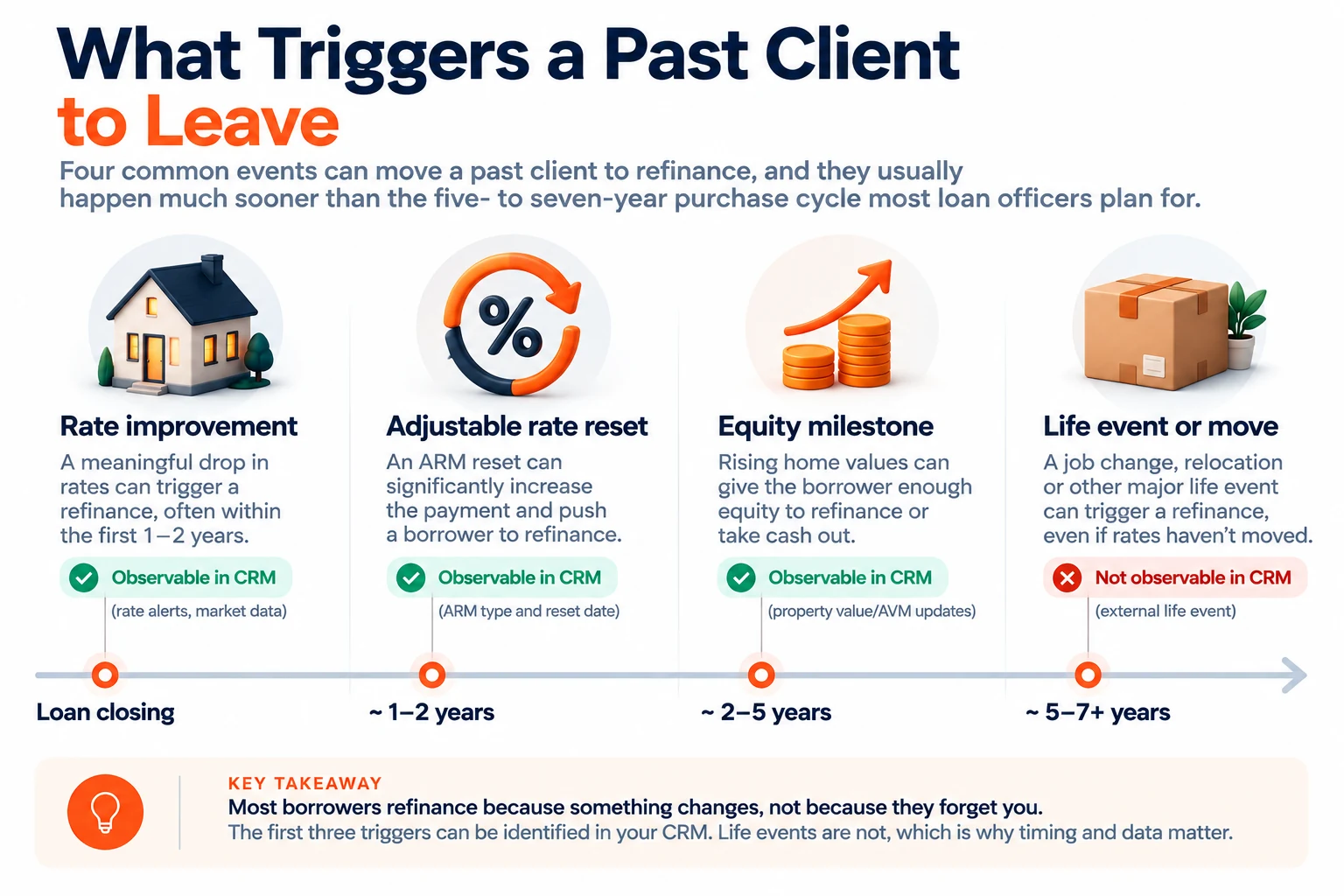
Four things move a borrower, and three are observable.
Rate crossing their threshold. The largest single driver, and the only one with a precise date. It is knowable in advance for every loan in your book.
Equity reaching a level. Drives cash-out and second liens. Homeowners withdrew $52 billion in equity in the fourth quarter of 2025.
A life event. Not observable, which is what makes cash-out retention harder than rate-and-term.
Servicing transfer. The loan gets sold, the new servicer markets to that borrower, and the relationship quietly moves. Nobody tells the loan officer.
What a retention system actually does
Four things, and none of them is a newsletter.
Watches a rate threshold per borrower. Not a blanket alert when rates move. A per-loan threshold based on their actual rate. The alert fires for the eleven borrowers in the money rather than for all nine hundred.
Tracks equity. Enough to know who could take a second lien without refinancing away from their first.
Runs a post-close sequence with an end. Defined, finite, and handing off to the monitoring above rather than running forever.
Puts the annual review on a calendar rather than in an intention. It surfaces changed circumstances, so the annual review works as a calendared event rather than as an intention.
The database work underneath is its own discipline. What the book needs before any of this fires correctly sits in mortgage database management. Once it does, mining your database for refi opportunities is the specific play these numbers argue for.
Figures we left out, and why
Three numbers circulate widely in this category and none of them is here.
That roughly 70% of customers forget their mortgage loan officer within 13 months. This is the most quoted figure in retention content. It appears on several pages ranking for this subject. We could not find a study behind it. No named researcher, no sample size, no year, no institution. A search for its origin returns the claim repeated on vendor pages and nothing else.
That lenders take 48 hours on average to respond to a customer inquiry. No stated source and no denominator.
That the top 500 independent mortgage banks are missing $108 billion in recapture opportunity. Leaders, it claims, miss 64% of repeat-borrower chances. The study is unnamed and the vendor citing it sells a recapture product.
Every figure in this article comes from a named ICE Mortgage Monitor report with a stated quarter. Retention is measurable. Guessing at it is a choice.
Frequently asked questions
What is a typical client retention rate for a loan officer?+Servicers retained 31% of refinancing borrowers in the second quarter of 2026, down from 35% two quarters earlier. That is the servicer-level figure rather than an individual officer’s. Retention is far higher on recent loans and falls sharply with loan age. A book weighted toward older originations performs below the headline number.
How long after closing does a borrower refinance?+Sooner than most follow-up plans assume. The average rate-and-term refinancer in the first quarter of 2026 had been in their previous mortgage for 19 months. Retention is strongest on the newest loans at 51% and falls toward 10% on the oldest. The window that decides borrower retention opens early and closes fast.
Why do banks retain fewer borrowers than non-banks?+Non-bank servicers retained 37% of refinancing borrowers in the second quarter of 2026 against 14% for banks. Our read is structural rather than cultural. At a non-bank, mortgage is the business and somebody owns the portfolio scan. At a bank, mortgage is one product and the relationship sits with the institution. Nobody watches that book specifically.
Does a monthly newsletter improve client retention?+Not on its own. Retention comes from identifying borrowers with refinance incentive and reaching them when it appears. ICE describes that as scanning existing portfolios and recent lending books. A newsletter arrives on a schedule rather than on a condition. It supports the relationship. It does not put you in front of the borrower the day their threshold clears.
Kevin Benner is the Chief Revenue Officer at Shape Software, where he leads revenue, marketing, and customer growth. He brings over 23 years of experience in mortgage lead generation and sales technology.
Meta is the easiest way to put a mortgage offer in front of a million people. It is also the easiest way to fill a pipeline with leads who never meant to talk to you. Which one you get depends on three things: who sees the ad, what it says, and how fast someone calls. […]
A one-person brokerage can now reach the same feed as Rocket or loanDepot. That is the real change social media brought to mortgage. A national lender buys attention with ad budgets and brand campaigns. On social, a broker or loan officer earns it with a face, a voice and a weekly habit. That is what […]
LinkedIn for loan officers is a referral and reputation channel, not a lead machine. Set the profile up once, then give it 30 minutes every week. The consistency is what pays, not the exact routine. Every post clears compliance first, and every new connection lands in your CRM. What LinkedIn for loan officers actually does […]