Database Marketing for Loan Officers
Database marketing for loan officers means working the book you already closed instead of constantly building a new one. That is the whole idea, and the reason it fails is never the idea.
It fails because nobody owns it. New leads have urgency attached. A borrower you funded in 2022 has none, right up until the week they call someone else.
This guide covers what to do with a database you have not touched in two years. Segmentation, the events worth calling about, what to send, and how to tell whether any of it worked.
What Every Guide Already Says
Your past clients trust you. It costs less to keep a client than to find one. Stay top of mind. Send a card on the loan anniversary.
All true, all in every article on this subject, and none of it survives contact with a Tuesday. You have 400 contacts, no time, and a pipeline to work. “Stay top of mind” is not an instruction.
The rest of this page assumes you agree with the premise and want the mechanics.
Mortgage Database Segmentation Comes Before Everything Else
Most loan officers have a contact list, not a database. The difference is whether you can ask it a question.
Can you pull everyone with an ARM resetting in the next twelve months? Everyone who closed above 6.5%? Everyone in a ZIP where values moved 15%? If the answer is no, segmentation is the work, and everything downstream waits on it.
That is a data problem before it is a marketing problem. Read the hygiene standards we recommend before building campaigns on a list you have not cleaned.
The Segments That Actually Produce
Four cuts do most of the work.
Rate. Everyone above today’s rate by a meaningful margin. This is your refi list and it rebuilds itself every time the market moves.
Loan type and reset date. ARMs with a known adjustment date are the most predictable calendar you will ever have. The date is in the file.
Equity position. Original loan amount against an estimate of current value. This is the HELOC and cash-out list.
Closing date. Anniversary timing, and the cohort question. People who closed in a single quarter share a rate, a market and a set of problems.
Everything else is a refinement. Start with these four and you have a year of reasons to call.
The Fields You Need in the Record
None of the four cuts works if the data is not there. Check for these before you plan a campaign.
Original rate and original loan amount. Both are in the file and both go missing in CRM migrations more than anything else.
Loan type, and for ARMs the first adjustment date. A fixed-rate flag with no product detail is not enough to build a reset list.
Closing date, property address, and a current value estimate. Address is what lets you attach a value feed later. Without one you cannot run equity segments at all.
Consent state and its date. This decides what you can send. It is also the field most likely to be blank after a migration.
If most of your book is missing two of these, the first project is enrichment, not marketing. That is worth knowing before you build a campaign calendar you cannot execute.
What You Do Right After Closing Decides the Next Loan
Retention is mostly settled before the relationship goes quiet. Almost no page on past client marketing for loan officers treats the post-closing window as a separate job.
A borrower who just closed has a clear memory of the process and no competing offers yet. That is the only window where you are the obvious answer rather than one of several. What you do in it sets whether they remember your name in four years or remember only the servicer’s.
Three things belong in that window.
Set the expectation that you stay in touch. Say it out loud at closing. A borrower told to expect an annual call receives one differently from a borrower who has heard nothing since funding.
Explain the servicing transfer before it happens. Most borrowers do not know their loan will be sold. The transfer notice is the moment they stop thinking of it as your loan. Getting ahead of that is the single cheapest retention move available.
Ask for the referral while the experience is current. Referral intent decays fast. The gap between a closing and the first referral ask is usually months. By then the story they would have told has faded.
Once the file is cold, the relationship moves to the schedule and the events. While it is still warm, it is still the loan.
Referrals Are a Separate Output
A database produces two things and most guides treat them as one.
Repeat loans come from events. Referrals come from timing and from asking, which is a different motion with a different cadence.
The practical difference is who you work. Your repeat list is everyone whose loan has a reason to move. Your referral list is everyone who had a good experience, regardless of whether their own loan will ever move again. A borrower who closed at 3% in 2021 is dead on the refi list. They may be your best referral source.
That is also the argument against judging database work on recapture alone. A book that produces no refinances can still produce loans, and measuring only recapture makes that book look dead.
The Four Events Worth Calling About
A reason to call beats a schedule to call on. Four events give you one.
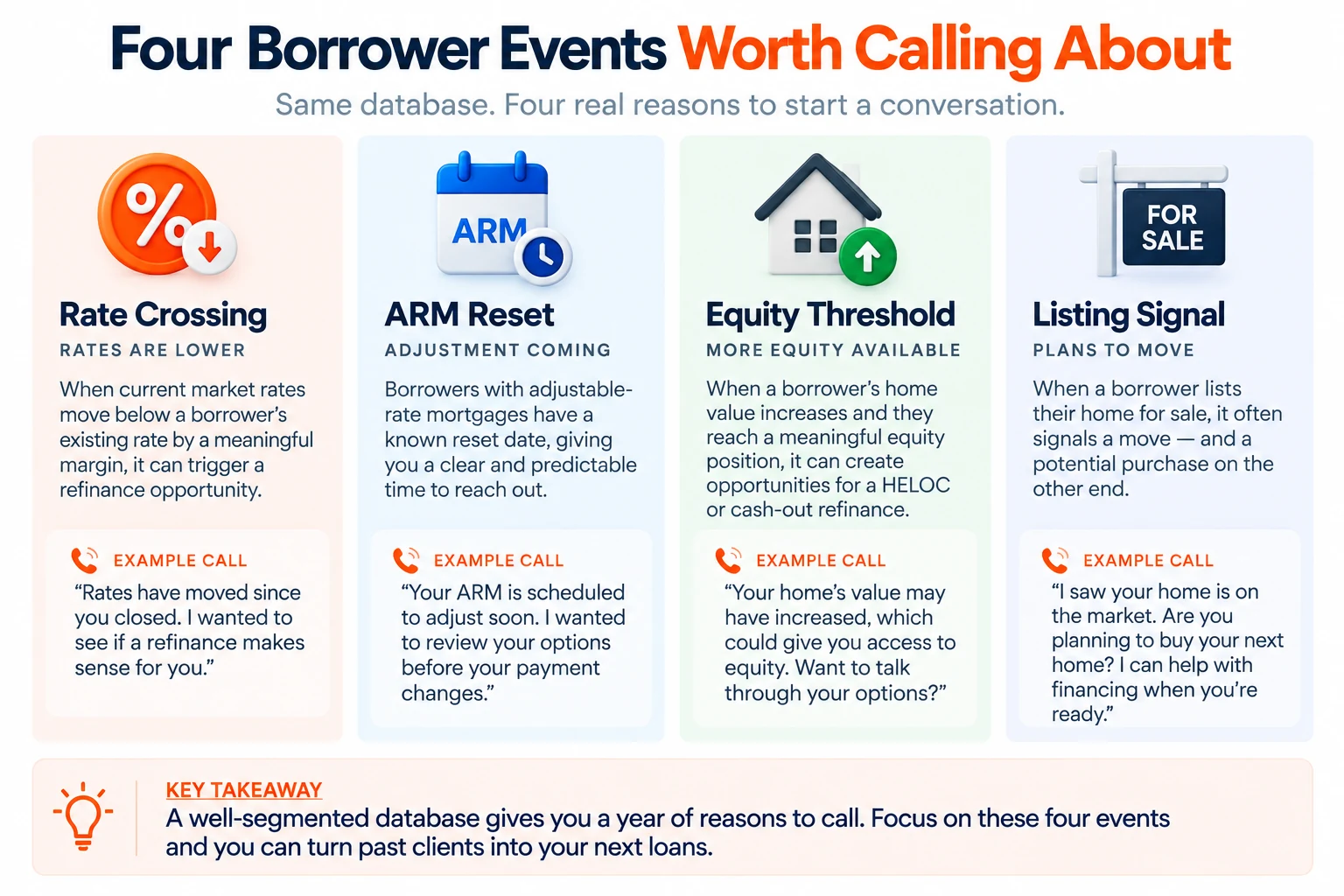
The rate crosses their number. Not a generic rate drop. Their rate, their balance, their break-even. A call that opens with a number specific to their loan is a different conversation from a newsletter.
Their ARM is approaching adjustment. You know the date. They may not have thought about it since closing. Six months out is early enough to be useful and late enough to be real.
Their equity crossed a threshold. Enough for a HELOC, enough to drop mortgage insurance, enough to consolidate. The trigger is a value estimate, not a guess.
They are about to list. Listing alert monitoring catches the client who is moving before the moving company does. This is the one most originators find out about too late, usually when a new lender’s verification request arrives.
Each of those is a spoke in the cluster index below. Each has enough in it to be its own answer.
What Does Not Count as an Event
A holiday. A quarterly newsletter. The fact that it has been a while.
Those are schedules, not events. They keep you visible and they do not produce a call. Confusing the two is why most database marketing reads as noise.
Run both. Just do not expect the schedule to do the event’s job.
Mortgage Database Marketing: What to Send and How Often
Two channels carry this. Email carries the schedule. The phone carries the event.
That division matters because the failure mode is using email for the event. A refinance opportunity specific to one borrower’s loan does not belong in a monthly send. It is worth a call, and treating it as a campaign is how it becomes a competitor’s loan.
Frequency. Monthly is safe for a schedule send. Quarterly is safe if monthly means the content gets thin. More than monthly and you are training people to ignore you, which costs more than the send saves.
The unsubscribe is not the number to watch. The number to watch is whether anyone replies. A list that never unsubscribes and never answers is a list nobody reads.
Compliance still applies, and the line is the method. Calling a past customer by hand does not require renewed consent. The moment an automated dialing system or an AI voice agent places the call, consent does. Same borrower, different rule, decided by how you dial. This is our operating read and not legal advice, so take TCPA questions to your own counsel before turning anything automated on.
Measuring Database Marketing for Loan Officers
Three numbers, and none of them is opens.
Recapture rate. What share of your closed loans that refinanced came back to you. This is the number the whole subject exists to move.
Return rate on purchase. Whether a past client used you for their next house. Slower, and the better signal, because it survives a rate environment.
Churn. What share of your book left in a period. A rising churn rate tells you the problem before the recapture rate does.
Set the baseline before you start. The most common version of this work runs campaigns for a year and cannot tell whether they did anything. Nobody recorded where things stood at the start.
Whether you can report any of this depends on the system. Most platforms track new leads well and closed borrowers badly. Which mortgage CRM fits a loan officer compares them on what they do with a past-client book.
Calculating Recapture Without Fooling Yourself
The denominator is where this goes wrong.
Recapture rate is the share of your past borrowers who refinanced and came back to you. The numerator is easy. The denominator is every past borrower who refinanced with anyone, and most originators do not have that number.
What they use instead is total past borrowers. That produces a rate that looks terrible in a high-rate market and excellent in a low one. It measures the rate environment, not your work.
It also moves when you do nothing at all, which is the tell.
Two ways to get closer. Run a quarterly check against public records or a monitoring service to see who transacted. Or narrow the denominator to borrowers who were plausibly in the money, using the rate segment you already built.
Neither is perfect and both are better than dividing by the whole book.
Allow for lag. A campaign run in March shows up in closings in May or June. Reading the number monthly produces noise. Quarterly is the shortest interval that means anything.
Where This Breaks
It breaks on availability, and that is physics rather than discipline.
A producing loan officer is the least available person in the shop. The database work is never urgent, so it loses every day to something that is. That is not a character flaw and no amount of intention fixes it.
Two things do. Put the events on a system that surfaces them instead of waiting for you to remember. Give the schedule send to someone whose job it is. A mortgage CRM with automated marketing is the difference between a list that produces and a list that sits there.
The second thing is picking fewer plays. Four segments and four events is a complete program. Most originators try to run twelve, run none of them for long, and conclude the database does not work.
Figures We Left Out
Recapture benchmarks circulate widely in this category and none appear on this page.
The figures we found were vendor-published without a stated denominator, or repeated across pages with no traceable origin. Servicers and originators also measure recapture differently. Two numbers describing the same thing routinely differ by a factor of three.
Your own recapture rate is the only one worth managing against. You can calculate it from your own closings this week.
Frequently Asked Questions
What is database marketing for loan officers?+
Working your existing contacts for repeat and referral business instead of starting over with new ones. It covers past borrowers, pre-approvals that never closed, and old leads.
The work is segmentation first, then reaching out on events specific to each borrower rather than on a calendar.
How often should you contact past clients?+
Monthly at most for a general send, quarterly if monthly makes the content thin. Event-driven outreach is separate and has no schedule, because it fires when something changes in that borrower’s situation.
Watch reply rate rather than unsubscribe rate. A list nobody leaves and nobody answers is a list nobody reads.
What is the best way to segment a mortgage database?+
Four cuts do most of the work. Current rate against today’s rate, loan type and ARM reset date, estimated equity, and closing date. Each produces a list with a reason to call attached.
Everything else is refinement on top of those four.
Does the TCPA apply to past clients?+
It depends on how you reach them. Calling a past customer by hand does not require renewed consent. Calling or texting with an automated dialing system or an AI voice agent does.
The distinction is the method, not the relationship. This is our operating read rather than legal advice, so confirm your setup with your own counsel.