Mortgage Call Script Examples for Every Hard Moment
Most script libraries write the opener and stop. The opener is not where you lose deals.
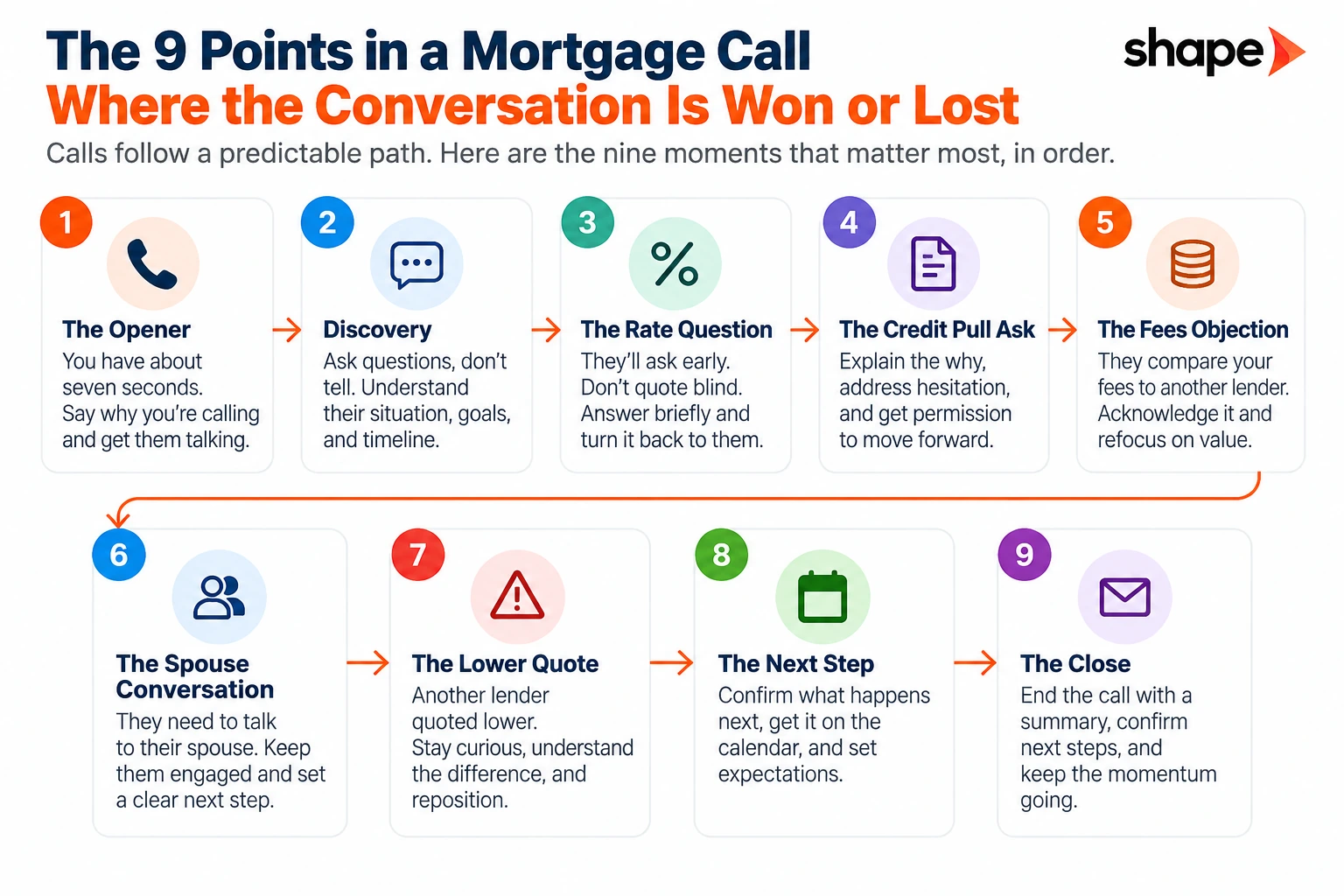
You lose them somewhere else. The borrower asks for a rate before you know anything. You ask to pull credit and hear hesitation. They say the other lender quoted lower. They need to talk to their spouse and you never hear back.
These are mortgage call script examples for those moments. Actual lines, and why each one works.
How to Use These Mortgage Call Script Examples
A script is a skeleton, not a monologue. These loan officer call scripts work the same way.
Pick four or five of these, run them until you stop hearing yourself say them, then stop reading. Officers who sound like a call center are reciting. Officers who sound confident have said the same lines so many times they forgot they were lines.
Read every one out loud before you use it on a borrower. Anything you would not say naturally, change until you would.
One pattern runs through all of them. Almost every line below is a question, not a statement. That is deliberate.
A statement invites agreement or argument. A question makes the borrower say something. What they say is worth more than anything you were going to tell them. It also keeps you out of the position every borrower expects you to take, which is defending yourself.
Tone matters as much as wording. Curious rather than eager. When you ask “how’s that been going?” it has to sound like you actually want to know.
The First Call on an Internet Lead
You have about seven seconds. Spend them naming why you are calling, then get them talking.
“Hi [Name], this is [You] with [Company]. You just looked at refinance rates on [site]. What’s got you thinking about refinancing right now?”
Notice what that is not. It is not a yes-or-no question.
“Do you have thirty seconds?” invites one word and half the time that word is no. “Did I catch you at a bad time?” hands them the exit. Every set of mortgage call scripts on the internet opens with a permission question, and permission questions get declined.
An open question forces a sentence. A sentence is where trust starts. They are talking about themselves instead of deciding whether to hang up.
You already know why they filled out the form. They told the site. So do not spend the call establishing what you already have. Spend it getting them to say it in their own words. What they say will not match the form.
Never open with “how are you today.” It identifies the call as a sales call before you finish the sentence.
Then keep asking rather than telling:
“How long have you been in the house?”
“What are you paying now?”
“What would make this worth doing for you?”
That last one is the whole call. Whatever they answer is what you sell against for the next twenty minutes.
One note on cold outreach specifically. If the number was not an inbound inquiry, DNC obligations and state calling-hour limits apply. You also cannot call into a state you are not licensed in. Confirm your list and your licensing before you dial, and take the specifics to your compliance officer.
“What’s Your Rate?”
The most common first question in this business, and the fastest way to lose a file.
Quote blind and one of two things happens. You are high and the call ends. Or you are low and cannot hold it once you know the real scenario.
Do not lecture them about why quoting is hard. Nobody wants a lesson. Answer with a question and keep moving.
“Depends on a few things. What rate are you at now?”
That is it. One sentence of answer, then straight back into qualifying. You did not refuse and you did not quote.
Keep going:
“And what’s the balance?”
“How’s your credit looking, roughly?”
“Is this the primary or a rental?”
Three more questions and you have what you need. They will answer all of them, because they think each one is getting them closer to the number.
If they push hard, give a real range and move without asking permission:
“For someone in the low sevens on a primary, we’re seeing [range] this week. Let’s find out where you land. What’s your credit score if you had to guess?”
Do not end with “want to go through them?” That is a permission question and they can say no. Assume the next step and ask the first qualifying question instead.
“I’m Already Working With Someone”
Do not argue, do not disparage, and do not pitch against them. Ask.
“Oh, okay. How’s that been going?”
Then stop. Say nothing.
That question does more than any rebuttal because it invites them to tell you what is wrong. Most of the time something is, or they would not have filled out another form. If nothing is wrong, you find that out in five seconds instead of ten minutes.
When they finish, ask the question that matters:
“So what made you fill out the form then?”
Neutral tone. Genuinely curious, not accusing. They did fill out the form while working with someone, and that gap is the whole opportunity. Let them explain it.
Whatever they say next is your entire path forward. Rate, responsiveness, something the other officer did not answer. You are not overcoming an objection at that point. You are working the reason they called you.
Asking for the Credit Pull
The hardest ask in a first call, and most officers soften it until it stops being an ask.
Do not apologize for it and do not explain the mechanics unless asked. And do not ask permission, because “ready?” gets a no.
“What would be more useful to you, a ballpark I’m probably wrong about, or the actual number?”
They pick the actual number. Everyone does. Now the credit pull is their idea.
“Then let’s pull credit. Two minutes, soft look at this stage, won’t move your score.”
Then stop talking. The pause does the work.
If you hear hesitation, do not defend it. Ask what the hesitation is about.
“What’s the concern?”
Neutral tone. Then handle whatever they actually said rather than what you assumed they meant. Half the time it is the score hit, which you already answered. The other half it is that they do not trust you yet, and no explanation fixes that. Another question might.
“Fair. What would you need to know before you’d be comfortable with it?”
That hands them the standard and then you meet it.
“Your Fees Are Higher”
The comparison is almost never apples to apples, and saying that out loud sounds defensive. Most mortgage objection handling scripts stop at the rebuttal. Do this in three parts instead.
Do not defend the fees. Ask what they are comparing to.
“Higher than what?”
Three words. Let them produce the other quote. Most of the time they cannot. What they usually have is a rate with points baked in and no fee sheet.
Then ask about the part they have not looked at.
“What are they showing you for the rate on that one?”
“Is that locked, or floating?”
“Any points in it?”
You are not arguing. You are asking three questions they probably cannot answer, and they will hear themselves not answering.
Then let them do the math out loud.
“So if their rate is a quarter higher and mine has the fee, which one costs you more over the five years you’ll actually keep this loan? Want me to run both?”
The last question is safe to ask because you already know the answer. And you never told them they were wrong. They worked it out.
If theirs really is better, say so and mean it. You will get the referral.
“I Need to Talk to My Spouse”
Sometimes real, sometimes a soft no. Find out which before you schedule anything.
“Sure. What do you think they’re going to say?”
That question is the whole section. If they know exactly what their spouse will say, the spouse is not the obstacle. You just found the real one. If they genuinely do not know, it is a real objection and now you schedule.
“Makes sense. When are you both in the same room next? I’ll call then so you’re not relaying numbers secondhand.”
Two decision makers on one call, at a time they picked.
What loses this file is “sure, give me a call after you talk.” Nobody calls back.
Voicemail and the Follow-Up Text
Most calls go to voicemail. Treat the voicemail as the first half of a two-part message.
“Hi [Name], [You] with [Company], calling about the rate quote you looked at this morning. I have your numbers ready. I am at [number] until six, or I will try you again tomorrow morning.”
Short, specific, and it names a reason. Then text within a minute:
“Hi [Name], [You] from [Company]. Left you a voicemail about your rate quote. Easier to text? Happy to send the numbers here.”
The text is what gets answered. The voicemail is what makes the text make sense.
Ending Every Call With a Scheduled Next Step
One line, and it separates a pipeline from a list.
“I am going to send those numbers over in the next ten minutes. Let’s put fifteen minutes on the calendar Thursday to go through them. Morning or afternoon better?”
Assume the appointment. Offer two choices rather than asking whether they want one. Every call ends with something on a calendar or it ends with nothing.
Past Clients and Rate-Drop Calls
Warm calls are a different job. They know you, so the opener is not the problem. Relevance is.
“Hi [Name], [You] from [Company]. You closed with me in [month, year] at [rate]. Rates moved enough this week that I ran your numbers again. Worth two minutes?”
That works because it proves you did something before calling. A generic check-in from a past lender reads as a solicitation. A specific number reads as service.
What the Recordings Show About Scripts for Mortgage Calls
Two things, and they both cut against how most people use a script library.
Tone carries more than wording. The same line lands differently depending on whether the officer sounds like they are reading.
And reading word-for-word backfires. A borrower can hear it, and hearing it costs more than a slightly worse sentence would have.
Which is why the instruction at the top matters more than any line below it. Rehearse until you stop reading.
Where the Scripts Have to Live
A script library in a document is a script library nobody uses.
The version that gets used is attached to the record. The right script surfaces when the officer opens the contact, based on where that opportunity actually is. That is what separates a loan officer CRM system from a shared drive full of PDFs.
Same for the follow-up. A voicemail script only works if the text goes out a minute later. That only happens if the system sends it.
We compared platforms on that specifically in our mortgage CRM comparison.
Frequently Asked Questions
What should a mortgage call script include?+
A reason for calling. One discovery question. A response for the two or three objections you hear most. And a line that schedules the next step.
Skip the pleasantries and skip the company history. Every second before the reason for calling is a second you could lose them.
How long should a mortgage call script be?+
Long enough to say out loud in under fifteen seconds per section. Anything longer is a monologue and it will get interrupted, which means you never delivered the part that mattered.
Write them as skeletons. Four or five lines you can run in any order.
Should loan officers read scripts word-for-word?+
No. Borrowers can hear it, and it costs more than an imperfect sentence would.
Rehearse until the lines stop feeling like lines. The goal is that you could run the conversation while thinking about something else.
Why are there no statistics on this page?+
Because the ones circulating are made up. Two pages currently ranking for this term attribute figures to the Mortgage Bankers Association and Freddie Mac. Neither organization publishes them.
Neither of them researches sales scripts. We would rather give you the lines.