Mortgage Lead Distribution: How to Route Leads and Inbound Calls
Lead distribution decides three things. Who gets the lead, how fast they get it, and what happens if they do nothing with it.
Most software comparisons stop at the first one. The other two are where the money is.
This page is about routing inside your own shop. If you came looking for ping-post, it is a different subject wearing the same name. That is publishers selling one record to five buyers.
The wider picture of what happens after a lead lands is in routing, prioritizing, and working leads.
Shared or Owned Is the Decision Underneath Everything Else
Before any routing rule matters, you pick a model. Most buyers never make this decision explicitly, which is why their configuration fights them later.
Shared
Cadence beats ownership. The lead gets called inside the window by whoever can call it.
The point is being first. A new lead should not sit for an hour with an officer who is in a meeting. The borrower is not waiting for that officer. They are waiting for anyone, and increasingly they are talking to someone else.
Shared suits purchased volume, internet leads, and anything where several lenders hold the same record.
Shared does not mean nobody owns it. Ownership vests at the first real conversation. Whoever actually speaks to the borrower owns the file from that point.
And it can be forfeited. A partial application that stalls for three days is a neglected opportunity. Neglected opportunities should become available to somebody else. That is what a shark tank is for.
Which is why redistribution is part of distribution rather than a separate feature. The rule that grants ownership and the rule that takes it back are the same configuration.
Owned
One named person is responsible for converting it, start to finish.
This is nearly always right for self-generated business and for referrals from relationships the officer built. The relationship is the asset and it does not transfer. Handing a realtor’s referral to the next available body damages the thing that produced it.
Almost nobody is purely one
That is the part the feature lists skip, and it is the whole buying criterion.
A shop buying leads and working referrals needs both models running from one intake. Purchased leads routed on availability. Referrals routed to the person who earned them. Same system, same day, different rules.
So the question to ask a vendor is not whether they do round robin. It is whether they can distribute differently by source.
One naming warning, because the industry uses the phrase twice. A shared lead in the lead-buying sense is a record sold to several lenders. The shared model here means cadence beats ownership. Unrelated meanings, same two words.
Eligibility First, Then Method
This is the structural point everything else sits on, and it is where most configurations go wrong.
The distribution rule decides who is eligible. State licensing, availability, team, department, source. Settled before anything is handed out.
The method decides which eligible officer gets it. Round robin and the rest are options inside that rule, not separate systems.
Order matters more than it sounds. A fairness rule that runs before a licensing filter distributes leads evenly to people who cannot legally take them.
It also explains something that otherwise looks strange. A lender can run one method during business hours and another after hours on the same pipeline. Those are two rules with run schedules, not two platforms.
Where these rules actually live is the configuration layer this page keeps pointing at.
Push, Pull, and Broadcast
Every method is solving the same problem. Knowing who is actually free. There are three answers.
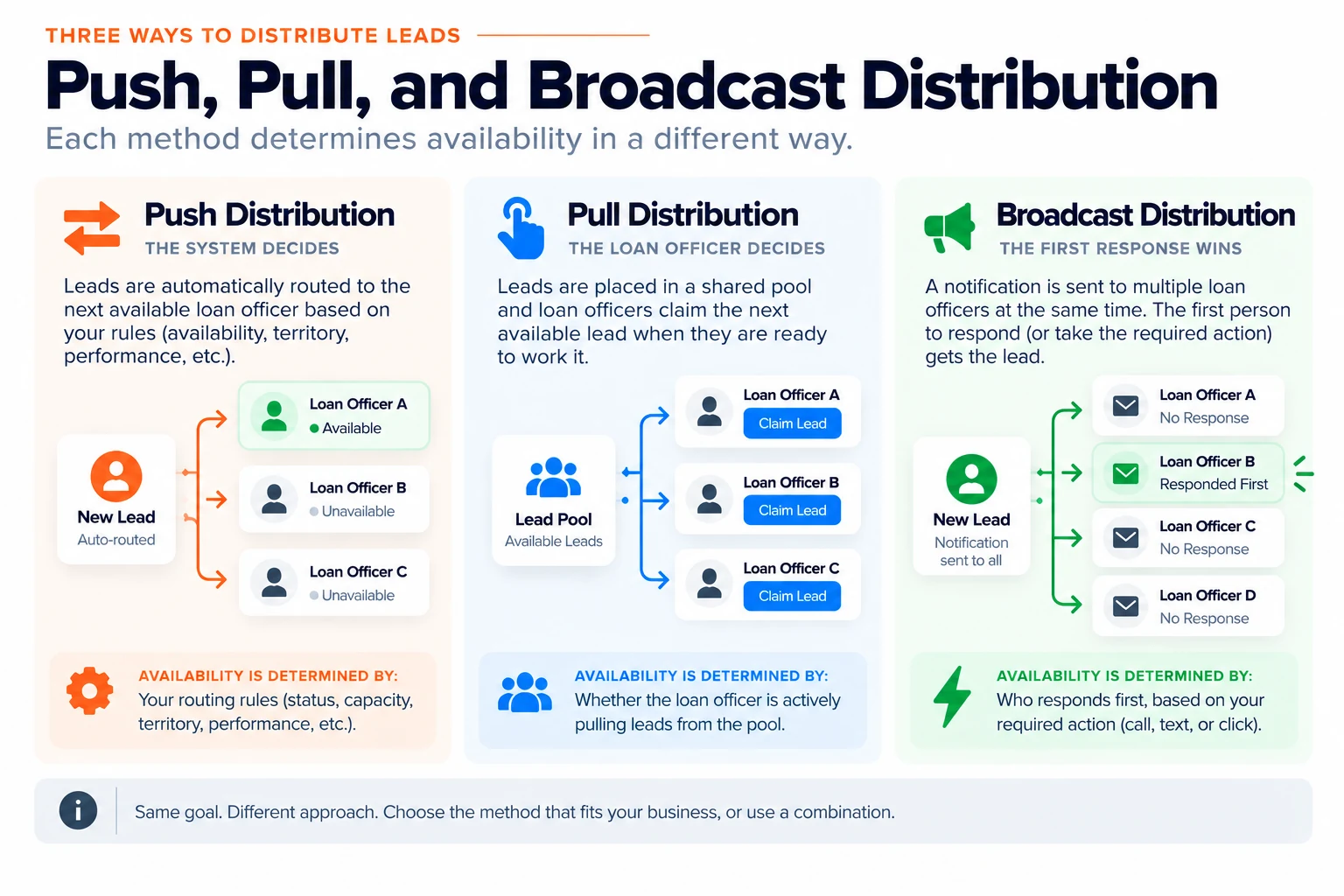
Push
The system assigns to a named person and infers availability from a status, a rotation, or a rule. Round robin is the common version.
It is simple and it is only as good as the availability signal underneath it. Assign on roster and you will hand leads to people at closing tables.
Pull
The officer asks for work. Availability is observed rather than predicted, because the person hitting the button is by definition not on a call.
Shape calls this Get Lead. The lender sets prioritization rules for what should be called next. A free officer pulls the top of that queue. Velocify has the same idea as Pull Distribution.
Do not confuse pull with a shark tank. A shark tank is pull on records that have already been neglected. Get Lead is pull on the live queue in priority order. Same motion, different pool, different reason.
The detail on recovery pools is in Round Robin vs Shark Tank. What goes into the priority order is what belongs in a lead score.
Broadcast and claim
The system notifies eligible officers and the first acceptance settles it. Availability is proven by the act of accepting.
Shape calls this QuickFire Connect. A record arrives, eligible users get an on-screen popup, and accepting starts the call. Velocify’s version is Shotgun Connect.
The popup is delivery. The logic underneath is a separate choice, and this is where the category gets muddled.
- First come, first serve. Everyone eligible is notified at once and the fastest hand wins.
- Sequential. A rejection passes the notification to the next user in a defined list.
Same popup, opposite distribution logic. A vendor demoing “instant notifications” has told you nothing about which one you are getting.
A few behaviours worth asking about, because they decide whether this works on a real floor. An unclaimed alert should expire rather than pile up. Accepting should close it for everyone else. A second alert should not stack on an unhandled one. And an officer already on a call should not be interrupted. In Shape that means no popup while they are talking.
Inbound Calls Are a Different Problem
A form fill can wait ninety seconds. A ringing phone cannot.
There is no response window on an inbound call. Either someone answers or nobody does, and no follow-up sequence repairs it.
Two requirements, in this order.
License first. Route only to officers licensed in the state the call is coming from. This is the same rule as everywhere else on this page and it runs before fairness.
Then cascade. Ring groups that try your top producers first and fall through to the next tier rather than dying. A call that rings one person and goes to voicemail is a call you paid for and lost.
Redistribution: What Happens When Nobody Acts
The third thing distribution decides, and the one that gets configured last.
Records go untouched. An application stalls at document collection and nobody notices for a week. Officers leave and their database stays behind.
In a shared model this is also how ownership gets returned. The officer who had the first conversation owns the file until they stop working it.
Redistribution is the rule that catches it. A record under your attempt standard moves. A stalled application moves. An orphaned book gets reassigned rather than aging quietly.
Worth checking how it interacts with everything else. In Shape, a redistribution rule firing while a QuickFire popup is open closes the popup automatically. Two rules cannot both claim one record.
Distribution is one piece of a larger picture. Where the rest of it sits is automation across the loan lifecycle.
Trigger Monitoring After the 2026 Rule Change
Trigger leads changed in March 2026 and it changed what distribution is for.
The Homebuyers Privacy Protection Act, Public Law 119-36, amended section 604(c) of the Fair Credit Reporting Act. That sits at 15 U.S.C. 1681b(c). Section 3 sets the effective date 180 days after the September 5 2025 enactment, which counts to March 4 2026. Much of the trade coverage prints March 5. A credit bureau can no longer sell the fact of a mortgage inquiry to lenders with no borrower relationship.
What survives is monitoring against your own book. The exceptions track the loan being current, not the relationship being historical. Three parties qualify. The originator of the consumer’s current residential mortgage loan. That loan’s servicer. An insured depository institution or credit union holding an active account. A firm offer of credit or insurance is still required.
That is a distribution problem the moment it fires. An event on a past borrower is worth nothing unless it reaches somebody. When the originating officer has left, there is no obvious owner at all. The same orphaned-book rule that catches stalled records catches this.
Configuring This Without a Two-Month Project
By now this reads like a quarter of setup work, and that is the honest objection.
It does not have to be. Shape ships pre-built best-practice configurations. A lender can go live on proven workflows rather than designing distribution logic from a blank screen.
The reason to care is not the time saved. It is that logic built from scratch by someone learning the product encodes whatever they understood in week one.
What to Test on a Demo
These five questions separate a mortgage lead management system that does this from one that says it does. Take them into the room.
Show me two sources routed differently in one instance. Purchased leads shared, referrals owned. If that needs two pipelines, it is not one system.
Where does the licensing filter run? If the answer is anywhere after assignment, walk.
Is your notification first come first serve or sequential? Both are defensible. Not knowing which you are buying is not.
What happens to a lead nobody touches? Ask them to show the rule, not describe it.
Can I run different methods at different times of day? Business hours and after hours are different problems.
Frequently Asked Questions
What is mortgage lead distribution?+
It is the rules deciding who receives a lead or call, how fast, and what happens if nobody acts. Distribution covers assignment, routing by state licensing and availability, inbound call cascades, and redistribution of records nobody has worked. It sits between lead capture and follow-up.
What is the difference between shared and owned lead distribution?+
Shared prioritizes speed, so the lead goes to whoever can call it now. Ownership then vests with whoever has the first real conversation. Owned assigns one person from the start.
Shared suits purchased and internet leads. Owned suits self-generated business and referrals, where the relationship is the asset and does not transfer.
Should leads be distributed by round robin?+
Sometimes, and it is not the only option. Round robin is fair by count and blind to availability, so it hands leads to people who cannot answer. It works when paired with a real availability signal.
For speed on purchased volume, broadcast or pull mechanisms usually beat it.
How should inbound calls be routed?+
License first, then priority. Route only to officers licensed in the state the call originates from. Then cascade through ring groups so top producers get first refusal and the call falls through rather than dying.
There is no response window on a ringing phone, so coverage matters more than cadence.
Are trigger leads still usable in 2026?+
Only within narrow exceptions. Since March 2026 the Homebuyers Privacy Protection Act limits recipients to four parties. The originator of the current mortgage, that loan’s servicer, an institution holding an active account, or anyone with explicit consent.
A firm offer of credit is still required. Monitoring your own book survives.