Mortgage Loan Origination Software: 11 Systems Compared
Mortgage loan origination software owns the loan file. It does not own the borrower. Confusing those two is how shops end up paying for three platforms that each do a third of the job.
Eleven systems below, compared for mortgage specifically. Each entry gives strengths, weaknesses, and who should actually buy it. Most comparisons in this category skip the weaknesses. That is the part you need.
Shape is not an LOS. We build the CRM and point-of-sale layer that sits in front of one. That means no dog in the ranking fight. It also means a clear view of how each platform behaves when something has to talk to it.
What an LOS will not do
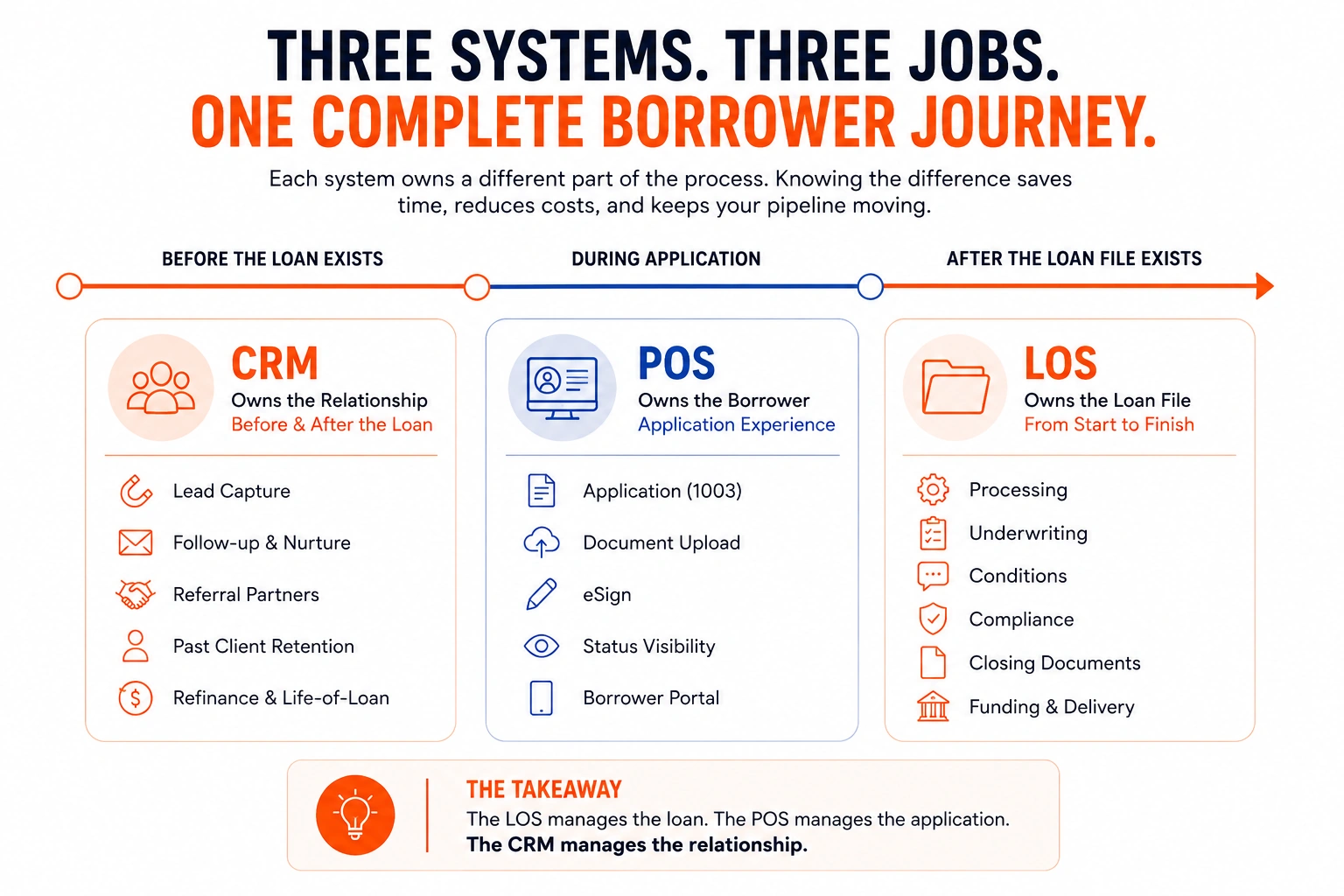
Three systems, three jobs. Most mortgage LOS stack problems come from expecting one to cover another’s work.
The LOS owns the loan file. Application data, underwriting conditions, disclosures, compliance, closing docs. It starts when there is a loan and it ends at funding.
The POS owns the borrower’s application experience. The 1003, document upload, status visibility, e-sign. Some LOS platforms bundle a POS. Most bundled ones are thin, which is why a dedicated borrower customer portal usually outperforms the one that came free with the loan file.
The CRM owns everything before and after the loan file exists. Lead capture, speed to lead, follow-up cadence, referral partners, past-client retention, refinance triggers. Your LOS has no opinion about a lead that never applied, and no memory of a borrower who funded two years ago.
That last gap is the expensive one. A loan officer with 400 past clients and no CRM has 400 relationships sitting in an LOS. Nothing in that system will ever prompt a call. Our mortgage CRM platform exists for exactly that stretch of the timeline.
Buy the LOS for the file. Buy the CRM for the relationship. Do not expect either to do the other’s job.
The best loan origination systems for mortgage, compared
Shape integrates natively with several of these and builds new connections when a client needs one. That means no reason to steer you. What follows is what each platform is good at, what it is bad at, and who should buy it.
1. Encompass (ICE Mortgage Technology)
Encompass is the most widely deployed loan origination system in US mortgage. It runs the full file from application through underwriting, closing, and investor delivery. ICE Mortgage Technology owns it, following the Ellie Mae acquisition. Most secondary counterparties assume you are on it.
Strengths. The deepest investor connectivity in the market. Secondary counterparties expect to see it, which removes friction at delivery. Compliance tooling is the most complete available, and the audit trail holds up under examination. Configurable to almost any workflow.
Weaknesses. Heaviest implementation on this list, measured in quarters rather than weeks. Highest total cost, and the pricing compounds through per-seat and per-integration charges. Configuration depth means you need someone who owns it. Small shops routinely buy Encompass and use a fraction of it.
Best fit. IMBs and banks with real volume, dedicated ops staff, and a compliance function. If you do not have all three, you will pay for capability you cannot operate.
2. LendingPad
LendingPad is a cloud-native LOS serving brokers through mid-size lenders. It was built for the browser rather than migrated to it, which shows in how the collaboration works. Positioned as a lighter alternative to enterprise platforms without giving up core origination.
Strengths. Cloud-native and genuinely multi-user. A processor and an LO work the same file at once instead of taking turns. Deploys in weeks, not quarters. Priced for shops that are not enterprises.
Weaknesses. Fewer investor connections than Encompass, which matters if you deliver to many counterparties. Compliance tooling is adequate rather than deep. Reporting is thinner than enterprise platforms.
Best fit. Brokers and small-to-mid lenders who want cloud origination without an implementation project.
3. ARIVE
ARIVE is an all-in-one platform built specifically for independent mortgage brokers. It combines the loan file, product and pricing, and a wholesale lender marketplace in one interface. Rocket puts its share at roughly half of all brokers. That makes it the closest thing the channel has to a standard.
Strengths. Built for the broker channel rather than adapted to it. Wholesale submission and pricing live in the same workflow as the loan file, which removes constant tab-switching. The widest lender network on this list. Rocket Pro completed full integration in 2026, so pricing, submission, and live status all happen without leaving ARIVE.
Weaknesses. Broker-only by design. If you originate retail or run a correspondent channel, it might not fit. Brokers pay a monthly subscription, where Jupiter does not.
Best fit. Independent mortgage brokers who want origination, pricing, and submission in one place.
4. Jupiter LOS
Jupiter is a broker-focused LOS that Rocket Pro launched with sister company Lendesk in February 2026. It is offered free to broker partners and runs under the broker’s own branding. Designed as an intake and submission layer that sits alongside whatever CRM a broker already uses.
Strengths. It is free. Credit pulls and DU/LPA carry no upfront cost, and you pay only when the loan funds. It submits to Rocket Pro in one click or exports a 1003 to any lender. Runs on a separate code base from Rocket Pro systems.
Weaknesses. New, launched in early 2026, so there is less peer experience to draw on than the incumbents. Built as an intake and submission layer rather than end-to-end origination through closing. The tightest workflow is the Rocket Pro path, so the value shifts if Rocket is a small share of your submissions.
Best fit. Brokers who send meaningful volume to Rocket Pro, and any broker whose CRM already works but whose origination workflow does not.
5. MeridianLink Mortgage
MeridianLink Mortgage is the former LendingQB, rebranded after MeridianLink acquired it. It sits inside a broader consumer lending suite covering auto, personal, and card alongside mortgage. Sold primarily to banks and credit unions rather than independent mortgage companies.
Strengths. Runs mortgage alongside auto, personal, and card lending in one system. Open API architecture and a large integration marketplace. The mortgage lineage is real rather than bolted on.
Weaknesses. Over-built if mortgage is your only product. Multi-product architecture adds configuration surface you will not use. Aimed at institutions, so the buying and implementation process assumes committees.
Best fit. Banks and credit unions where mortgage is one line of business among several.
6. Byte Pro (Byte Software)
Byte Pro is one of the oldest loan origination systems still in active use, built by Byte Software since 1985. It has been refined over decades rather than rebuilt, and the depth of its workflow engine reflects that. Known in the market for customization rather than for design.
Strengths. Mature workflow engine. Customization depth through custom fields, workflows, and macros is genuinely deep. Handles unusual processes that break template-driven platforms.
Weaknesses. The interface shows its age and users say so. Customization depth means configuration work, which means time and someone to own it. Not a fast deployment.
Best fit. Lenders whose process genuinely does not fit a standard template and who have in-house admin capacity.
7. Calyx Path
Calyx Path is the browser-based successor to Calyx Point, from the same vendor. It carries forward the structure and terminology Point users already know. Positioned mainly as the upgrade path for the large base of shops still running the desktop product.
Strengths. Familiar structure for anyone who came up on Calyx. Migration path from Point is the cleanest available. Priced for small operations.
Weaknesses. Ecosystem-bound. Most of the case for it is continuity rather than capability. Thinner than the enterprise platforms on integrations and reporting.
Best fit. Small lenders and brokers moving off Point who want to stay in the Calyx ecosystem.
8. Calyx Point
Calyx Point is desktop loan origination software with a long history in the small broker and lender market. It predates the cloud era and still runs in a meaningful number of shops. Calyx now steers new customers toward Path.
Strengths. Deeply familiar to a large installed base. Low cost. Works offline.
Weaknesses. Desktop software in a cloud market. No real multi-user collaboration. Integration options are limited by architecture, not by choice.
Best fit. Nobody starting fresh. Point is a migration decision, not a purchase decision. If it is your incumbent, the real question is where you go next.
Worth knowing before any migration. Loan data moves between systems as Fannie Mae 3.2 or MISMO files, not as a database export. Our guide to importing Fannie Mae 3.2 files covers what survives the trip and what does not.
9. LendingWise
LendingWise is a specialist LOS built for lending outside conventional agency paper. Its core market is non-QM, hard money, fix-and-flip, and commercial. Configuration flexibility across loan types is the reason shops choose it.
Strengths. Handles non-QM, fix-and-flip, hard money, and commercial natively rather than through workarounds. Configurable across loan types that break agency-focused platforms.
Weaknesses. Less refined on vanilla agency origination than the mortgage-first platforms. Smaller installed base and ecosystem.
Best fit. Shops whose product mix runs past agency paper.
10. Blue Sage Solutions
Blue Sage is a browser-native origination platform built cloud-first rather than migrated from desktop. It covers retail, wholesale, and correspondent channels in a single system. A newer entrant relative to the incumbents on this list.
Strengths. Modern architecture without legacy carried forward. Multi-channel out of the box.
Weaknesses. Smaller installed base than the incumbents, so fewer peers to reference. A younger ecosystem means fewer prebuilt third-party connections.
Best fit. Lenders originating through more than one channel who want a single modern platform.
11. LendingDox
LendingDox is a lower-cost origination platform aimed at smaller lending operations. Its emphasis is document workflow and loan file management rather than breadth of features. Positioned below the enterprise platforms on both price and scope.
Strengths. Document-heavy origination at a price point below enterprise platforms. Straightforward to stand up.
Weaknesses. Narrower feature set than the platforms above. Smaller ecosystem.
Best fit. Smaller shops that need solid document workflow without enterprise cost.
Loan origination software comparison, by shop type
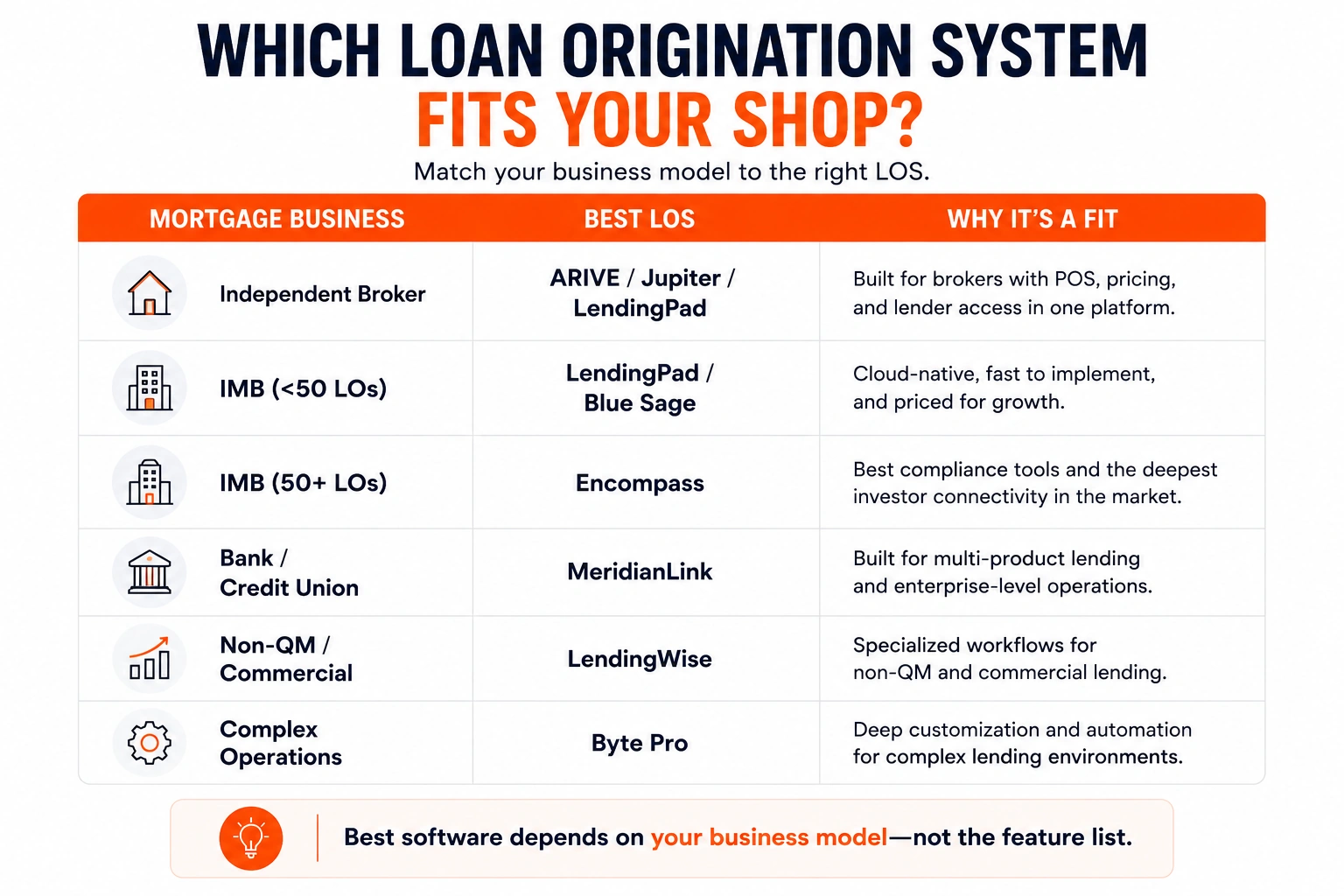
Independent broker. Three real options, and the right one depends on where your loans go.
ARIVE is the default. Widest lender network, and Rocket Pro now integrates fully, so you price, submit, and track without leaving it. You pay a monthly subscription.
Jupiter is free. Rocket Pro launched it with Lendesk in February 2026 for the broker network. If Rocket Pro takes a meaningful share of your submissions, that math is hard to argue with. One-click submission, no upfront cost on credit or DU/LPA. You can still export a 1003 to any other lender.
LendingPad is the pick if you want a fuller LOS than Jupiter and are not tied to the ARIVE marketplace.
IMB under 50 originators. LendingPad or Blue Sage. Encompass is available to you and will probably cost more than it returns at that size.
IMB over 50 originators. Encompass, unless you have a specific reason not to. Investor connectivity and compliance depth stop being nice-to-have.
Bank or credit union. MeridianLink if mortgage sits alongside other consumer lending. Encompass if mortgage is a standalone operation with its own team.
Non-QM or commercial mix. LendingWise. The others will make you work around them.
Unusual workflow, in-house admin. Byte Pro.
Whichever LOS you pick, the connection to the rest of your stack is where daily pain lives. We cover what Shape connects to and how at integrations and APIs.
Five questions to ask in the demo
Vendors answer feature questions well. Ask these instead.
“Walk me through exactly how data moves between this and my CRM.” Do not expect a live demo. Almost nobody has one standing. What a good vendor can do is describe the workflow in detail: what triggers a push, what comes back, how often, and specifically which fields are and are not included in an update. Vagueness here is the answer.
“What is the implementation timeline, and who does the work?” If the answer is a range, ask what makes it the long end.
“What does this cost at double our current volume?” Per-seat, per-file, and per-integration pricing behave very differently as you grow.
“What happens to my data if I leave?” Export format, cost, and whether historical loan files come with you.
“Which parts of the borrower experience does this cover, and which do I still need?” This is where you find out whether the bundled POS is real.
Frequently Asked Questions
What is the difference between an LOS and a mortgage CRM?+
An LOS manages the loan file from application through funding: underwriting, conditions, disclosures, compliance, closing. A mortgage CRM manages the borrower relationship before the file exists and after it closes. That covers lead capture, follow-up, referral partners, retention, and refinance triggers. Shape’s position is that most mortgage shops need both, because neither system covers the other’s stretch of the timeline.
What is the best loan origination software for mortgage brokers?+
For independent brokers, ARIVE and LendingPad are the strongest fits. Both are cloud-native, built for the broker channel, and deployable without an implementation team. ARIVE folds wholesale lender submission and pricing into the same workflow. LendingPad allows multiple team members in the same loan file simultaneously. Brokers sending volume to Rocket Pro should also look at Jupiter, which currently is free.
Does an LOS replace a mortgage CRM?+
No. An LOS holds no record of a lead that never applied. It has no mechanism to prompt follow-up two years after funding. Those are CRM functions. Shops running their database out of an LOS lose repeat and referral business by default. Nothing in the system is watching for it.
How much does mortgage loan origination software cost?+
Pricing models vary too widely for a single figure. Platforms charge per seat, per funded file, per integration, or some combination. Shape recommends modeling cost at double your current volume rather than today’s, since per-file pricing scales very differently from per-seat.