Caller Reputation for Mortgage Lenders: Why Calls Get Flagged
Your dialer is working. The call connects, the handset rings, and nobody picks up.
Most shops respond by buying more numbers. That is the wrong move, and it is the one the category keeps recommending. Caller reputation for mortgage lenders is scored on how your traffic behaves. It is not scored on how many numbers that traffic runs through. Spreading the same behavior across more lines spreads the problem with it.
Four separate systems decide what a borrower sees when you call. Only one of them decides whether you get labeled, and it is not the one every vendor sells you.
Four systems get confused, and only one decides the label
They do different jobs and the industry uses the names interchangeably.
| System | What it does | Does it stop a spam label |
|---|---|---|
| CNAM | Shows a name on legacy caller ID lookup | No |
| STIR/SHAKEN | Signs the call so carriers can verify it is not spoofed | No |
| Branded Caller ID | Puts a verified name and logo on supported handsets | No |
| Spam analytics | Scores your traffic and applies the label | Yes, this is the one |
Signing a call proves you are who you say you are. It does not say anything about whether people want the call. A verified, branded, correctly attributed call can still be scored as a nuisance. Those are two different questions, and two different systems answer them.
That is the sentence most lenders have never been told.
Who scores caller reputation for mortgage lenders
Three analytics engines do most of the phone number reputation scoring in the US market: Hiya, First Orion and TNS. Carriers and handset apps draw on them to decide what appears on screen.
Public sources disagree about which engine sits behind which carrier, and the mappings change. Do not build a plan around one. What matters operationally is simpler. Registering with one engine does not register you with all of them, so remediation means approaching each separately.
The engines do not score one number in one way. They score several dimensions at once and roll them into a single risk level. The distinction matters. Some of those dimensions describe the number itself. Others describe how your calls behave once they are placed, which means answer rate and call duration are scored inputs, not just results. That behavioral half is the part no registration can reach, and it is the part you actually control. So it is worth being precise about what feeds it.
What gets a lender’s numbers flagged
Six things, and a producing shop generates most of them without trying.
- High volume pushed through too few numbers
- Low answer rates, which the model reads as unwanted calls
- Short call durations, including hang-ups and zero-duration attempts
- Complaints from recipients
- Recycled numbers carrying a previous owner’s reputation
- Unregistered or unattested traffic
The recycled-number point catches people. Every number you buy has been somebody else’s. It arrives with history attached, and scoring begins on your first day of dialing rather than after some grace period.
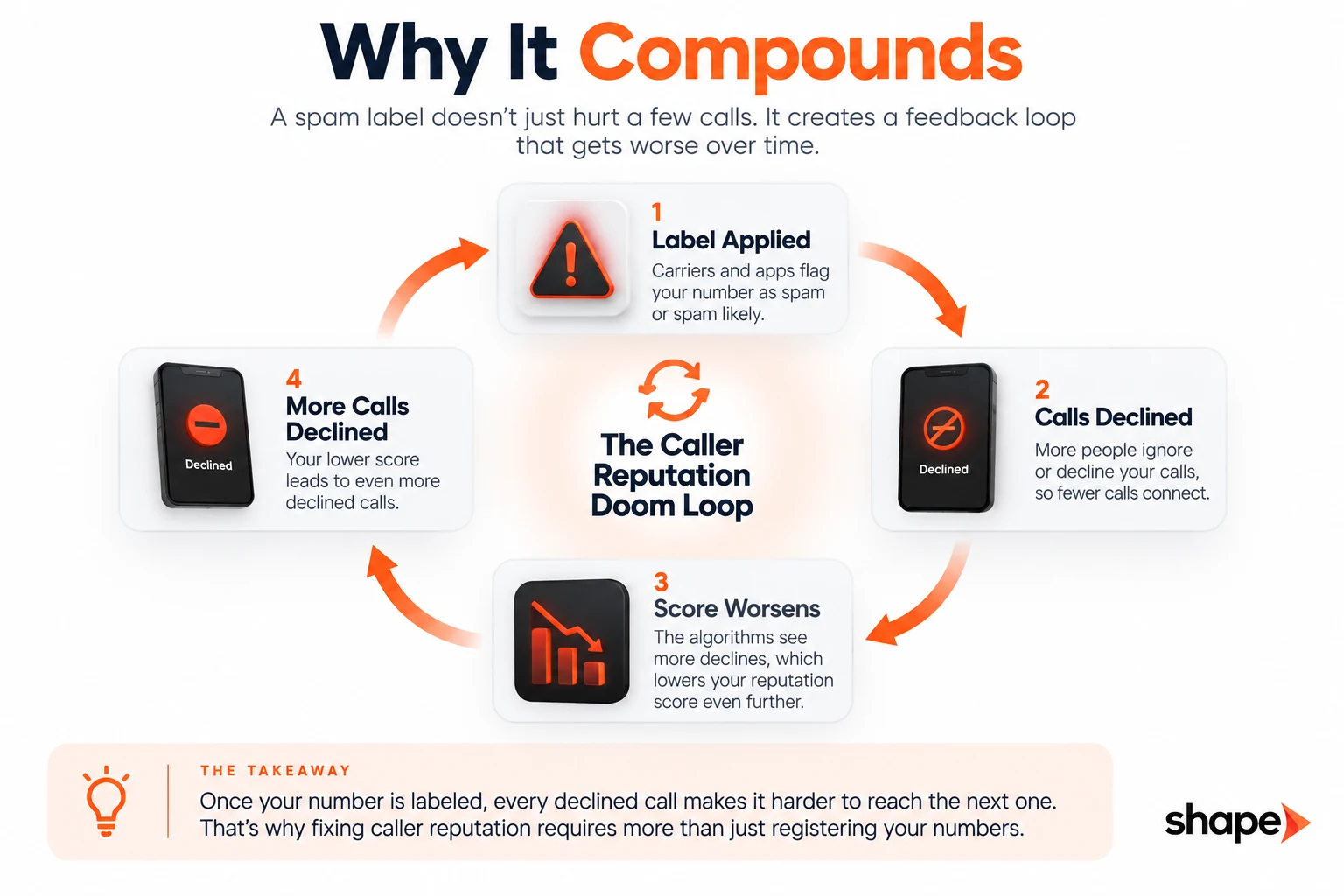
Why it compounds
A flag is self-reinforcing, which is why the problem never sits still.
The label appears. Borrowers decline the call. The engine reads declines and short durations as confirmation. The score drops further. More borrowers decline.
A shop that does nothing does not hold steady at a bad number. It slides.
Why rotating to fresh numbers makes it worse
Number-hopping is what most shops do and it is the wrong answer.
The instinct is understandable. One number is flagged, so retire it and dial from a clean one. The problem is that the flag was earned by a pattern. Move the pattern to a new number and it reproduces there. Now you have two damaged numbers instead of one. The footprint also looks more like a spam operation than it did before.
There is one case where replacement is the only option. A number carrying a regulatory block cannot be remediated. Those get replaced, and nothing else does.
Registration is the floor, not the fix
Register your numbers. Then stop expecting it to be enough, because registration establishes a baseline and does not override behavioral scoring.
The same goes for the paid layer above it. Branded caller ID for mortgage lenders puts your name and logo on the screen. It buys recognition, not immunity.
Shape registers client numbers with the analytics engines to establish a baseline. We also run spam remediation on numbers already carrying flags. Both are worth doing and neither is the whole answer.
Here is the part nobody selling this will tell you. Those are the two mechanical halves. The behavioral half belongs to you, and no vendor can register their way out of a dialing pattern. Call duration, answer rate, volume per number and complaint rate are the inputs the model watches. If those do not change, the flag comes back.
Registration also has a lead time, and it depends on people outside your project. It belongs with the other setup work you start early rather than finish late. That is one of several things worth settling in what to decide before you go live.
There is no regulator to appeal to
Blocking and labeling are treated completely differently, and almost nobody outside telecom knows it.
If a provider blocks your call using analytics, federal rules apply. The FCC requires providers to return SIP code 603+, so you learn that the block happened and why. Providers that block must also offer a single point of contact for disputes. That is a redress path with an address on it.
A labeled call is not blocked. It rings. It shows “Spam Likely” and the borrower declines it, and none of the blocking provisions apply, because nothing was blocked.
What exists instead is voluntary. The analytics engines run their own correction processes, and the industry maintains a best-practice framework for handling labeling complaints. Both are real and neither is mandated.
That is why remediation is slow and why it runs engine by engine. It is also why nobody will quote you a timeline. You are asking for a favour under a good-faith framework, not filing a claim.
Spam remediation: which lines need it and which do not
Outbound and local-presence numbers need it. Inbound-only numbers do not.
The reason is mechanical rather than economic. An inbound line places no calls, so there is no outbound behavior for an analytics engine to score. Remediating it buys nothing.
Caller reputation for loan officers running dedicated numbers works the same way. A dedicated outbound line is scored like any other. Most shops get this wrong in one of two directions. They remediate everything, which spends money on lines that were never at risk. Or they remediate nothing, because the quote covered every number they own and the total looked absurd.
Sort your numbers by what they do before you price anything. The list is usually shorter than people expect, and the decision gets easier once the inbound lines come off it. That sorting runs into a bigger question about where your numbers should live at all. Answering it is part of what a mortgage CRM has to do when it owns your calling.
What a lender actually runs
Caller reputation for mortgage lenders is standing work, not a project. Four things, and only the first has an end date.
Somebody owns it. Name a person. Caller reputation sits between marketing, operations and IT, which in most shops means it sits nowhere until answer rates collapse.
Monitoring runs on a schedule, not on a complaint. Checking when somebody notices is how a slide becomes a crisis. Reputation data can be queried on a set cadence, and the useful signal is direction rather than a single reading.
Number inventory is documented. Which numbers exist, what each one does, which are registered, which are flagged. Most lenders cannot produce this list, which is why the first remediation quote is always wrong.
Entity changes trigger a full pass. This is the one that catches people. When a lender rebrands or gets acquired, three things move to the new entity. Carrier registration, CNAM records and brand records. Numbers keep dialing in the meantime under a name that no longer matches the registration. That mismatch is what the scoring models look for.
None of that requires a new platform. It requires somebody with the list, and a calendar. It also requires a CRM for mortgage lenders that records call duration and outcome at the number level. Those are the inputs you are scored on.
Figures we left out, and why
This category has a statistics problem, and naming it is more useful than adding to it.
Four claims are in wide circulation about what branded calling does to answer rates. One vendor publishes a 30% answer rate described as three times the industry average. Another publishes up to 56% improvement. The same vendor claims 88% of consumers will not answer a number-only call. It also publishes revenue figures of 18 to 22% and 8 to 22%. A major cloud provider’s own documentation puts branded calling at a flat 30% lift.
None of them states a denominator. None describes a method. None says over what period, in which industry, or against what baseline. Four numbers measuring the same thing at very different values means at least one is measuring something else.
Three more circulate in this corner and none is here. That 80% of unidentified calls go unanswered. That branded calling produces a 133% answer-rate increase. That a number can safely carry 75 calls a day. No study sits behind any of them.
One more, because it is about our own industry. A competitor currently publishes a figure attributed to a Harvard Business Review study. It says 78% of mortgage closes go to the lender who reaches the borrower first inside five minutes. There is no such study in the year cited. The figure traces to a lead-generation vendor’s 2024 blog post about general sales rather than lending. Shape retired it from our own pages for that reason.
For the framework, the FCC’s own orders are the source worth citing. For the outcome, nobody has published a number that survives a check.
Frequently asked questions
Why do our calls show as spam likely when we are STIR/SHAKEN verified?+
Because those answer different questions. STIR/SHAKEN signs the call so a carrier can verify the number is not spoofed. Spam labeling is a separate scoring model. It looks at how your traffic behaves: answer rates, call duration, complaints. A fully verified call from a legitimate business can still be scored as a nuisance. Verification gives no protection from that.
Will branded caller ID stop our numbers being flagged?+
No. Branded caller ID puts your name and logo on supported handsets, which raises the chance someone answers. It does not touch the analytics score that produces the label. The two run independently, so a branded call can still arrive marked. Branding is worth buying for what it does, not for what vendors imply it prevents.
Should we rotate numbers when one gets flagged?+
Only when the number carries a regulatory block, which cannot be remediated. Otherwise rotation makes things worse, because the flag was earned by a calling pattern and the pattern moves with you. You end up with more damaged numbers and a footprint that looks less legitimate. Fix the behavior and remediate the number you have.
How long does spam remediation take?+
Nobody can quote you a reliable figure, and the reason is structural. There is no federally mandated redress path for labeling, unlike blocking, so corrections run through each analytics engine’s voluntary process. That means engine by engine, with no service standard. Plan in weeks rather than days, and treat any promised timeline as an estimate.
{“@context”:”https://schema.org”,”@type”:”FAQPage”,”mainEntity”:[{“@type”:”Question”,”name”:”Why do our calls show as spam likely when we are STIR/SHAKEN verified?”,”acceptedAnswer”:{“@type”:”Answer”,”text”:”Because those answer different questions. STIR/SHAKEN signs the call so a carrier can verify the number is not spoofed. Spam labeling is a separate scoring model. It looks at how your traffic behaves: answer rates, call duration, complaints. A fully verified call from a legitimate business can still be scored as a nuisance. Verification gives no protection from that.”}},{“@type”:”Question”,”name”:”Will branded caller ID stop our numbers being flagged?”,”acceptedAnswer”:{“@type”:”Answer”,”text”:”No. Branded caller ID puts your name and logo on supported handsets, which raises the chance someone answers. It does not touch the analytics score that produces the label. The two run independently, so a branded call can still arrive marked. Branding is worth buying for what it does, not for what vendors imply it prevents.”}},{“@type”:”Question”,”name”:”Should we rotate numbers when one gets flagged?”,”acceptedAnswer”:{“@type”:”Answer”,”text”:”Only when the number carries a regulatory block, which cannot be remediated. Otherwise rotation makes things worse, because the flag was earned by a calling pattern and the pattern moves with you. You end up with more damaged numbers and a footprint that looks less legitimate. Fix the behavior and remediate the number you have.”}},{“@type”:”Question”,”name”:”How long does spam remediation take?”,”acceptedAnswer”:{“@type”:”Answer”,”text”:”Nobody can quote you a reliable figure, and the reason is structural. There is no federally mandated redress path for labeling, unlike blocking, so corrections run through each analytics engine’s voluntary process. That means engine by engine, with no service standard. Plan in weeks rather than days, and treat any promised timeline as an estimate.”}}]}