A mortgage CRM for multi-branch lenders has to solve a tension, not a size problem.
You want each branch free to build workflows that fit how they sell. You also need every one of those workflows to stay compliant. Most platforms give you one or the other.
Six platforms below operate at branch scale. Any multi-branch mortgage CRM shortlist starts with some subset of them.
We build Shape, and it is on this list. The criteria below apply to all six equally, so use them on us too. Banks and credit unions run a related version of this decision, and the best mortgage CRM for banks and credit unions compares six for depositories.
The Tell That Your Current CRM Is Not Working
A branch buys its own.
A branch manager pays out of pocket for a second system. The corporate platform does not help them grow, and their loan officers will not log into it.
Sit with that for a second. A branch is running a shadow CRM. Working around the platform corporate already pays for, trains on, and reports out of.
That is not a change management problem. The corporate system failed at the one thing that decides whether a CRM works. The branch voted with a credit card.
I have seen it more than once. Corporate usually hears about it last.
Why Loan Officers Will Not Log In
Legacy mortgage platforms are built for the marketing manager.
They are good at campaign management, brand control, template governance, and compliance reporting. Corporate evaluates them, buys them, and is satisfied with them.
Then the loan officers do not log in, because nothing in the system helps them close a loan today.
The best mortgage CRM is the one the loan officer actually uses. Adoption comes down to one thing. Whether the system serves the person using it or the person reporting on it.
Those are different people with different incentives, and most enterprise platforms picked the second one years ago.
Adoption is a management problem before it is a software problem. The measurement side of it is in the branch manager’s playbook.
Branches Are Not Interchangeable, and Most Are Mixed
This is where multi-branch stops being about scale.
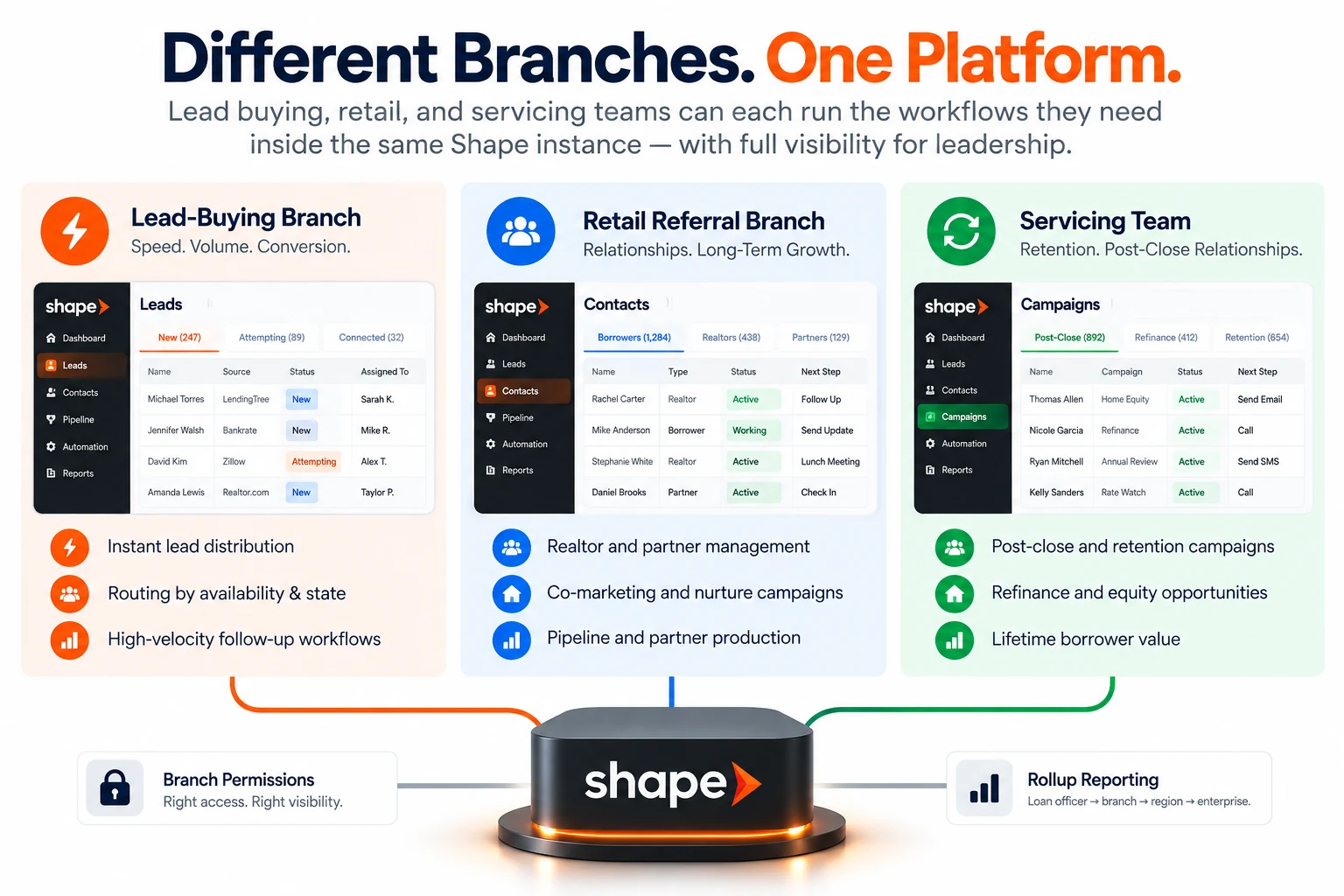
A lead-buying branch lives on speed. Purchased volume, routed on availability and licensed state, answered in seconds.
A retail branch runs on relationships. Realtor partners, co-marketing, long nurture, and partner production tracked next to the borrower pipeline rather than in a separate tool.
A servicing team runs on retention and post-close contact, which is a different job again.
And most real branches are a mix. A retail branch working referrals that also buys leads to fill capacity needs both configurations at once.
So the question is not whether a platform supports consumer direct or retail. It is whether a branch can configure any combination of those without corporate approving a new template each time.
What a Mortgage CRM for Multi-Branch Lenders Has to Do
Seven requirements. Each is testable on a demo.
Requirement
Why it decides the purchase
Branch level CRM configuration
A lead-buying branch and a referral branch need different pipelines, stages, and cadences
Guardrails that survive that flexibility
Branch autonomy cannot mean branch-level compliance exposure
Permissions scoped by branch
A branch manager sees their branch. Corporate sees everything.
Rollup reporting
Loan officer to branch to region to enterprise, without exporting anything
Distribution filtered on licensed state
A multi-state footprint needs a licensing filter before a fairness rule
Marketing coordination and approval
Corporate sends have to coexist with branch sends, and LO-initiated posts need a compliance path
Loan officer adoption
If they will not log in, every row above is theoretical
Those seven are the shortlist filter. A platform missing the first two cannot deliver the rest, because configuration and guardrails are what everything else sits on. That is the order mortgage CRM for banks and multi-branch lenders has to be built in.
The marketing row is the one buyers underestimate. Three separate problems live in it.
Corporate needs to coordinate email sends. Two branches should not hit the same borrower in one week. A branch campaign should not collide with a corporate one.
Some lenders also want to manage social posting for their loan officers centrally. Others want the opposite: let the loan officer post, with an approval step so only compliant messages go out.
That second version is the harder build and the better outcome. The loan officer gets to sound like a person, and compliance still sees everything before it publishes.
Test the last row first. Ask to see the loan officer view before the admin view. Every vendor demos the admin view, because the admin is who buys.
Two more demo questions. Show me two branches configured differently in one instance. And what have you released in the last twelve months?
The first tests whether flexibility is real or a roadmap item. The second tells you whether the platform is still being developed or just maintained.
1. Shape
Best for: lenders running structurally different divisions in one instance.
Each branch gets its own sub-account with independent data, settings, and users. Corporate provisions branches, manages users in bulk, and pushes settings org-wide without touching each one.
The part that matters for multi-branch is what a branch can configure. Dialer, email, and texting are native, so a branch is not attaching its own phone system. What differs is how each branch uses them.
A lead-buying branch configures distribution rules and inbound call routing. A retail branch configures partner management alongside its pipeline. A servicing team configures retention contact. Same instance, same native stack, three different configurations of it. Mixed branches run any combination.
Corporate keeps guardrails on compliance and marketing initiatives over all of it. That covers the marketing side too. Sends get coordinated across branches so campaigns do not collide. And loan officers can post with an approval step, rather than choosing between silence and risk.
Views and roles are configurable, not three preset tiers. That happens at field level on the same record.
Marketing can see the full campaign and engagement detail on a lead. The loan officer working that same lead sees what closes the loan and not the rest. An owner sees the organization, a manager sees their branch.
That is the practical answer to adoption. The loan officer is not given a stripped-back admin console. They are given a screen containing their job.
Requirements met: all seven. Strongest of the six at holding lead management and referral partner tracking in one system.
That combination is the point. A branch buying leads and a branch working realtor relationships chase conversion the same way. Only the source differs. Most platforms make you pick which one they are good at.
Watch for: pricing is not published. Get a quote before you plan a budget.
Certifications: SOC 2, HIPAA, PCI.
2. Total Expert
Best for: banks and credit unions with a dedicated marketing team.
Total Expert does not call itself a CRM. Their own term is a customer engagement platform, and the target is financial institutions with 50 or more loan officers.
Strengths are co-branded marketing and compliance-aware content workflows. Customer IQ is propensity modeling rather than credit trigger alerts. Access controls, permissions, and audit trail are all present.
Requirements met: the strongest here on marketing coordination and approval workflows, with guardrails and reporting to match. Branch configuration leans toward access control rather than workflow.
Watch for: this is a marketing platform first. If your problem is loan officer adoption rather than marketing governance, that is not what it was built to solve. Enterprise pricing, custom quote.
3. Surefire
Best for: shops already on Encompass that want pre-built marketing content.
Surefire is part of ICE, which matters if Encompass is your LOS. The library of pre-built creative and the templating for account executive marketing are its clearest strengths.
Where it earns its place on this list is marketing control at scale. Pre-built creative, templated output, and approval paths. A compliance officer can govern what hundreds of originators send without writing any of it.
Requirements met: content governance and marketing coordination are the real advantages, with enterprise reporting behind them.
Watch for: the strength is marketing output rather than branch-level workflow configuration. If your problem is that two branches need different pipelines, that is not what this was built to solve.
4. Insellerate
Best for: high-volume lenders running multiple channels.
Insellerate positions on granular permissions, intelligent lead distribution, and reporting that rolls up from loan officer to branch to enterprise.
Multi-channel is the pitch, covering retail, wholesale, TPO, and consumer direct on one platform. For a lender running several channels under one roof, that is the relevant claim to test.
Requirements met: distribution, permissions, and rollup are the core of their offering.
Watch for: built for scale, which means the implementation is a project. Enterprise pricing.
5. Jungo
Best for: lenders already committed to Salesforce.
Jungo is built on Salesforce. You inherit the data model, reporting engine, and integration ecosystem, with mortgage workflows layered on top. Customization is effectively unlimited.
Requirements met: per-branch configuration is possible because Salesforce makes almost anything possible.
The point of Jungo is that the mortgage layer is already built. You are not starting from a blank Salesforce org.
Watch for: you inherit Salesforce’s depth in both directions. Configuration at this level usually wants somebody who knows the platform, on staff or on retainer.
6. Lendware
Best for: mid-size operations consolidating multiple CRMs.
Lendware runs a deliberate dual-layer interface. Branch managers and executives get reporting and compliance oversight. Loan officers get a simpler focused view.
That is the right instinct on adoption. Give the loan officer a screen built for their job rather than a stripped-back version of the admin console.
Requirements met: the exec and LO split addresses adoption directly.
Watch for: the name. Lendware was Aidium, and before that Daily AI. Three names in three years, with the most recent acquisition closing in October 2025. For a multi-year commitment, ask about roadmap continuity.
A Note on Building Your Own on Salesforce
Some lenders skip the mortgage platforms entirely and build direct on Salesforce.
The logic is sound on paper. You get complete control, you configure exactly what each division needs, and nothing is constrained by somebody else’s product decisions.
In practice the cost and the timeline get away from people. Heavy upfront spend, a long build, and an onboarding cycle measured in quarters rather than weeks.
Then the part that decides it. After all of that, the loan officers do not use it.
You spent enterprise money and a year of calendar time to arrive at the same adoption problem. Except now you own the maintenance too. Every change is a project and every project needs a developer.
Build if you have a genuine reason no product can serve. Otherwise you are paying to reinvent something and inheriting its hardest problem anyway.
The CRM Is the Road the AI Drives On
There is an assumption worth killing.
AI does not make the CRM less important. It makes it considerably more important, and the reason is structural.
An AI agent qualifying a lead or answering an inbound call needs three things to operate safely. The borrower record, to know who it is talking to. The consent state, to know whether it is allowed to. The activity history, to know what already happened.
All three live in the CRM. The CRM is the road the AI drives on.
That matters most at branch level. Let each branch deploy its own AI tooling on its own stack. Now you have an unmanaged compliance surface across every state you lend in, and nobody at corporate can see it.
So per-branch flexibility with guardrails intact is not a nice-to-have. It is the precondition for letting branches use AI at all without accepting risk you cannot audit.
What Happens When a Platform Cannot Do This
Lenders solve it by adding systems.
Corporate keeps the enterprise platform for reporting and compliance. Branches run something else for daily work. Somebody builds an integration, or somebody exports a spreadsheet every Monday.
Three costs follow and all three compound.
The borrower record splits. Activity in one system, marketing in another, neither complete.
Reporting stops being trustworthy. Numbers that require a merge are numbers somebody can dispute.
And AI has no road to drive on. An agent working from a partial record is worse than no agent, because it acts confidently on incomplete information.
A mortgage CRM for multi-branch lenders has to hold both ends at once. That makes it a narrower category than the roundups suggest.
For the wider platform comparison outside the multi-branch question, see the CRM shortlist for loan officers. Branch-level flexibility and enterprise-level control at once.
Frequently Asked Questions
What makes a CRM for multiple branches mortgage lenders can use?+Per-branch configuration with enterprise guardrails intact. Each branch needs pipelines and cadences that fit how it sells. Corporate needs rules that hold whatever a branch configures.
After that: permissions scoped by branch, rollup reporting without exporting, and distribution filtered on licensed state.
Should branches be allowed to buy their own CRM?+Lenders handle this three ways and none of them is obviously right. Some approve a short list of options and let each branch pick. Some run a corporate platform and allow flexibility around the edges. Some try to keep everyone on one system.
What actually happens is that the tail wags the dog. A high-performing branch tends to get its way, up to a point, and corporate spends more energy negotiating than mandating.
One thing holds under any of the three. When a branch buys its own, the corporate platform already failed at something. That is information, whichever policy you run.
Does AI reduce the need for a mortgage CRM?+The opposite. An AI agent needs the borrower record, the consent state, and the activity history. All three live in the CRM.
Deploy AI without that foundation and you have automated outbound contact with no memory and no consent trail.
How many platforms genuinely handle multi-branch mortgage lending?+Fewer than most buyers expect. The realistic enterprise mortgage CRM field is roughly six platforms. Fewer support per-branch configuration rather than just per-branch permissions.
Test it directly. Ask to see two branches configured differently inside one instance.
Kevin Benner is the Chief Revenue Officer at Shape Software, where he leads revenue, marketing, and customer growth. He brings over 23 years of experience in mortgage lead generation and sales technology.
Mortgage texting software is judged by what happens after the borrower replies, not by how many texts it can send. Any tool can send. The ones worth paying for put the reply on the borrower’s record and stop the automation. Then they show a loan officer who needs an answer. Everything else is a bulk […]
Most lenders reading about the Encompass SDK transition deadline have nothing to migrate. That is not what the coverage suggests. The subject has produced a steady run of posts about an Encompass SDK sunset, an end-of-life, a cutover. Several carry a countdown clock. Some of it is written by firms that sell migration work. Here […]
Most lists of the best CRM for banks and credit unions are general mortgage CRM lists. Each entry gets a sentence about members added to it. That misses what actually separates these platforms for a depository. Your mortgage division runs like any mortgage shop, so the mortgage capability has to be real. But you also […]