Mortgage Pricing Engines Compared: 7 PPEs for 2026
Mortgage pricing engines decide how fast you can quote and how accurate the quote is. Everything else about them is secondary.
Seven engines below. They split cleanly by channel, and two of them are owned by the same company while serving completely different buyers. That distinction gets missed on most comparisons, and it sends brokers toward the wrong product.
How does a mortgage pricing engine actually work?
A mortgage pricing engine takes a loan scenario and returns eligible products with their rates.
You enter credit score, loan amount, property type, occupancy, and loan purpose. The engine checks that scenario against every investor’s guidelines. It drops what does not qualify and prices what does. What comes back is a list of eligible loans ranked by price, current as of that moment.
The guideline check is the part that matters. Rate sheets tell you what a product costs. A product and pricing engine tells you whether your borrower qualifies for it before you quote it.
Mortgage pricing engines split by channel
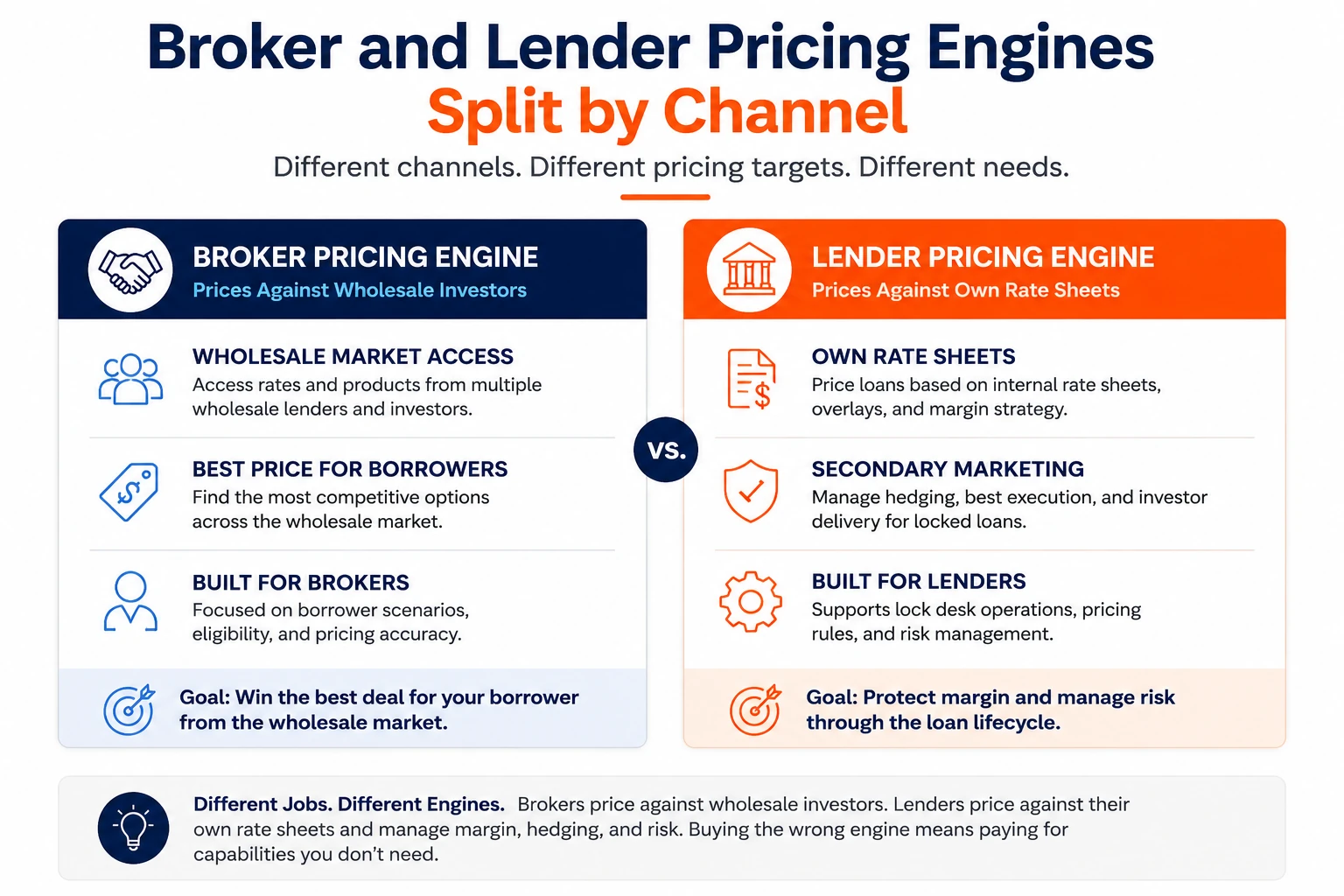
Brokers price against wholesale investors. Lenders price against their own rate sheets and manage margin, hedging, and lock desk risk on top.
Those are different jobs and the engines split along that line. Buy a lender engine as a broker and you pay for a secondary marketing stack you will never open.
The Top 7 Mortgage Pricing Engines of 2026
1. Optimal Blue
Optimal Blue is the lender and enterprise standard. It sits under Constellation Software’s Perseus Group. Perseus acquired it from Black Knight in September 2023, an FTC condition of ICE’s Black Knight purchase.
The engine prices and locks loans in real time against investor guidelines, applying adjustments by borrower scenario. Underneath it sits the part brokers do not need: BESTX competitive execution, margin management, hedging, trading, and lock desk automation.
Key features
- Real-time rates and eligibility across a wide investor and correspondent network
- Eligibility checks on credit score, DTI, LTV, occupancy, and loan purpose
- Instant locking with lock desk workflow automation
- Configurable pricing rules and margin strategy by channel
- Audit trails on pricing and product selection
- Secondary marketing tools for hedging and pipeline risk
- CRM and LOS integrations
Fits: banks, credit unions, and lenders running secondary marketing in house. Skip if: you are a broker. Their broker product is LoanSifter, entry four.
2. Mortech
Mortech belongs to Zillow Group and serves correspondent lenders, community banks, and credit unions. Its strength is stability and breadth of integration rather than newest interface.
The engine prices loan rules, borrower specifics, and PMI requirements together. That matters if mortgage insurance affects your pricing. It also pushes live rates to your website and to Zillow.
Key features
- Automated pricing built from guidelines, borrower criteria, margin, and PMI
- Instant mortgage insurance quotes from multiple MI providers
- API integrations with LOS platforms and CRMs
- Live rate display on your site and on listing marketplaces
- Rate disclosure compliance controls
- Lead activity tracking alongside pricing
Fits: community banks, credit unions, and correspondents who want a mature platform with MI built in. Skip if: you want the newest interface.
3. Lender Price
Lender Price is the API-first option, and it goes deepest on non-QM.
Its Base Price solution automates base pricing so capital markets teams are not maintaining spreadsheets. Pricing controls run granular: overlays, margin periods, and conditions configurable by channel or by branch.
Key features
- Cloud-native engine with configurable eligibility, rules, and margin
- Base Price automation for capital markets teams
- Overlay and margin control by channel and branch
- Deep LOS, CRM, and POS integration
- Compliance checks on pricing rules
- Analytics on loan officer pricing behavior
- SOC 2 controls
Fits: shops building custom pricing experiences, and anyone with real non-QM volume. Skip if: you want something configured out of the box.
4. LoanSifter
LoanSifter is the broker engine, and it has been the default for independent brokers for over a decade.
Same owner as Optimal Blue, entirely different product. This one prices against wholesale investors and produces borrower-facing comparisons. It carries no secondary marketing stack. That is why it costs a fraction of the lender engine.
Optimal Blue reports 120-plus wholesale investors, 6,000-plus users, and roughly 800,000 monthly searches on the platform. Product Comparison, the side-by-side report you hand a borrower, is included in every subscription.
One more thing on positioning. Pricing is sourced across the market rather than influenced by a single lender. That matters when a broker is defending a recommendation.
Key features
- Live pricing from 120-plus wholesale investors in one search
- Best-execution search by borrower criteria and loan parameters
- Rate locking with wholesalers inside the platform
- Borrower-facing Product Comparison report, included in all subscriptions
- LOS integration with Calyx Point and Encompass
- Saved search templates and investor groups
On price: Optimal Blue does not publish LoanSifter pricing. Third-party listings quote figures that do not agree with each other. Get a quote.
Fits: independent brokers and small broker shops. Skip if: you are pricing off your own rate sheets rather than wholesale.
5. Polly
Polly is the tech-forward option for mid-size and larger lenders. Cloud-native, no-code configuration, and the strongest developer-facing API of the seven.
Beyond the engine it runs a Loan Trading Exchange, which connects loan buyers and sellers digitally. That makes it a capital markets platform rather than only a pricing tool.
Key features
- No-code product, pricing, and margin configuration
- Loan Trading Exchange for secondary market execution
- Real-time dashboards on margin, lock volume, and investor performance
- AI assistance that surfaces alternatives when a loan is ineligible
- Multi-channel pricing for wholesale, retail, and correspondent
- API-first architecture
Fits: mid to large lenders who want to configure pricing without a vendor ticket. Skip if: you are small enough that no-code flexibility is not worth the platform.
6. Encompass Product and Pricing Service
EPPS is the pricing service built into Encompass, and ICE calls it the only Encompass-native product and pricing engine. That claim is the entire argument for it.
Pricing, locking, and underwriting happen in one system, so nothing gets rekeyed between pricing and the loan file. For a shop already running Encompass, that outweighs most feature comparisons.
ICE reports pricing across thousands of programs. Rate quotes and lock requests both submit from inside the LOS. It also monitors the loan for changes after pricing. That is what catches a scenario drifting out of eligibility mid-file.
HELOC support is worth naming. First Tech Federal Credit Union cited it specifically when they selected EPPS. Not every engine here handles home equity lines well.
Key features
- The only pricing engine native to Encompass
- Pricing across thousands of programs from inside the LOS
- Instant borrower rate quotes and lock request submission
- Automatic monitoring for loan changes through the file’s life
- Program-specific rules and guidelines for compliance
- HELOC product support
- Eligibility rules and overlays by branch and channel
One naming note. ICE markets this as the ICE Product and Pricing Engine on product pages. Press releases still say EPPS. Same product.
Fits: anyone already on Encompass, and credit unions with HELOC volume. Skip if: you are not on Encompass, since the native integration is the whole case.
7. LoanNEX
LoanNEX exists for the loans the other engines handle badly. Non-QM, DSCR, jumbo, bank statement, asset-based, ITIN, and self-employed borrowers.
It runs as a marketplace as well as an engine. The Broker Marketplace connects originators to investors and wholesalers with two-way scenario negotiation. In non-agency, pricing is often a conversation rather than a rate sheet.
The company reports more than 50 investor programs and non-QM product lines. It also reports 80% year-over-year growth in lock activity and a 77% rise in unique customer adoption. Growing fast in a segment the legacy engines mostly skipped.
Its practical advantage is discovery. A broker working a self-employed or investor-property scenario would otherwise check investor portals one at a time.
It deploys two ways: embedded in Encompass TPO Connect, or standalone with an open API. It also integrates with LendingPad.
Key features
- Real-time pricing and eligibility across agency and non-agency in one engine
- Broker Marketplace for shopping, engaging, and transacting in one place
- Two-way scenario submission and pricing negotiation with investors
- 50-plus investor programs and non-QM product lines
- Custom eligibility rules and dynamic overlays by channel and borrower type
- Support for DSCR, bank statement, asset-based, and ITIN products
- Deploys inside Encompass TPO Connect or standalone via open API
Fits: brokers and correspondents where discovery across many non-agency investors is the actual problem. Skip if: you write agency paper almost exclusively.
Key Features to Look for in a Mortgage Pricing Engine
Six capabilities separate these platforms. Everything else is table stakes.
| Capability | Why it decides the purchase | Strongest here |
|---|---|---|
| Channel fit | A lender engine sold to a broker includes a secondary marketing stack nobody opens | LoanSifter for brokers, Optimal Blue for lenders |
| Native LOS integration | Rekeying between pricing and the loan file is where quotes get stale | EPPS inside Encompass |
| Non-agency depth | Agency engines return nothing on a bank statement or DSCR scenario | LoanNEX, then Lender Price |
| API and developer access | Determines whether pricing reaches your CRM, POS, and website | Polly, then Lender Price |
| Secondary marketing tools | Only matters if you hedge and run a lock desk in house | Optimal Blue, then Polly |
| MI quote integration | Only matters if mortgage insurance affects your pricing | Mortech |
Four questions settle it faster than a feature list.
Which channel are you? Broker means LoanSifter or LoanNEX. The best mortgage pricing engine for lenders is a different question. That answer is Optimal Blue, Polly, Mortech, or Lender Price. Most engines are built for one side or the other.
What is your LOS? On Encompass, EPPS starts ahead of everything else. That advantage is real and specific.
Do you run secondary marketing in house? If yes, hedging and lock desk automation move from nice to necessary. That narrows you to Optimal Blue or Polly.
What share of your book is non-agency? Above a small share, LoanNEX or Lender Price earn a look regardless of the other answers.
How Mortgage Pricing Engines Improve Lending Operations
Three things change, and they are measurable.
Quote turnaround. A loan officer pricing manually opens rate sheets, checks guidelines by hand, and calls someone when the scenario is unusual. That takes minutes per quote and longer when the borrower is not straightforward. An engine returns eligible products with pricing in one search.
Requote volume. Manual pricing produces quotes that die at underwriting because the borrower never qualified. Every one of those is a call back to the borrower and a repriced file. The eligibility check is what prevents it, and it is the difference between a pricing engine and a rate sheet.
Lock desk load. Pricing that flows into the lock request without rekeying removes an entry point for errors. Lock desk exceptions get expensive at volume, and most of them start as a transcription mistake.
None of that happens if the quote stops at the pricing tool. It has to reach the systems your team works in. POS to LOS data sync belongs in the evaluation alongside rate accuracy.
We compared the systems that own the loan file in how the LOS platforms stack up. The borrower-facing layer is in the mortgage POS comparison.
Frequently asked questions
What is a mortgage pricing engine?+
A mortgage pricing engine, or PPE mortgage tool, takes a loan scenario and returns the products the borrower qualifies for. Each comes back with current pricing. It checks the scenario against investor guidelines first, then prices what is eligible.
The distinction from a rate sheet is the eligibility check. A rate sheet tells you what a product costs. A pricing engine tells you whether your borrower can have it.
What is the difference between Optimal Blue and LoanSifter?+
Channel. Both belong to Constellation Software’s Perseus Group, and they serve different buyers.
LoanSifter prices against wholesale investors for mortgage brokers. Optimal Blue PPE prices for lenders and carries a secondary marketing stack: hedging, trading, and lock desk automation. A broker buying Optimal Blue pays for capabilities they will not use.
Which mortgage pricing engine is best for credit unions?+
Mortech is the common answer, for MI integration and platform stability. Optimal Blue fits credit unions running secondary marketing in house.
The deciding factor is usually the LOS rather than the engine. If you are on Encompass, EPPS starts with an advantage nothing else can match.
Do pricing engines integrate with a CRM?+
Most do, through an API. What varies is how much passes through. Some send the rate quote back to the contact record and some only return it in the pricing tool.
Ask what fields come back and whether the quote lands on the borrower record. A quote nobody can find later is a quote that gets rebuilt.