Most mortgage lead generation companies are not selling the same product. The lists ranking for this term treat them as if they were. A rate table, a shared-lead marketplace, and a live transfer are different purchases with different price structures. Buy the wrong one for your operation and the lead cost is not your problem. The mismatch is.
Below are the eight worth your money. Each entry covers what the company sells and how to price it against your own market.
The three kinds of company that actually sell mortgage leads
Every vendor below fits one of three models. The model determines what you own, who else got the same contact, and how you pay.
Publishers sell access to an audience they own. Marketplaces and mortgage lead aggregators sell a submitted inquiry to three to five buyers. Live transfer sells a phone call already in progress. Three different transactions, and the price of each means something different.
Model
What you buy
How you pay
Exclusivity
Fits
Publishers and comparison sites
Access to an audience the publisher owns
Per click, per placement, or per lead
Shared by design
Lenders with competitive pricing and fast quote turnaround
Shared-lead marketplaces
A submitted consumer inquiry
Per lead, priced by filter set
Sold to three to five lenders
Teams with real follow-up capacity and volume tolerance
Live transfer
A consumer already on the phone
Per transfer, several times a lead price
Yours for the length of the call
Teams staffed to answer immediately
What is not on this list
Landing page builders, funnel software, and mortgage marketing agencies are not mortgage lead generation companies. They belong in a different budget line. They build the machine that produces leads. They do not sell you one.
Credit bureaus selling prescreen data are also out. That is a data purchase governed by different rules, and the rules changed this year.
Managed marketplaces are out too. Getting placed on a vetted panel and billed on funded loans is a referral arrangement, not a lead purchase.
Every one of those is a legitimate spend. None of them answers the question a loan officer asks when searching for mortgage lead providers. That question is where to send money today and get contacts back this week.
The Homebuyers Privacy Protection Act reshaped lead supply in 2026
The Homebuyers Privacy Protection Act took effect March 4, 2026. Public Law 119-36 amends the Fair Credit Reporting Act and nothing else. It closed the credit-report route to lead generation. Credit bureaus can no longer sell prescreened mortgage inquiry data, the practice the industry called trigger leads. A narrow set of existing-relationship exceptions survives.
That removed a large block of cheap inventory from the market. Cheap inventory sets the floor price for everything above it. With the floor gone, competition concentrated on what was left. That remaining supply is what the eight companies below sell.
Two practical effects. Filtered inventory in competitive markets is harder to source at volume. And any vendor still quoting you prescreen-derived data owes you a written explanation of which exception it operates under.
The 8 best mortgage lead generation companies
Each entry covers the same fields. What it is, what you buy, how it prices, who it fits, where it falls down.
1. LendingTree
The default marketplace, and the one every LO has an opinion about. Consumers submit a single inquiry and get matched to a lender panel.
You buy a shared lead, filtered by loan purpose, credit band, geography, and loan amount. Pricing runs per lead against the filter set you select. The panel structure means speed decides the outcome more than pitch quality.
Fits teams with staffed follow-up and the discipline to work a contact the same minute it arrives. Falls down for solo originators who cannot answer inside a few minutes.
2. Bankrate
The highest-intent rate shopper on the open web, and priced accordingly. Bankrate’s tables put your quote in front of consumers actively comparing lenders.
You buy placement rather than a contact record. Pay per click or per lead depending on the placement. Your rate has to be genuinely competitive or you are paying for traffic that bounces to the lender above you.
Fits lenders with pricing that holds up in a side-by-side table. Falls down if you compete on service rather than rate.
3. Zillow
The largest purchase-intent audience in residential real estate, with a caveat covered below. Zillow’s lender advertising products connect you to buyers already shopping homes.
You buy connections from consumers deep in a purchase search. Pricing is placement-based and varies by market. Purchase intent here is stronger than almost anywhere else, and the competition for it reflects that.
Fits purchase-focused originators in markets they know well. Falls down as a refinance source.
4. NerdWallet
Strong consumer trust and a national audience, with the same caveat as Zillow. NerdWallet’s rate tables and lender profiles reach shoppers who research before they apply.
You buy visibility with that audience and pay for the connections it produces. NerdWallet states that advertising compensation does not affect its lender star ratings or listing order on mortgage pages. Take the stated policy at face value and plan around it. Position is earned on rate and rating, not bought.
Fits lenders with strong reviews and rates that survive comparison. Falls down for teams without a review footprint to point to.
5. FreeRateUpdate
Internet leads and live transfers from a network built specifically to route consumers to lenders. It has operated in this category since 2008 and works with a lender network in the hundreds.
You buy either a standard internet lead or a live transfer, which is a consumer already on the phone. Live transfers price several times a standard lead and should be measured on close rate, not contact rate.
Fits teams with someone available to take a transfer during business hours. Falls down if calls hit voicemail.
One note for anyone checking licenses. FreeRateUpdate holds mortgage broker licensing under NMLS #1154338 and describes itself as a marketing lead generator. Holding a license is not the same as originating loans in competition with you.
6. Lendgo
A rate-comparison marketplace that matches consumers to a lender panel after they complete a quote request.
You buy a shared lead, sold to three to five lenders. Filter control covers geography, loan purpose, and credit profile. Pricing follows the marketplace model, set by filters against available volume.
Fits teams testing a second marketplace alongside a primary source. Falls down as a sole source, because panel volume in any single market is finite.
7. LeadPoint
A long-running mortgage lead marketplace that rewards buyers who track their own numbers. Filter control is the reason to use it.
You buy shared leads, sold to three to five lenders, filtered on geography, loan purpose, and borrower profile. Price moves with how tight the filters are and what volume is available.
Fits buyers who measure conversion by filter and adjust the buy. Falls down for anyone who wants a vendor to manage it for them.
8. Mortgage Research Center
The strongest Veteran and military audience in the category. This entry also demands the most precision about what you buy.
Mortgage Research Center operates a network of military-focused consumer properties with real audience reach. It also carries NMLS #1907 as a dba of Veterans United Home Loans.
Buy refinance, FHA, and conventional purchase from them. Do not go to them for VA purchase leads. That flow feeds Veterans United, and it is not going to be sold to a competing lender.
Fits lenders serving military communities on non-VA-purchase products. Falls down the moment you expect VA purchase volume out of it.
Three of these companies are also lenders
Zillow originates through Zillow Home Loans, NMLS #10287. Its own materials state that it originates and processes loans itself. Zillow Group told shareholders it continues to expand that product suite. NerdWallet acquired the brokerage Next Door Lending in late 2024 and now runs NerdWallet Mortgage Experts. Mortgage Research Center is the Veterans United entity.
None of that is a reason to avoid them. All three sell real inventory, and two of them sit on audiences nobody else can reach.
It is a reason to be specific about what you buy. A parent that originates keeps the loan type its business is built around and sells the rest. The Mortgage Research Center case is the clearest version, because the boundary is obvious: VA purchase stays home.
Zillow and NerdWallet are less clear cut, and one of them has said something on the record. NerdWallet publishes that advertising compensation does not affect lender star ratings or listing order on its mortgage pages. That is a stated policy about placement. It is not a statement about how the in-house brokerage sits inside the same experience. NerdWallet Mortgage Experts is one of the options a consumer can choose.
Neither company publishes the mechanics underneath. So ask during the sales call. Which products does your origination arm prioritize in my markets? How is that inventory kept separate from what you sell me?
A vendor that answers straight is worth buying from. A vendor that talks around it has told you something.
Why lead pricing changes state to state
Anyone publishing a national cost-per-lead table is selling you certainty they do not have. Before you compare two vendors on price, find out how each one sets it. Mortgage lead generation companies do not use the same model, and many have changed models in the last few years.
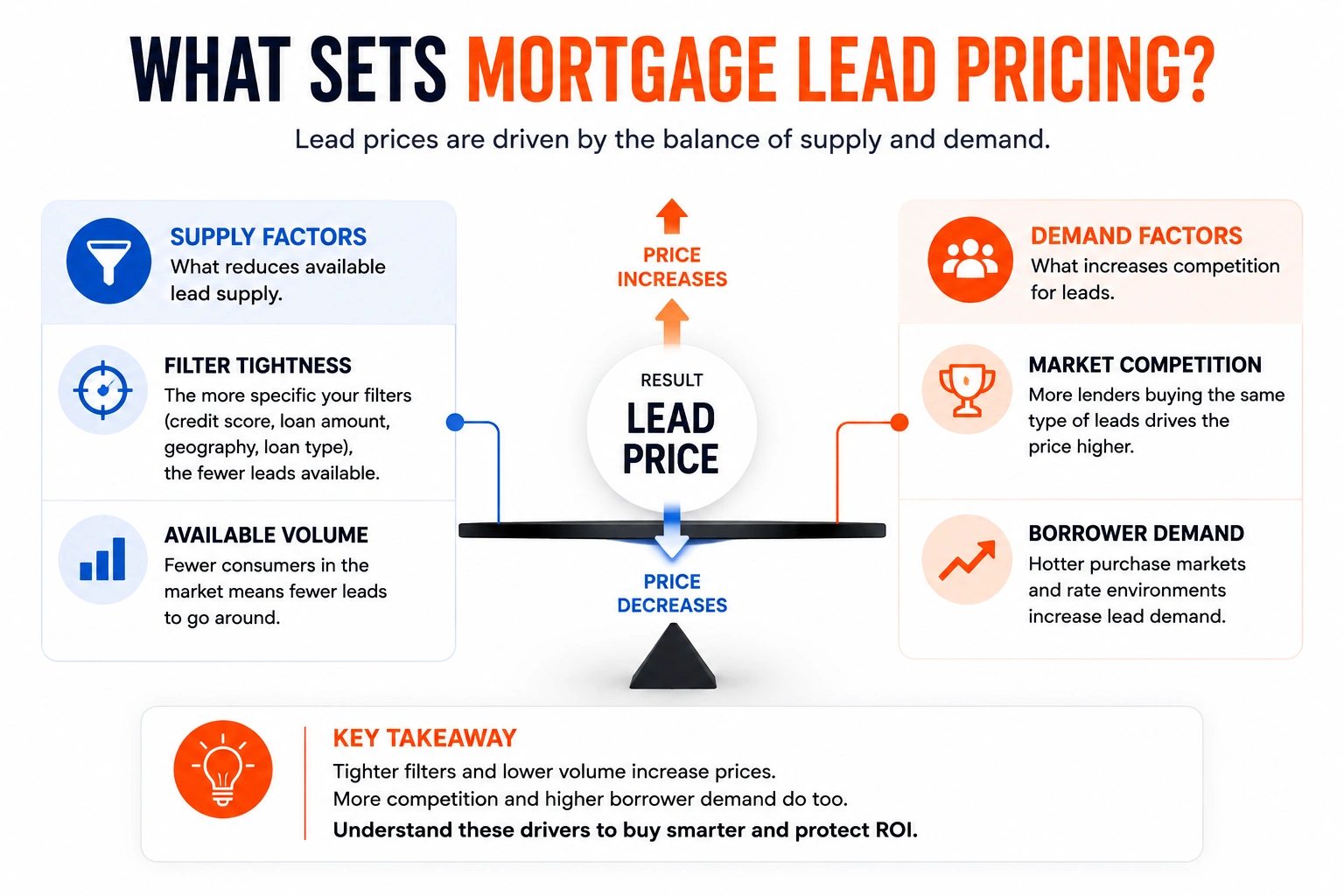
Many vendors now price to the market. Demand and available volume set the number, and nobody is defending a sheet. That is a deliberate choice. Market-based pricing moves the pricing pressure off the vendor and onto the auction.
Two things move the price under that model. The first is the filter set you ask for. Tighter filters on credit, loan amount, property type, and timeline shrink the pool and raise the unit cost. The second is available volume against current demand in that market. A market with heavy licensed lender competition and thin inventory prices high. A market with less competition prices lower for the identical filter set.
Run the same criteria in California and in Idaho and the prices usually diverge. Nothing about the consumer differs. Demand inside that vendor’s marketplace does.
Volume and long-term relationships still affect pricing. They always have. A vendor who trusts you to take consistent delivery treats you differently from a buyer testing 50 leads. Some smaller vendors quote off a rate card, where that shows up most directly.
What market-based pricing changed is how easily a vendor sidesteps the discussion. The market set the price, not us. In many cases that is where it ends. Bring volume and build the relationship anyway, because both still move things. Do not expect a market-priced vendor to drop a unit cost on a call.
Your faster lever under market pricing is what you bid on rather than the ask. Loosen a filter, add an adjacent county, or widen the hours you accept delivery.
So price your own market. Ask every vendor to quote your states and your exact filter set. Ask how that price gets set. Run the identical filter set at two vendors to see the spread. Commit volume only after a market-specific number is in hand.
One piece of context for the math. MBA’s Q1 2026 Quarterly Mortgage Bankers Performance Report puts average total loan production expense at $11,898 per loan. Pre-tax net production profit came in at $727. That is 16 basis points. Lead cost discipline is not a preference at that margin.
That discipline has a playbook of its own. Our guide to buying mortgage leads without burning your budget covers setting a maximum cost per funded loan and pacing the spend so one slow month does not sink the channel.
How to vet a lead vendor before you spend
Ask these in writing and keep the answers. The mortgage lead companies worth buying from will answer all five. A vendor that will not put them in writing has answered anyway.
How is the lead generated? Owned property, paid media, partner network, or resold from another source. Resold inventory arrives with history you did not buy.
How many buyers receive it? Get the number, not the word “limited.”
What is the resale window? Some inventory sells again after a set period. Know when.
What is the return policy? Wrong number, wrong state, and duplicate contacts should return. Get the window and the process.
What consent record comes with it? This is the one that matters most and gets asked least.
On that last point, know what you are asking for. The TCPA requires prior express written consent before autodialed marketing calls or texts, under 47 CFR 64.1200. In January 2025 the Eleventh Circuit vacated the FCC rule requiring one-to-one consent naming each seller. The case is Insurance Marketing Coalition v. FCC. The underlying consent obligation survived it.
Ask the vendor to supply a certifiable consent record per lead, of the kind third-party services like TrustedForm produce. Ask what disclosure the consumer saw and whether your company was identified. Then have your own counsel tell you what that record has to contain for your operation. We are describing what the instruments say. We are not ruling on your situation.
What your CRM has to handle before you buy
Purchased leads punish weak intake. Four capabilities decide whether the spend works, and they belong on your checklist before the first invoice.
Speed to first touch, measured in seconds. CFPB research found 77% of borrowers apply to only one lender, and almost half seriously consider only one. On a shared lead, four other people are racing you into that consideration set.
Deduplication against your existing database, checked before the lead is accepted. Paying a vendor for someone already in your pipeline is the most common invisible waste in a lead budget.
Consent field capture on intake, stored with the record. A consent certificate sitting in a vendor portal does you no good during a dispute.
Source-level reporting through to funded. Cost per lead is a vanity number. Cost per funded loan by source is the only figure that tells you which vendor to scale.
Those four are lead management, not contact storage, and mortgage lead management software treats them as the product rather than as settings.
Not every system does these natively. The differences between platforms run deeper than the marketing suggests. We broke down how the top mortgage CRMs compare on lead intake, routing, and attribution rather than on feature counts.
Frequently Asked Questions
Are mortgage leads worth buying?+Yes, for teams that answer fast and measure to funded. The best mortgage leads are rarely the cheapest ones, and never the ones nobody calls. Shape client data puts the average at 17 attempts across calls, texts, and email to convert a lead. The vendor rarely determines the outcome.
No, if you lack three things. Reporting, follow-up, and lead management that holds the team to a speed to contact. That is what maximizes conversion. Without those three, bought leads will not pay for themselves at any price.
Why do mortgage lead prices vary so much by state?+Because some vendors set pricing by demand rather than off a fixed rate. Where that is the model, the price tracks lender competition and available volume inside that vendor’s marketplace. The same criteria then price differently from state to state. Ask each vendor how it sets price, then get a quote on your own states.
Can you negotiate lead pricing with a vendor?+Volume and a long-term relationship affect pricing with most vendors. That is our experience on both sides of these deals. Market-based pricing gives a vendor a clean way to sidestep the discussion, and many use it. Ask how a vendor sets price before you open the conversation. Your faster lever under that model is the filter set and the geography.
Kevin Benner is the Chief Revenue Officer at Shape Software, where he leads revenue, marketing, and customer growth. He brings over 23 years of experience in mortgage lead generation and sales technology.
Mortgage lead cost runs from pennies to over $200 per lead. Five different products get sold under the same word, which is most of the spread. The rest of the spread is that vendors do not really have a price. More on that below. Lead type Price range Where to buy Shared short form, no […]
Most lead vendor questions get answered with adjectives. Ask for numbers instead. These are the questions to ask a lead vendor before you commit. They separate a company generating its own inventory from one reselling somebody else’s. Both can be worth buying from. You need to know which you have. Work it in order. It […]
Neither one is better. The answer depends on your contact rate, and you do not know that number yet. That is not a dodge. Exclusive vs shared leads has a real answer. It is just a different answer for a two-person shop than for a floor of forty with a dialer. Every guide on this […]