Time Zone for Calling Leads: Area Code, State or ZIP?
An area code tells you where a phone number was issued. It does not tell you where the borrower is when you dial. Most dialers still start there. Getting the time zone for calling leads right comes down to which data your system trusts first. It also depends on what the system does when that data disagrees. On a mortgage lead, that is a real question. The file carries an area code and up to three addresses.
Whose clock the calling window runs on
The federal calling window runs on the called party’s local time, not yours. The FCC’s rule bars telephone solicitations before 8 a.m. or after 9 p.m. The clock it names is “local time at the called party’s location.” That language sits in 47 CFR 64.1200(c)(1).
The rule says location. It never mentions area codes. Whether an area code is enough to establish where a borrower is may be read differently by different courts. Your counsel decides how your shop treats it.
Which contacts the window covers, and what consent changes, is its own subject. That belongs to the legal hours for calls and texts. The question here is narrower: once the window applies, whose clock is it?
Area code vs address time zone: the area code is the weakest signal
Mobile numbers move with people. A borrower who left Charlotte for Seattle years ago can still answer a 704 number. Dial that lead by area code at 8:30 a.m. Eastern and the phone rings in Seattle at 5:30 a.m. Reverse the move and the call lands late morning, which is harmless. The risk runs one way, and it runs against you.
Split time zone states make it worse. Florida, Kentucky, Tennessee, Indiana and Texas all span two time zones. Florida’s 850 area code covers Tallahassee on Eastern time and Pensacola on Central. The area code alone cannot tell you which side of the line the borrower lives on.
Florida adds a legal wrinkle. Its telephone solicitation law presumes a call to a Florida area code reaches a Florida resident (Fla. Stat. 501.059(8)(d)). That presumption may matter for which state’s law applies. It still says nothing about the borrower’s time zone.
A mortgage lead carries three addresses
To determine a lead’s time zone on a mortgage file, rank the data you already hold. A mortgage lead carries up to three: a present address, a mailing address and a property address. They answer different questions.
The property state decides who can originate the loan. The present address decides when you can call. Take a borrower who lives in Chicago and is buying a second home in Scottsdale. Licensing follows Arizona. The calling window follows Illinois, where the borrower wakes up.
Purchase leads raise the stakes. On a purchase lead, the property ZIP points at where the borrower is going, not where they are now. A system that reads the property ZIP first will call people on the wrong clock.
The order that holds up:
- Present ZIP
- Mailing ZIP
- Property ZIP
- Area code, as a last resort
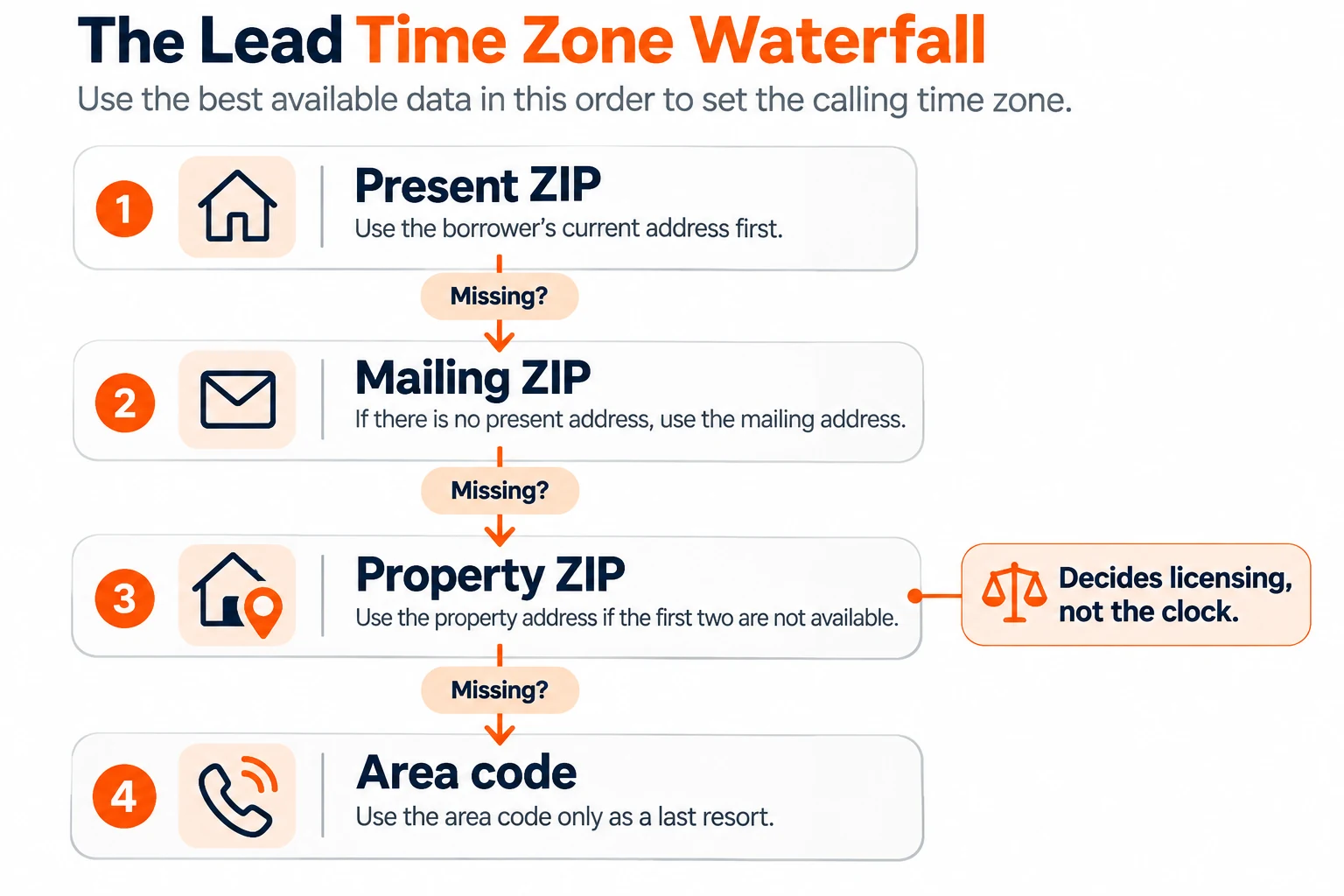
That ranking only works if the system keeps all three addresses as separate fields. A contact list with one phone and one state cannot do it. Lenders run a mortgage CRM with compliance features and audit trails for that reason, not a spreadsheet feeding a dialer.
When the time zone for calling leads is unclear, use the stricter window
When the data cannot settle the time zone, take the most restrictive window that could apply. That covers a missing ZIP, a split-state area code, or two addresses that disagree.
Take an 850 number with no address on file. The borrower could be on Eastern or Central time. The first call waits for 8 a.m. Central. The last call ends by 9 p.m. Eastern. You lose an hour at each end. You also stop guessing.
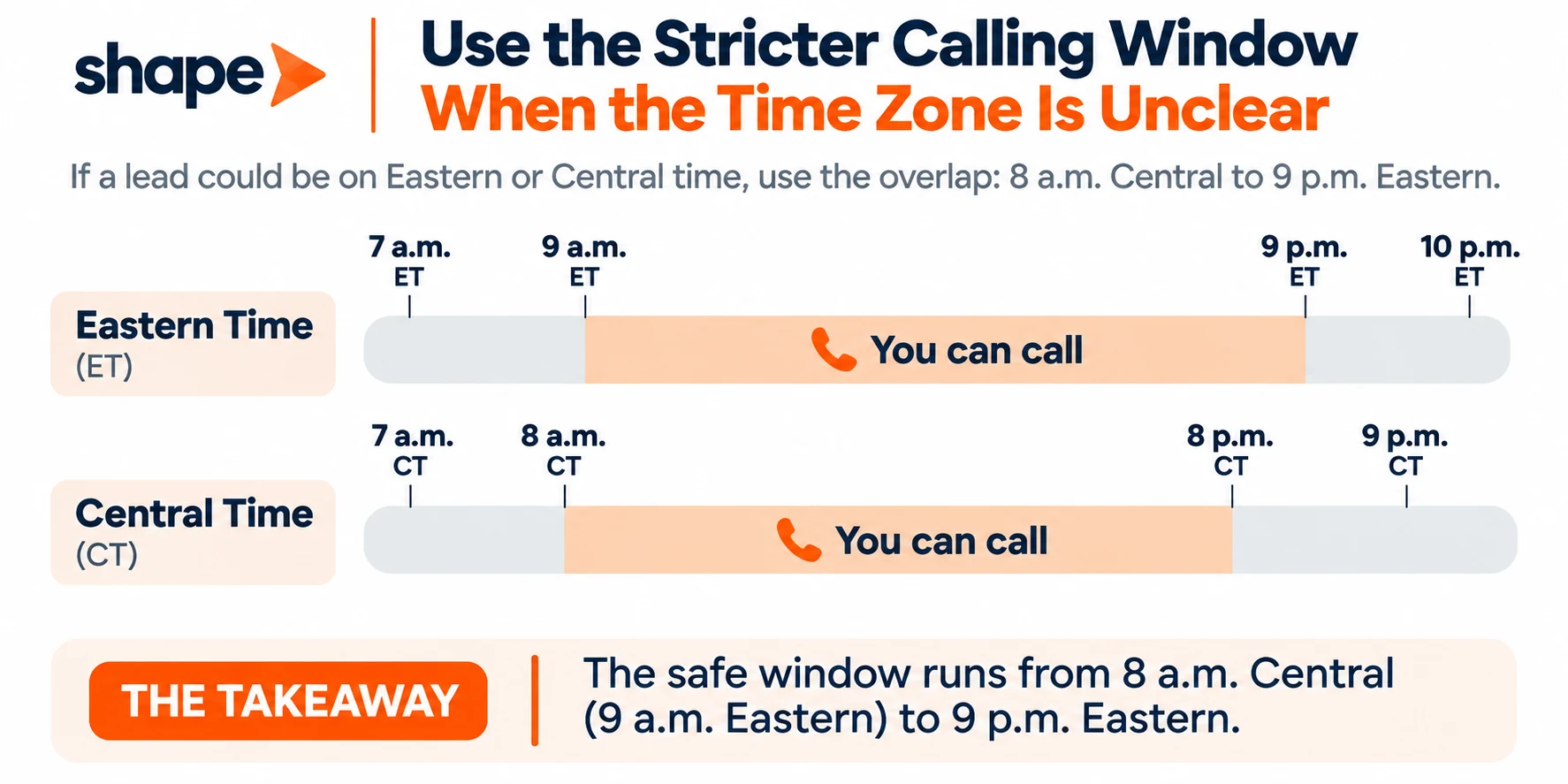
Set that rule once as your time zone for calling leads whenever data is missing. Apply it to every channel your system sends on. Which field sets the clock, and what happens when it is blank, is a configuration choice. It belongs on the list of what to decide before you go live, next to consent and opt-out data.
State laws narrow mortgage calling hours
Federal hours run 8 a.m. to 9 p.m. Several states cut that window or close Sundays. Two examples show how far they move.
Florida bars commercial solicitation calls before 8 a.m. or after 8 p.m. “in the called person’s time zone.” That is Fla. Stat. 501.616(6)(a), last amended in 2021.
Texas allows telephone solicitation from 9 a.m. to 9 p.m. Monday through Saturday, and noon to 9 p.m. on Sunday. That is Tex. Bus. & Com. Code 301.051. The section exempts calls made at the consumer’s express request. It also exempts a prior or existing business relationship. A borrower who asked to be contacted may fall inside that exemption. Check with counsel before you rely on it.
Check the statute itself before you set a window. Then have counsel sign off on the windows you run.
What to ask any CRM or dialer
Time zone blocking is standard in dialers. The differences sit in four answers:
- Which field sets the time zone, and in what order?
- What happens when that field is blank, or two fields disagree?
- Are state windows, holidays and daylight saving built in, or does an admin type them?
- Does the rule hold AI calls, AI texts and pull queues, or only manual dials?
Put those four in the demo script for the mortgage CRM decision. The other place they come up is the review after a complaint.
How Shape’s Time Zone Protect sets the window
Shape’s Time Zone Protect reads the borrower’s address before the area code. It checks present ZIP, then mailing ZIP, then property ZIP. The area code is the last resort. Many dialers start from the area code instead.
State windows, state holidays and daylight saving changes come pre-configured. Nobody on your team builds them by hand. When Shape cannot verify where the borrower is, it applies the stricter window.
AI calls and AI texts in Shape always wait for the borrower’s window. No user can override them.
Shark Tank hides leads that sit outside their window, so nobody claims a lead at 6 a.m. borrower time. The lead reappears when its window opens. Account for those hidden leads when setting neglected-lead rules for claim timers.
Warnings on calls a loan officer places by hand are off by default. Turn them on during setup. Third-party dialers are not covered. If your team dials from another phone system, that system needs its own calling-hour controls.
Shape treats these windows as platform settings, not legal advice. The full configured list of states and holidays is in the Time Zone Protect guide.