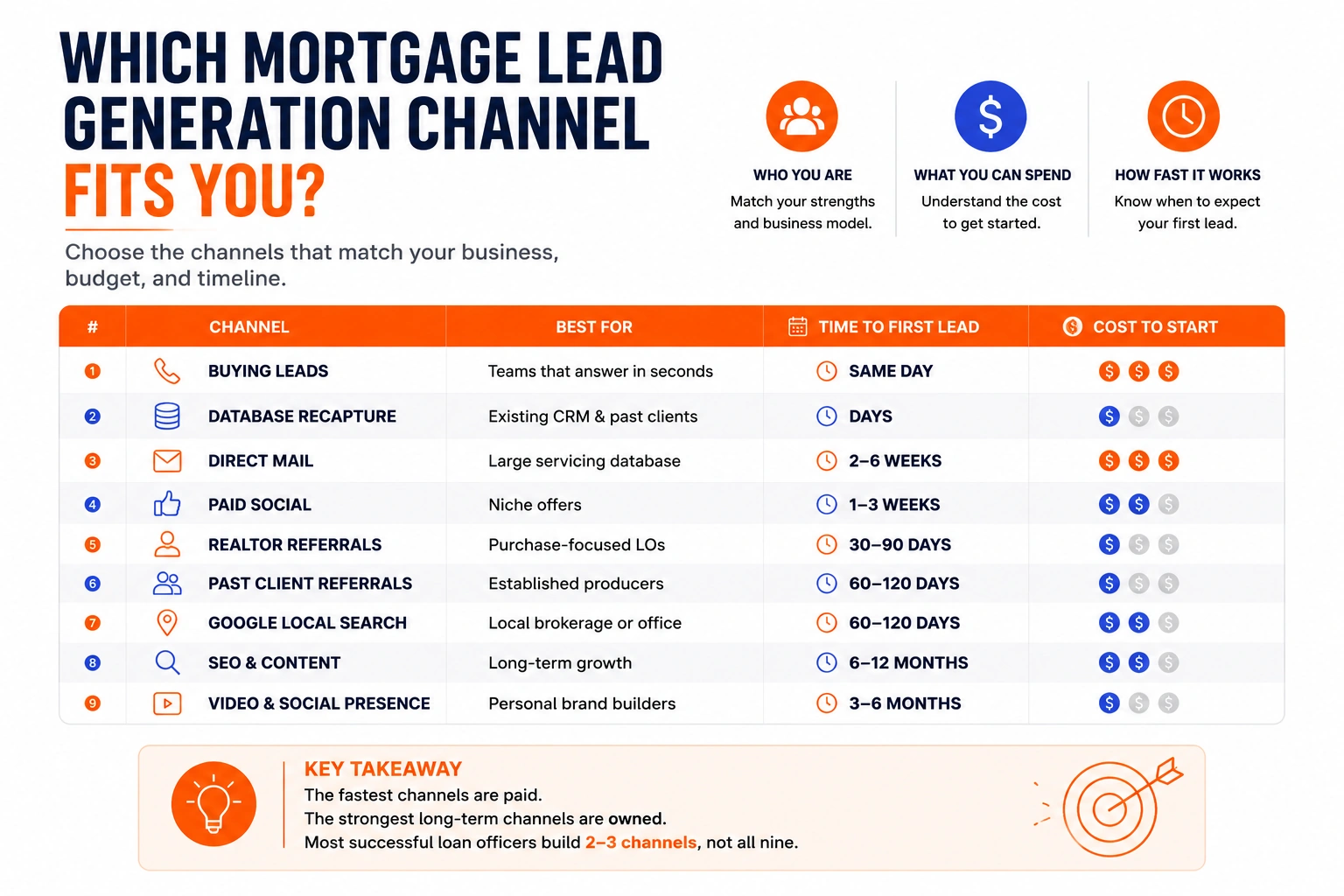
Nobody runs all nine mortgage lead generation channels. Everyone runs two or three, and the ones they pick usually match how they already sell.
An originator who came up buying leads works leads. Someone whose business comes from three agents grows referrals. Both are right. The mistake is reading a list of tactics and assuming you are supposed to do all of them.
Every roundup of mortgage lead generation strategies presents all of them as equally applicable to whoever is reading. They are not.
So this is not a build order. Below are nine channels. What each one is good at, who it suits, where it hurts, and one thing to do this week.
How to pick
Two questions get you most of the way.
What already works for you? Whatever produces your business today is the channel with the shortest path to more. Doubling a source you understand beats starting one you do not. Most originators skip past this because the existing channel feels boring.
What are you willing to do every week? Every channel on this list demands a specific behavior. Video demands being on camera. Referrals demand showing up in person. Content demands writing when nothing is happening yet. Pick against your temperament, not against the return, because the channel you abandon returns nothing.
Runway matters too. Some of these pay in days and some in quarters, which the table below makes explicit.
The nine mortgage lead generation channels at a glance
Channel
Best for
Cost to start
First lead
Ceiling
Buying leads
Teams that answer in seconds
Per lead, no setup
Same day
Your budget
Database recapture
Anyone with a year of history behind them
Near zero
Days
Size of your list
Direct mail
Lenders with a servicing portfolio or a deep past-client file
Per piece, at volume
2 to 6 weeks
Size of your file
Paid social
Originators with a specific niche offer
Ad budget plus a week
1 to 3 weeks
Your budget
Realtor and agent referrals
Purchase-focused LOs who are good in person
Your calendar
30 to 90 days
Very high
Past-client referrals
LOs with volume and a service reputation
Near zero
60 to 120 days
Very high
Local search
Anyone with a defined market or an office
Low spend, steady upkeep
60 to 120 days
Your market size
Organic content and SEO
Shops with budget or an owner who writes
Time or a retainer
6 to 12 months
Very high
Video and social presence
People who will show up on camera weekly
Time and consistency
3 to 6 months
Very high
The channels you can switch on with a budget are capped by that budget. The ones that take months to earn have no ceiling. That trade runs through all lead generation for mortgage brokers.
Buying leads
The fastest way to get a conversation today, and the least forgiving channel here.
Best for. Teams with staffed phones or automation answering in seconds. Refinance-focused shops that need volume now. Newer originators without a database or a referral base yet.
What works. Volume on demand. You can turn it up or down this week. No relationship building, no waiting, no audience to earn.
What hurts. Shared leads reach three to five lenders at once. CFPB findings from the National Survey of Mortgage Originations show most borrowers seriously consider only one lender, and few consider more than two. You are not out-selling four competitors. You are racing them into a consideration set that only has room for one.
Start this week. Pick one vendor, one state, and one filter set. Set a 60-day budget you can lose. Route every lead to whoever picks up fastest rather than round-robin by turn. Choosing between providers is its own problem. We broke down where to buy mortgage leads by what each company sells and how it prices.
Database recapture
The most underworked channel in the business, and the cheapest by a wide margin.
Best for. Anyone with twelve months of history behind them. Established originators get more from this than from anything else on the list, and almost none of them run it.
What works. You already paid to acquire these contacts. Past applicants, fallouts, and pre-approvals that never closed are all sitting there. Rate-drop triggers, equity checks, and anniversary timing produce inside days.
This channel got more valuable in 2026. The Homebuyers Privacy Protection Act closed the credit-report route to lead generation. A large block of cheap inventory left the market. When bought supply tightens, the list you already own is the cheapest acquisition left.
Screen the list before you spend on it. Give a bureau your database and the criteria you want. What comes back is which of those consumers qualify. You never receive their credit data. Prescreen is a filter, not a purchase, which is why it sits apart from the route the Act closed.
For a refi campaign that is the difference between mailing your whole file and mailing the ones who can close.
What hurts. It is capped by the size of your database, so it will not scale past your history. And the blocker is almost never strategy, it is data. A list with dead numbers and missing loan detail cannot be segmented, so nothing runs. That is what mortgage lead management software is for: holding the fields that make a segment possible.
One caution. Consent does not carry forever, and marketing texts sit under the TCPA. Check what each contact agreed to and when. An old application is not blanket permission to text them in 2026.
Start this week. Pull everyone who closed 24 or more months ago. Compare their locked rate against today. Call the twenty with the biggest gap yourself.
Direct mail
Still working in mortgage long after most industries gave up on it, and the pairing above is why.
Best for. Lenders with a servicing portfolio or a deep past-client file. Shops with capital to spend before anything comes back. It also reaches borrowers who ignore email entirely, which is a real segment in this business.
What works. A mailer gets opened by people who never open an email. Paired with a screened list it is precise, because you are writing to borrowers you already know qualify. Response is slow but measurable, and the format survives inbox fatigue.
What hurts. You pay per piece whether anyone responds or not. Attribution is the hardest of any channel here. A mailer received Tuesday becomes a call three weeks later with no source attached. Volume economics only work at scale, and lead times run weeks from list to mailbox.
Start this week. Take the screened refi list from the section above. Mail the top 500 by rate benefit. Put a distinct phone number and a distinct URL on the piece so you can attribute the response.
Paid social
Faster than search, slower than buying leads, and the only paid channel where you control the message.
Best for. Originators with a specific niche offer. First-time buyer programs, a physician loan, a local down payment assistance product. Generic rate advertising loses here.
What works. You control the audience and the creative. Testing is cheap and results come back in weeks. A niche offer nobody else advertises can produce for a long time before it fatigues.
What hurts. Costs rise the moment you scale. Nothing you build carries over when you stop paying. Creative fatigues and needs replacing. And the leads are colder than search, because you interrupted the person rather than answering them.
Start this week. One offer, one audience, three weeks. Send traffic to a landing page with a form, not to your homepage. Kill anything that has not produced by the end of week three.
Realtor and agent referrals
Still the highest-quality purchase pipeline in the business, and the slowest to earn.
Best for. Purchase-focused originators who are good with people in person. If you would rather sit across from an agent than record a video, this is your channel.
What works. Referred borrowers arrive pre-trusted, close at higher rates, and cost nothing per lead. NAR’s 2025 buyer profile puts 88% of buyers purchasing through an agent or broker. Agents sit upstream of almost every purchase loan. A single productive agent relationship can carry a quarter.
What hurts. Slow. Expect 30 to 90 days before the first file, and expect to lose most of the agents you court. Concentration risk is real, since agents leave the business and change lenders. Most originators work this channel passively, meet an agent, ask for business, and then wait to be remembered.
Start this week. List the ten agents who closed the most in your primary zip code last quarter. Pick five. Bring each one something they cannot get elsewhere. A market update they can send to their own list. Weekend pre-approvals. A co-hosted buyer event where they get the credit.
Past-client referrals
Everyone agrees this is the best source. Almost nobody systematizes it.
Best for. Originators with real volume behind them and a service reputation worth trading on. The more loans you have closed, the more this channel is worth.
What works. Highest conversion of anything here and effectively free. It compounds, because every referred client becomes a referral source. It also protects you in a slow market, when nothing else is producing.
What hurts. It sits downstream of retention. If your communication stops at the closing table, there is nothing here to harvest. The ask usually gets left to whoever remembers, so it happens after easy closings and never after hard ones.
Start this week. Put the ask into your closing checklist so it stops depending on memory. Then call twenty clients from last year with no agenda at all. That call is the channel.
Local search
A claimed Google Business Profile and location-specific content put you in front of borrowers already searching your market.
Best for. Brokers with an office and a defined geography. Anyone competing in a market small enough to own rather than a metro with fifty lenders bidding.
What works. It does not stop producing when you stop paying, which separates it from everything paid. Intent is high, because a person searching for a lender in your city is shopping now. Upkeep is light once it is built.
What hurts. Capped by the size of your market. Slower than paid, at 60 to 120 days. And review volume is the lever, so a profile with six reviews will not compete with one carrying sixty.
Start this week. Claim and verify the profile if you have not. Add your loan products as services. Then ask your last ten closings for a review, by text, with the direct link.
Organic content and SEO
The longest payback here, and the only channel still producing in year three without further spend.
Best for. Shops with a marketing budget, or an owner who genuinely likes to write. This is a poor fit for a solo originator with three months of runway.
What works. You own it outright. It produces while you sleep, it compounds, and it has no ceiling. It also feeds every other channel, because agents and past clients check you out before they refer.
What hurts. Months one through five produce almost nothing visible. That is the channel working normally, and it is where most people quit. It needs consistency past the point where it feels pointless.
Start this week. Pick one narrow question borrowers in your market actually search. Write the best answer available anywhere. A first-time buyer guide for one metro beats national content competing against every lender in the country.
Video and social presence
Consistency beats production quality every time.
Best for. People who will actually show up on camera weekly. If that sentence made you wince, pick a different channel and stop feeling guilty about it.
What works. It keeps you visible to past clients, agents, and in-market borrowers at once. That is why it lifts your other channels rather than standing alone. Cost is your time. No ceiling.
What hurts. It rarely produces a lead directly, which makes it hard to justify and easy to quit. Attribution is poor. And inconsistency is worse than absence, since a feed that stopped six months ago is a bad signal.
Start this week. Record one 60-second market update on your phone. Post it. Do it again next week. Depth on individual plays lives in the posts beneath this one.
How to tell a channel is working
Whichever ones you pick, judge them the same way.
Contact rate is the early signal. It tells you inside a week whether the leads are real and whether your response process functions. Conversion takes months. Contact rate does not.
Cost per funded loan by source is the verdict. Cost per lead is a vanity number. It makes the worst channels look like the best ones. Mortgage lead generation budgets die from unmeasured channels far more often than from bad ones.
Give it a real window. Sixty days minimum on anything paid. A full quarter on referrals and local search. Six months on content. Killing a channel early tells you only that you were impatient.
Count the attempts before blaming the channel. Shape client data puts the average at 17 attempts across calls, texts, and email to convert a lead. Most channels get declared dead after four.
Ways to generate mortgage leads are not scarce. Picking the two or three that match how you already work is what decides whether any produces.
Channel choice is one part of a wider plan. For the tactics that sit alongside pipeline building, see our marketing ideas for loan officers.
Frequently Asked Questions
What is the cheapest way to generate mortgage leads?+Your existing database. Past applicants, fallouts, and pre-approvals that never closed are contacts you already paid to acquire. Rate-drop triggers and equity checks against that list cost close to nothing and produce inside days. Shape’s view is that most originators reach for a lead vendor before working the names already sitting in their CRM.
How many lead generation channels should a loan officer run?+Two or three, chosen to match how you already sell. Most mortgage broker lead generation stalls with four half-run channels and no numbers on any of them. Running nine badly produces less than running two well. Shape recommends one test either way. If you cannot state what a channel costs you per funded loan, you are not ready to add another one.
Which mortgage lead generation channel is best?+There is no single answer, which is why this page is organized by fit rather than by ranking. Referrals convert best and take longest. Bought leads produce today and stop when the budget does. The best mortgage leads for any given originator come from the channel that matches their temperament and their runway.
How long before a new lead generation channel produces?+It depends entirely on the channel. Bought leads produce the same day. Paid social takes one to three weeks. Referral relationships and local search take 30 to 120 days. Organic content runs 6 to 12 months. Pick against your runway, not against the return.
Is buying mortgage leads better than generating your own?+Neither is better. They solve different problems. Bought leads fill this month and compound into nothing. Owned channels take a quarter or longer and become an asset. Teams that only buy have no business when the budget stops. Teams that only build have no pipeline while they wait.
Kevin Benner is the Chief Revenue Officer at Shape Software, where he leads revenue, marketing, and customer growth. He brings over 23 years of experience in mortgage lead generation and sales technology.
Mortgage lead cost runs from pennies to over $200 per lead. Five different products get sold under the same word, which is most of the spread. The rest of the spread is that vendors do not really have a price. More on that below. Lead type Price range Where to buy Shared short form, no […]
Most lead vendor questions get answered with adjectives. Ask for numbers instead. These are the questions to ask a lead vendor before you commit. They separate a company generating its own inventory from one reselling somebody else’s. Both can be worth buying from. You need to know which you have. Work it in order. It […]
Neither one is better. The answer depends on your contact rate, and you do not know that number yet. That is not a dodge. Exclusive vs shared leads has a real answer. It is just a different answer for a two-person shop than for a floor of forty with a dialer. Every guide on this […]