Neither one is better. The answer depends on your contact rate, and you do not know that number yet.
That is not a dodge. Exclusive vs shared leads has a real answer. It is just a different answer for a two-person shop than for a floor of forty with a dialer.
Every guide on this decision was written by a company selling one of the two products. Here is what exclusivity buys, why the published math contradicts itself, and how to settle it on your own numbers.
Exclusive vs shared leads: what exclusivity actually buys
Exclusive means one buyer received the record. Shared means several did, usually three to five.
That is a statement about distribution. It is not a statement about the borrower.
An exclusive lead does not mean the borrower stopped shopping. They can fill out another form on another site an hour later, and most do. CFPB found that most borrowers submit one application and never seriously weigh a second lender. It puts the figures at 77% and nearly half. That consideration set is narrow, but you do not get placed in it by buying exclusivity. You get placed in it by being in the conversation.
What exclusivity buys is the first conversation without three other callers in it. That is worth real money. It is not the same thing as the borrower being yours.
Watch for semi-exclusive. Some vendors sell to two or three buyers and call it exclusive. That is a real category with a real price point. It is not exclusive. Ask for the number of buyers, not the adjective.
The source matters more than the label
Comparing exclusive mortgage leads vs shared leads on price alone skips the variable that moves conversion most. Where the borrower came from.
A generic rate-comparison form and a branded application form produce different people. Somebody filling out “compare mortgage rates from multiple lenders” came to shop. That intent does not change because a vendor sold the record to one buyer instead of five.
Somebody filling out a form on a lender’s own site came to talk to that lender. Different intent, same lead category.
So ask two questions, not one. How many buyers got this record, and what did the page say that produced it. A vendor who will answer the first and dodge the second is telling you something.
Why the published math contradicts itself
Two of the most-cited analyses on this question reach opposite conclusions.
One states that shared leads are cheaper per lead and exclusive leads are cheaper per closed loan. Another publishes a scenario table showing the reverse: shared leads at $1,250 per funded loan against exclusive at $2,000.
Both are modeling the same thing. Neither sources a single conversion rate.
That is how you end up with a category where every answer sounds authoritative and no two agree. The model is simple arithmetic. Contact rate, application rate, pull-through rate. Change any one input by a few points and the conclusion flips. Both authors picked inputs that favored the product they sell.
We are not going to hand you a third set of made-up numbers.
The number that decides it
Contact rate. Everything else follows from it.
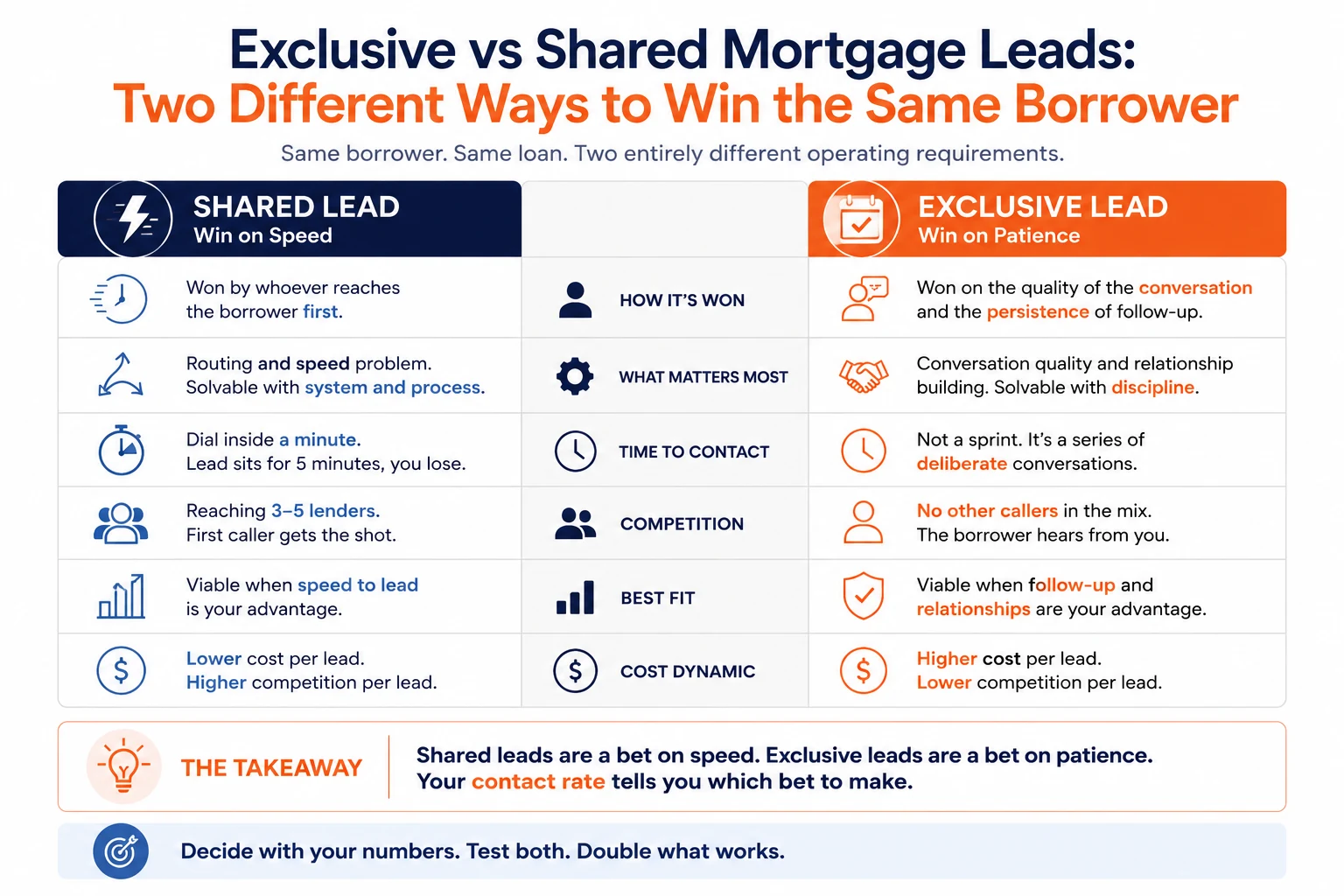
A shared lead reaching five lenders is won by whoever reaches the borrower first. That is a routing and speed problem, and it is solvable with software rather than talent. If your system routes on arrival and dials inside a minute, shared leads are viable. If a lead sits in a queue until someone opens it, you are funding four competitors.
An exclusive lead is won differently. Nobody is racing you, so the first conversation is not a sprint. It is won on the quality of the conversation and the persistence of the follow-up. Shape platform data across every industry we serve, over more than fifteen years, puts conversion at 17 attempts on average. Exclusive leads reward the shop that actually makes 17.
Same borrower, same loan, two entirely different operating requirements.
Shared lead
Exclusive lead
Won on
Speed to first contact
Conversation and cadence
Requires
Automated routing, instant dial
Disciplined follow-up over weeks
Fails when
Nobody answers in the first minutes
Nobody calls back after attempt three
Fits
Volume shops with dial capacity
Smaller teams with strong closers
Read the bottom row. The question is not which lead is better. It is which failure mode your shop already has.
What this means for your CRM
Different lead types need different configuration, and this is where most lead budgets quietly die.
For shared leads, the system has to do three things without a human deciding. Create the record on arrival. Route it to an available loan officer licensed in that state. Fire the first touch.
Any manual step in that chain costs you the race.
For exclusive leads, the system has to enforce the cadence. Seventeen attempts across calls, texts, and email does not happen from memory. It happens because tasks generate themselves and nothing falls off the list.
Aged leads are a third case and they behave differently again. Nobody is racing you and nobody is expecting your call, so the work is reactivation rather than response. That belongs in a campaign, not a queue.
Buy more than one type and you need each configuration running at once, keyed off lead source. A $150 exclusive lead should never sit in the same queue as fifty aged records. The lead source field is what makes that separation possible. It has to be captured on arrival, not typed in later.
Most shops learn this a month in. The reporting cannot tell them which vendor produced which loan. By then the data is gone. That is a CRM system for mortgage brokers problem rather than a lead vendor problem. It is also the part nobody selling leads will mention.
The arithmetic both vendors hide
The model is four lines. Write it down once and the disagreement stops being confusing.
Leads bought, times price, equals spend
Leads, times contact rate, equals conversations
Conversations, times application rate, equals applications
Applications, times pull-through, equals funded loans
Cost per funded loan is spend divided by funded loans. That is the whole thing.
Now watch what happens when you change one input. Take 100 shared leads at $30, a 30% contact rate, a 17% application rate, and 40% pull-through. That funds two loans for $3,000, so $1,500 per funded loan.
Move the contact rate to 45% and hold everything else. Now it funds three loans for the same $3,000, and cost per funded loan drops to $1,000.
You changed nothing about the leads. You changed how fast someone picked up the phone.
That is why the published analyses disagree. Contact rate has the widest range and the biggest effect. It is also the one input that depends on you rather than the vendor. Pick a low number and shared leads look terrible. Pick a high one and they look like a bargain.
Nobody selling leads has any reason to tell you the deciding variable is on your side of the transaction.
How to settle it in ninety days
Stop reading benchmarks. Run the test.
Buy 10 to 20 of each type. Same vendor if you can, or two vendors matched on lead source. Then track four numbers separately by source:
Contact rate. Share you reached in a live two-way conversation.
Application rate. Share of contacts that started a 1003.
Funded rate. Share of applications that closed.
Cost per funded loan. Total spend divided by loans funded.
That last number is the only one that settles the argument. Cost per lead is a sticker price. Cost per funded loan is what you actually paid.
Ninety days is the window because pull-through takes that long to read. Thirty days tells you about contact rate and nothing about revenue.
One number to hold it against.MBA puts total production expense at $10,936 per loan in Q2 2026. A cost per funded loan of $2,000 is roughly 18% of what the loan costs you to originate. Every guide on this subject discusses lead cost in isolation from that figure.
Which one to start with
If you are buying leads for the first time, start shared and small.
Shared leads are cheaper to be wrong with. You learn your real contact rate on a $500 test instead of a $2,000 one. Every other decision depends on that number. If it comes back under 30%, exclusive leads will not save you. You have a response problem, and paying more per lead makes it more expensive rather than fixing it.
Exclusive starts paying for itself when your contact rate is already strong and five lenders keep getting there first.
That is the real shape of exclusive vs shared leads. One is a bet on your speed. The other is a bet on your patience.
Which vendors sell which model is covered in top mortgage lead vendors. The wider budget question is covered in How to Buy Mortgage Leads Without Burning Your Budget.
Vendor-specific pricing and quality vary more than the category does. Zillow Mortgage Leads: What LOs Should Know Before Buying covers one of the larger sources in detail.
Whichever way you go, the platform has to hold both configurations. We compared the options in top CRMs for loan officers.
Frequently asked questions
Are exclusive mortgage leads worth it?+They are worth it when your contact rate is strong and you keep losing deals to lenders who called first. They are not worth it when your contact rate is low. Exclusivity does not fix a response problem. It makes the same problem more expensive per lead.
Test both on a small budget and compare cost per funded loan, not cost per lead.
How many lenders get a shared mortgage lead?+Usually three to five, though some sources sell to more. Ask the vendor for the number rather than accepting a description. Semi-exclusive means two or three buyers and is priced between shared and exclusive.
What is a good shared mortgage lead conversion rate?+Nobody can tell you honestly. Every published figure comes from a company selling leads, and the ranges do not agree. What matters is your own number tracked over ninety days across contact rate, application rate, and funded rate.
If you need a starting point, treat anything under a 30% contact rate as a response problem.
Does exclusive mean the borrower is not talking to anyone else?+No. Exclusive means one buyer received that record. The borrower can submit another form elsewhere an hour later, and many do. Exclusivity buys you the first conversation without competing callers in it. It does not stop the borrower from shopping.
Kevin Benner is the Chief Revenue Officer at Shape Software, where he leads revenue, marketing, and customer growth. He brings over 23 years of experience in mortgage lead generation and sales technology.
Mortgage lead cost runs from pennies to over $200 per lead. Five different products get sold under the same word, which is most of the spread. The rest of the spread is that vendors do not really have a price. More on that below. Lead type Price range Where to buy Shared short form, no […]
Most lead vendor questions get answered with adjectives. Ask for numbers instead. These are the questions to ask a lead vendor before you commit. They separate a company generating its own inventory from one reselling somebody else’s. Both can be worth buying from. You need to know which you have. Work it in order. It […]
Nobody runs all nine mortgage lead generation channels. Everyone runs two or three, and the ones they pick usually match how they already sell. An originator who came up buying leads works leads. Someone whose business comes from three agents grows referrals. Both are right. The mistake is reading a list of tactics and assuming […]