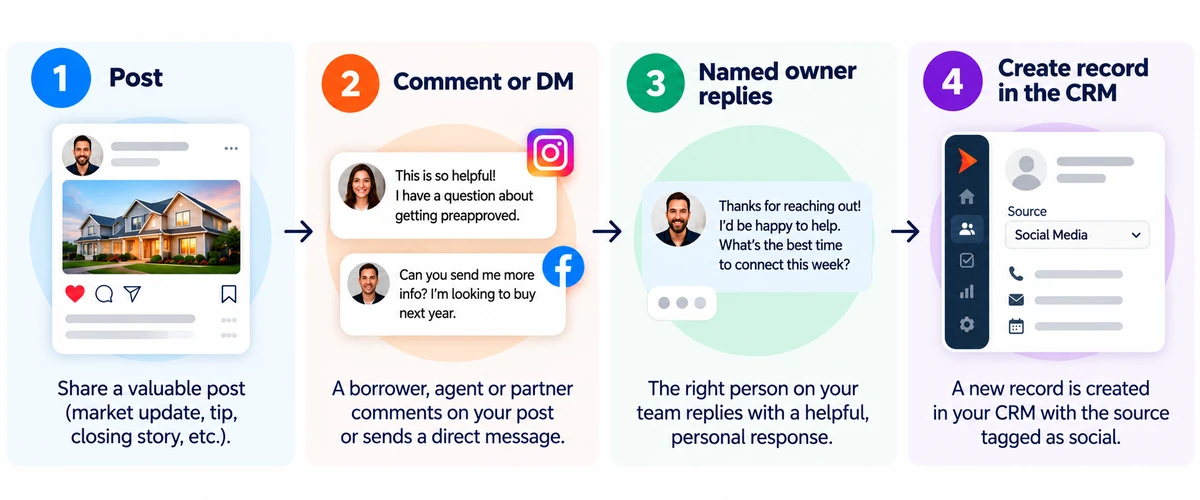
A one-person brokerage can now reach the same feed as Rocket or loanDepot. That is the real change social media brought to mortgage. A national lender buys attention with ad budgets and brand campaigns. On social, a broker or loan officer earns it with a face, a voice and a weekly habit.
That is what mortgage social media marketing is for. It is not a lead faucet. It builds an audience that knows you before they need a loan. The reach is only half of it. When a borrower comments or sends a message, someone has to answer. The answer builds trust, and trust is what closes loans and sends referrals back.
Why mortgage social media marketing levels the playing field
A large lender’s edge is money. It can outspend you on search, buy TV time and put its name on an arena. None of that makes a borrower trust the person on the other end of the phone.
Social flips the math. Feeds reward people more than logos. A loan officer who posts a market update every week becomes a face borrowers recognize. A national brand stays a company they compare on rate.
The cost is time, not budget. That is why social suits the small shop better than the big one. A broker can be the local expert in a way a call center never will be.
Social is one channel among several. It works best alongside referrals, database work and local search, not instead of them. The mortgage lead generation strategies guide compares all nine channels on cost and time to results.
Social media marketing for mortgage brokers versus loan officers
The playing field is level. The rules on it are not the same for everyone.
Brokers own the brand
A broker owns the business. You decide what posts, which platforms you use and how you answer. You also own the compliance sign-off, so every post is yours to stand behind.
That freedom is the advantage. A broker can post the day rates move, with no review queue in the way.
Loan officers start with a question
A loan officer at a bank or lender works inside someone else’s brand. Before you post, sit down with your branch manager or your lender. Find out what you can and cannot do on social before you jump in.
Social media marketing for loan officers starts with four questions:
Are there any limits to which platforms I can post mortgage content on?
Does someone review my posts before they go live?
Can I mention rates, programs or specific products?
Which disclosures does every post need?
Getting those answers first costs one conversation. Getting them after the fact means deleting posts and explaining them.
What to post
Mortgage social media posts work when they answer a question a borrower already has. They fail when they read like an ad. Social media content for mortgage brokers and loan officers comes down to a short list.
Questions you heard this week. If one borrower asked it, others are wondering. Answer it in under a minute.
Your local market. Inventory, prices, what is selling and what is sitting. National news is everywhere. Your zip code is not.
Closings, with permission. A photo with the buyers at the table says more than a testimonial graphic. Get their written consent first.
Agent and partner spotlights. Feature an agent you work with. It strengthens the relationship and puts you in front of their audience.
What you see that borrowers do not. Why a file stalled, what an appraisal gap means, why rates moved this week. This is where you sound like an expert.
Skip the motivational quotes and stock-photo house graphics. They fill a feed and earn nothing.
Social is one play of many that work for a small shop. The rest sit in the full list of marketing ideas, from direct mail to past-client campaigns.
Where to post: platforms compared
Pick one or two platforms and post on them every week. One platform worked well beats five worked badly.
Platform
Who you reach
What works there
LinkedIn
Agents, referral partners, past clients with professional jobs
Market takes, closing stories, partner shout-outs
Facebook
Your local community, past clients, neighborhood groups
Local market updates, community posts, answers in groups
Instagram
First-time buyers and younger borrowers
Short video, Reels, behind the scenes of a closing
TikTok
Younger first-time buyers
Short explainers that answer one question
YouTube
Borrowers searching for an answer
Longer explainers that keep getting found
The choice comes down to where your borrowers and partners already spend time. A purchase broker in a young market belongs on Instagram. A loan officer who lives on agent referrals belongs on LinkedIn.
LinkedIn rewards the same person showing up week after week. That is why how loan officers use LinkedIn comes down to a routine, not a viral post.
What compliance requires before you post
A post about a loan product can be an advertisement. Federal regulators said so in their 2013 social media guidance. It states that Truth in Lending advertising rules apply to ads delivered electronically.
That guidance came from the FFIEC agencies, including the CFPB. Nonbank lenders the CFPB supervises fall under it too. States were urged to adopt it.
Three points come up most often:
Rates and payment terms. Some terms in a rate post may trigger extra disclosures under Regulation Z. A down payment, a payment amount or a number of payments can each do it.
Your NMLS ID. State rules on showing your NMLS ID in advertising may apply to posts as well.
Records. Your company may need to keep copies of posts and the comments on them.
Treat this list as questions for your counsel, not answers. Shape’s operating read is that every post deserves a check before it goes out.
A broker can do that check alone. A lender with twenty loan officers posting cannot. That is the job of social media approval software for loan officers. It holds each post for review before it publishes.
What happens after someone comments
Posting is the half most guides cover. The other half decides whether social pays.
A comment, a DM or a reply to a story is a borrower raising a hand. It deserves the same speed as any other inbound inquiry. When nobody answers, the attention you spent months earning goes nowhere. When someone answers fast and well, trust starts there. That trust turns into closed loans, and later into referrals.
Three things separate the shops that get business from social and the ones that only get likes:
Someone owns the inbox. Comments and messages need a named person checking them every day, not whoever remembers.
The conversation gets a record. A DM that never reaches your system is a lead nobody can follow up. Capture the contact, tag the source as social, and work it like any other lead.
You judge it on conversations, not followers. Count the conversations, applications and closings social produced. Follower counts measure reach. They do not measure business.
The second point is where most social efforts leak. The borrower who messaged in March and closed elsewhere in June was never in anyone’s pipeline.
Closing that gap takes mortgage contact management that puts social conversations on the same record as calls, texts and email. Shape’s Social Media Manager gives comments and DMs a shared inbox your team works from, alongside post approval. It is an optional module, not part of every subscription.
Figures we did not use: APM’s claim that co-created content doubles reach, which names no study.
Frequently asked questions
How do mortgage brokers generate leads on social media?+Mortgage brokers generate leads on social media in two steps. Post useful local content every week, and answer every comment and message quickly. The posts build an audience that recognizes you. The replies turn that attention into conversations. Capture each conversation in your CRM and follow it up like any other inbound lead.
What should loan officers post on social media?+Loan officers should post answers to borrower questions and local market updates. Closings shared with permission and agent spotlights work too. Leave out quotes and generic graphics. Check your lender’s social media policy first. Some policies limit what you can say about rates and products from a personal account.
Do loan officers need approval before posting on social media?+It depends on the lender. Many have a social media policy, and some require a review before a loan officer’s post goes live. Ask your branch manager or compliance team before you start. Posts about loan products may count as advertising, so disclosure rules can apply. Your lender’s counsel has the final word.
Is mortgage social media marketing worth it for a one-person shop?+Yes, if you commit to it. Mortgage social media marketing gives a single broker or loan officer the reach of a national lender. The cost is time, not ad spend. It pays when you post every week and answer every borrower who reaches out. Irregular posting and unanswered comments waste the effort.
Kevin Benner is the Chief Revenue Officer at Shape Software, where he leads revenue, marketing, and customer growth. He brings over 23 years of experience in mortgage lead generation and sales technology.
Meta is the easiest way to put a mortgage offer in front of a million people. It is also the easiest way to fill a pipeline with leads who never meant to talk to you. Which one you get depends on three things: who sees the ad, what it says, and how fast someone calls. […]
LinkedIn for loan officers is a referral and reputation channel, not a lead machine. Set the profile up once, then give it 30 minutes every week. The consistency is what pays, not the exact routine. Every post clears compliance first, and every new connection lands in your CRM. What LinkedIn for loan officers actually does […]
Social media approval software for loan officers decides one thing: whether compliance sees a post before the public does. Every product in this category answers that question one of two ways. Some stop a post until someone approves it. Others find posts after they go live and flag the problems. Pick the wrong kind, and […]