Mortgage Text Message Deliverability: Why Cheap Texting Costs You Loans
Mortgage texts get filtered when carriers do not trust the sender. Registration, consent, content and number reputation all feed that decision. The worst part is that you often cannot see it happen. A text can show “delivered” and never reach the borrower’s phone.
Most lenders compare texting platforms on price per message. That number says nothing about how many texts arrive or how fast. It says nothing about what happens when a carrier filters. Compliant setup is the boring part. It is also the part that decides whether your texts produce conversations or vanish.
Why mortgage texts get filtered
Carriers filter business texts to protect their subscribers from spam. They judge each sender on a handful of signals.
- Registration. Is the business and its use case registered for 10DLC texting?
- Consent. Did the borrower agree to receive texts, and can the sender prove it?
- Content. Does the message look like what the sender registered, or like a loan solicitation?
- Reputation. How do recipients react? Opt-outs, spam reports and blocks all count.
- Volume. Does sending stay inside the limits carriers set for that sender?
Fail one and texts slow down or disappear. Fail several and the number stops working for marketing at all.
Mortgage draws extra scrutiny. Carrier rules single out loan offers, rate promotions and lending lead generation. A legitimate lender gets judged against those rules unless the setup is clean.
Texting runs inside the same sequences as email, so the two share a plan. Our guide to email marketing for loan officers covers the email half of those sequences.
Deliverability is a stack, not a setting
No single switch makes texts deliver. Six layers work together, and a gap in any one of them shows up as lost texts.
Brand registration and trust score
Your business registers as a brand with The Campaign Registry. The registration produces a trust score that decides how much you can send. A weak registration means low limits for as long as that score stands.
Campaign use case
Each campaign registers what you will send and why. Carriers compare your actual texts to that description. Texts that drift from the registered use case get filtered.
Website opt-in and disclosures
Carriers check how you collect consent before they approve a campaign. That review starts on your website forms.
Message content
Carriers scan message text. Some mortgage language reads like spam to their filters, even when it is legitimate.
Number reputation and volume
Every number builds a history. Opt-outs, blocks and complaints lower it. Sudden bursts from one number look like a blast.
Carrier routes and redundancy
Texts reach carriers through messaging providers, and each provider reviews registrations on its own. A business rejected by one can be approved by another. A platform with one provider leaves you nowhere to go.
How trust score sets your throughput
Your trust score caps how many texts carriers accept from you, and it does not improve on its own.
The score comes from brand registration and secondary vetting, on a scale of 0 to 100. Twilio’s published tiers show how much it matters:
| Trust score | Messages per second to AT&T | T-Mobile daily limit |
|---|---|---|
| 75 to 100 | 75 | 200,000 |
| 50 to 74 | 40 | 40,000 |
| 25 to 49 | 4 | 10,000 |
| 1 to 24 | 4 | 2,000 |
AT&T figures are SMS messages per second for standard campaigns. T-Mobile figures are SMS segments plus MMS per day. Sources: Twilio’s throughput article and T-Mobile daily limits article.
Twilio states that trust scores are static. They do not rise as you send good traffic. A shop that registered carelessly lives with that ceiling until it fixes the registration.
Three details catch lenders out.
The T-Mobile limit is per EIN, not per platform. Twilio says the daily cap is shared across every brand and platform registered under the same EIN. A lender texting through two systems splits one limit between them.
Long texts count twice. A message over 160 characters bills and counts as more than one segment. Wordy templates burn through the daily limit faster.
Registration can fail outright. We see it regularly. A lender’s main brand gets approved, and a second brand is rejected for a low trust score. The second brand cannot text until the registration is fixed.
When you hit the T-Mobile cap, texts to T-Mobile customers fail for the rest of the day. The limit resets at midnight Pacific time.
Solo loan officers get the smallest lane. Many register as a sole proprietor brand. Twilio limits those to one campaign and one number. They get no trust score and a fixed throughput. T-Mobile caps them at 1,000 segments a day. That covers a personal book, not a lead-buying operation. A solo LO planning to scale should register as a business entity with an EIN.
What carriers look for on your website
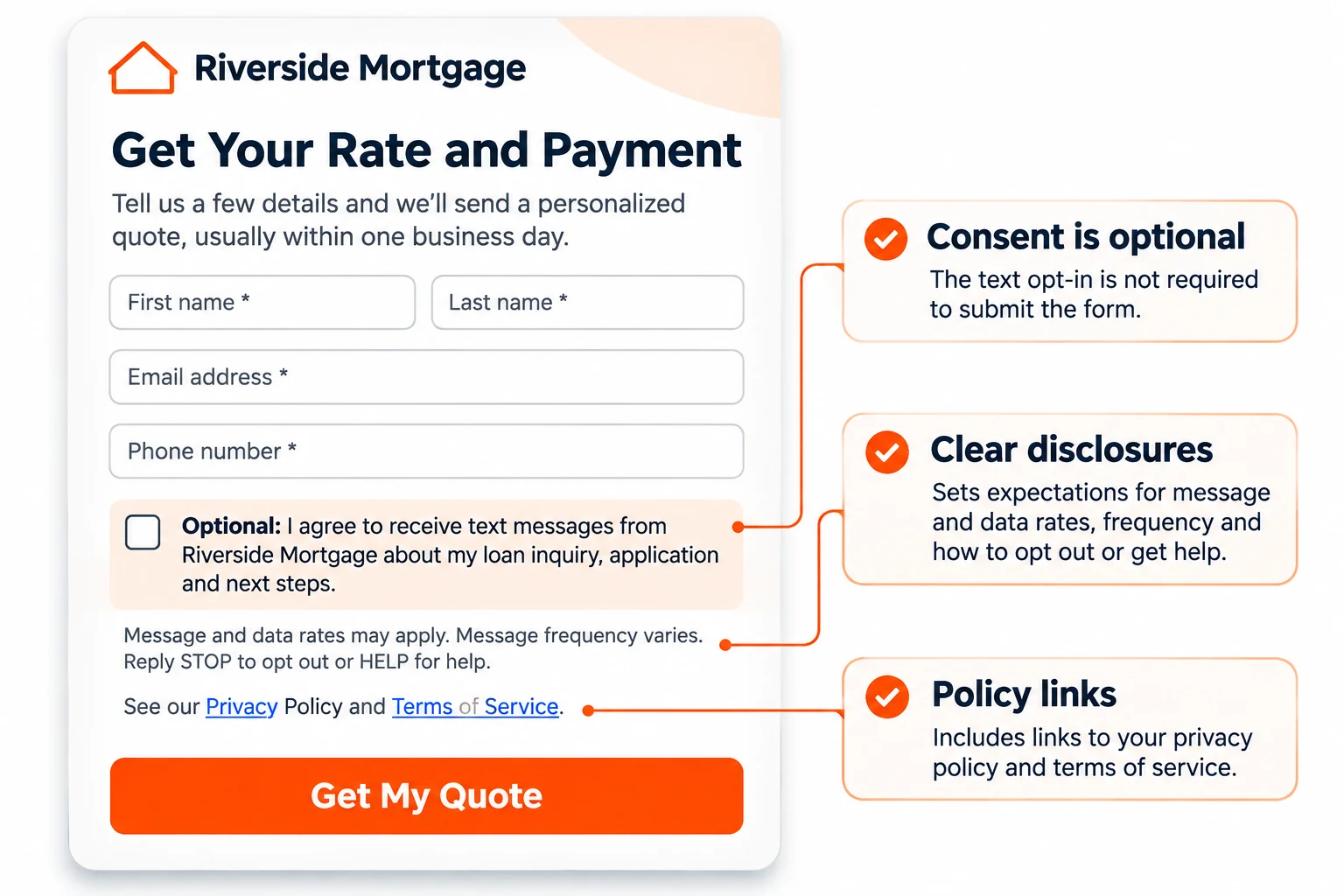
Carriers review your website before they approve a campaign. A form that collects phone numbers without proper consent language is a common reason for rejection.
Twilio’s campaign rejection guidance lists what the opt-in needs:
- A clear request for permission to send text messages
- A consent checkbox that is optional and unchecked by default, if you use one
- Your business name and what the messages are about
- Message frequency, such as “Message frequency varies”
- “Message and data rates may apply”
- “Reply STOP to unsubscribe” and “Reply HELP for help”
- Links to a privacy policy and terms on your own website
The privacy policy has to say you do not share mobile numbers with third parties. Plenty of lender websites fail on that line alone, because their policy was written for a general audience.
Carriers look past the form too. Shape’s 10DLC registration guide lists the rejections we see most:
- No opt-in language on a form that collects phone numbers
- A tax ID that does not match the company name or business type
- No About Us, Terms and Conditions or Privacy Policy page
Fix the website before you apply. Carrier review currently takes 4 to 6 weeks. A rejection restarts that clock, and some rejections cannot be resubmitted.
Mortgage words that get texts filtered
Carriers filter on content, and mortgage has some words that look like fraud or loan spam.
Requests for sensitive data. “Send me your Social Security number and date of birth” reads like a phishing attempt. Never ask for SSN, date of birth or account numbers by text. Send a secure application link instead.
Credit pull language. “We need to pull your credit” in a text from an unknown number looks like a scam. Move that conversation to a call or the application portal.
Rates, payments and offers. Any message with a rate, a payment or an offer solicitation can get a campaign rejected. Twilio’s loan marketing rejection names loan offers, interest rate promotions and pre-approval solicitations. It also flags lead generation that connects consumers to lenders.
Shortened links. Public link shorteners hide the destination, and spammers use them constantly. Use links on your own domain.
Missing identification. The first text in a campaign should name your company and include opt-out instructions. A text from an unknown number with no name reads like spam.
Shape’s 10DLC guide lists the same territory among common rejections: third-party mortgage loan offers, debt refinancing offers and lead generation. The rule for mortgage texting is simple. Keep texts to notifications and general conversation. Save the rate and the offer for the phone call.
A text’s job is to get the borrower on the phone. What works is plain, expected language. “Your appraisal is scheduled for Thursday.” “I have your updated loan estimate, when is a good time to talk?” Those read as service, because they are.
Why “delivered” does not mean delivered
A “delivered” status means the carrier accepted the message. It does not prove the borrower’s phone received it.
Twilio’s own help center says texts can show “Delivered” without reaching the device. For multiple recipients, it names carrier filtering as a cause. In most filtering cases the carrier sends back an error. Not in all of them.
So the report you rely on has blind spots. A failed-message report shows texts the carrier rejected. It cannot show texts the carrier accepted and then dropped.
That makes three habits worth keeping:
- Read the failed-message report weekly. A rise in failures is the earliest warning you get.
- Watch replies, not just sends. A campaign that used to get replies and now gets none is being filtered.
- Test on real phones. Send campaigns to team members on AT&T, T-Mobile and Verizon before a big push.
Why the cheapest texting platform underperforms
A cheap texting platform prices the message and skips the work that gets it delivered.
Here is what usually goes missing:
- No registration help. You fill out the forms alone, and a weak application sets a low trust score that sticks.
- One messaging provider. If that provider rejects your registration, there is no second option.
- No content checks. A loan officer texts a borrower for an SSN and the number takes the hit.
- No failure reporting. Nobody sees filtered texts until replies stop.
- No opt-out discipline. A STOP on one number does not reach the loan officer texting from another.
- Shared or pooled numbers. Other senders’ behavior lands on your reputation.
Price per text is the wrong comparison. The cost that matters is price per text that arrives. A platform charging less per message that loses texts costs more per conversation.
That is also why throughput matters as much as price. A speed-to-lead text that sits in a queue behind a throttled campaign arrives after a competitor’s call. Automated texts fire on triggers, which is where automation fits the loan lifecycle.
How Shape handles texting deliverability
Shape handles the layers above inside the CRM, so loan officers text without managing carriers.
Registration. Clients enter their business details in Shape, and Shape’s team submits the 10DLC application. We review the website and consent language carriers check first. Numbers added later enroll under the same registration, up to 49 numbers.
Two messaging providers. Shape works with Twilio and Plivo. Some clients are approved by one and rejected by the other. We register each client with the provider that approves them.
Opt-outs. STOP, CANCEL, END, QUIT and UNSUBSCRIBE are handled automatically. A STOP applies system-wide for that contact, across every number and loan officer.
Quiet hours. Shape enforces texting quiet hours based on the borrower’s location.
Content protection. Prohibited-content detection catches risky messages, and duplicate-message protection stops repeat sends. Shape’s AI texting writes to carrier content rules, so it asks for an application link instead of an SSN.
Reporting. The text message report surfaces failed messages. Every text sits on the borrower’s record with the sender and the number used.
None of this replaces consent and clean lists. It keeps texts from good shops arriving, and it catches the mistakes that would otherwise cost a number its reputation. Our texting deliverability guide covers what to check when results change.
How often to text, when, and what gets a cadence blocked sit in our guide to text message cadence. Lenders choosing a tool should start with what to require from texting software.
Comparing platforms? Ask one question first. Will this mortgage CRM with SMS handle registration, routes and reporting, or just send?
Text open-rate figures in wide circulation are left out of this guide. None counts what a person actually read.