Text Message Cadences That Don’t Get You Blocked
A text message cadence fails when the texts stop arriving, not when the copy is weak. Carriers filter numbers they do not trust. Borrowers block numbers that text too often. Regulators set hours and opt-out rules. A mortgage text message cadence has to clear all three before timing or wording matters.
Four ways a text message cadence gets blocked
Every blocked text traces back to one of four causes:
- An unregistered number. Carriers filter or stop business texts from numbers that are not registered.
- An opt-out that was not honored everywhere. The borrower said stop to one number and heard from another.
- A text outside permitted hours. Federal and state rules set the window, and some states set it narrower.
- Too many texts too close together. The borrower blocks the number or reports it, and the number’s reputation drops. At volume, the same pattern runs into why carriers throttle messages.
Each one damages more than the message in front of you. A reported number carries that reputation into every text it sends next.
Register the number before the first text
Business texting from a local number runs on 10DLC registration, through The Campaign Registry. Carriers began blocking texts from unregistered 10DLC numbers on August 31 2023. An unregistered number is not a slower channel. It is a channel that does not deliver.
Registration asks who the business is and what it plans to send. It also asks for sample messages and proof of how people consented. Carriers reject applications for predictable reasons. The most common is missing opt-in language on a web form that collects phone numbers. Every form needs it, not just the main contact page.
Shape’s team helps clients apply for and get approved for 10DLC. Once approved, you can send texts that deliver.
An SMS follow-up cadence by lead stage
A good SMS follow-up cadence front-loads and then tapers. The first text goes out fast, because a new inquiry expects one. After that, every text has to earn its place.
- New inquiry. One text the moment the lead arrives, paired with a call. Stop the sequence the moment the borrower replies, and hand the conversation to a person.
- First week, no reply. Space the texts out. Each one should say something new: a question, a next step or a reason to talk.
- After the first week. Drop to an occasional touch. A borrower who has not answered six texts will not answer the seventh.
- Nurture. Text only when something changed: a rate move, a program they asked about, a document deadline.
The cadence is a ceiling, not a target. Texting less and saying more keeps the number trusted. Automating it belongs to a wider question about which steps should run without you.
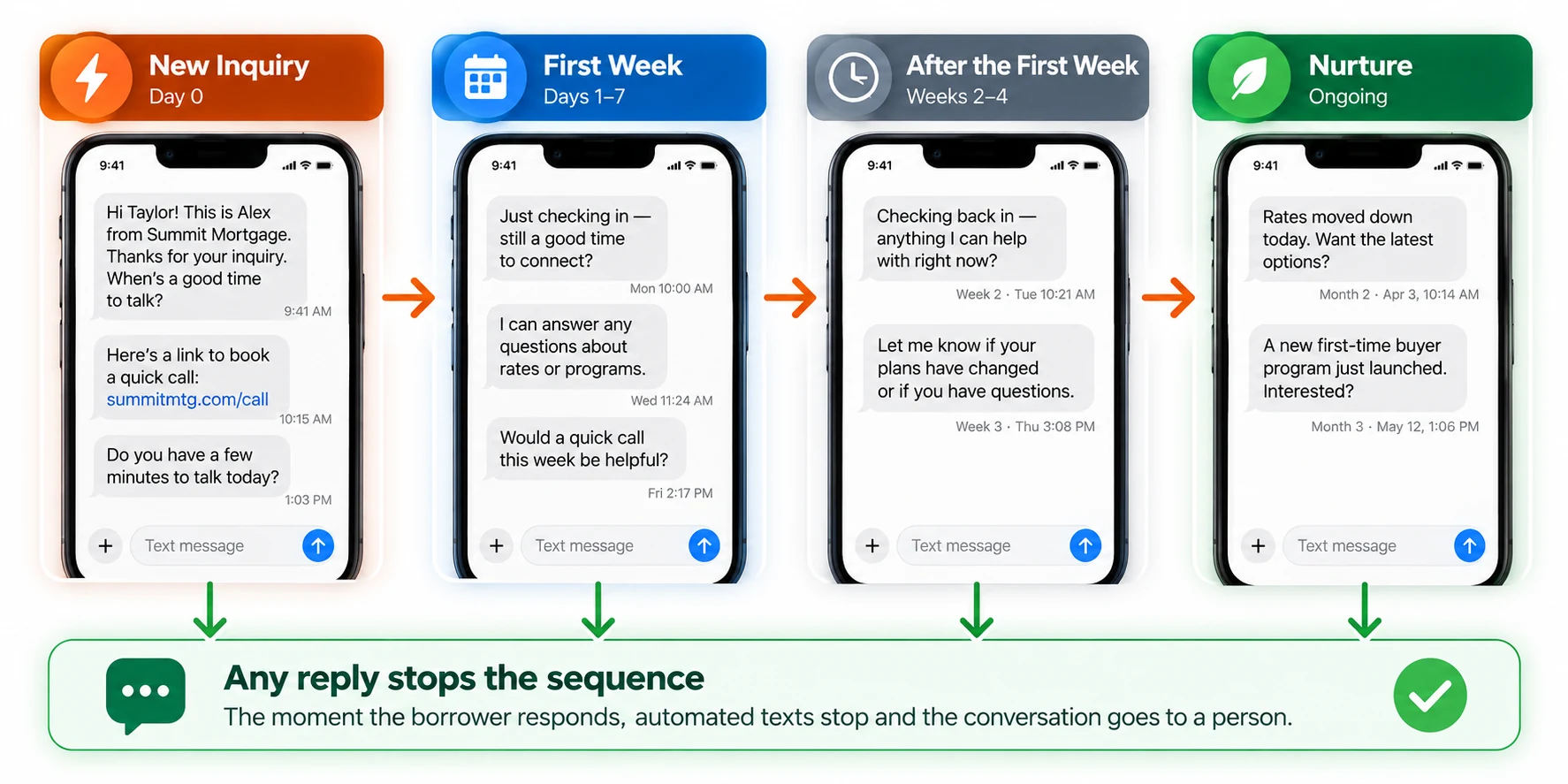
How to text leads without getting blocked
Hours come first. The federal TCPA limits telemarketing calls and texts to between 8 a.m. and 9 p.m. in the recipient’s local time. Some states go further. Florida and Oklahoma narrow the window to 8 a.m. to 8 p.m. They also cap sales calls and texts at three per 24 hours on the same subject. Both treat a number with the state’s area code as belonging to someone in the state.
How those rules apply to a given message is a question for your counsel. The safe design keeps every automated text inside the narrowest window that might apply. Shape enforces texting quiet hours, so an automated step does not fire at 10 p.m. because someone built it at 4 p.m.
Volume comes second. A cadence that stays inside the hours can still get a number reported. Watch STOP replies, blocks and complaints by sequence, the way email marketing for loan officers watches complaint rates. A sequence that draws them is the problem, not the borrowers.
One STOP ends every text
The FCC’s revocation order took effect April 11 2025. It lets consumers revoke consent in any reasonable way. Words like stop, quit, cancel, unsubscribe and end count. Requests have to be honored within ten business days. A single confirmation text is allowed if it carries no marketing.
A broader part of the order, covering how far one revocation reaches, was delayed and then revisited by the FCC. Its current status may change how your program works. Check it with your counsel.
The operational point does not wait on that. A borrower who texts STOP to one loan officer and then hears from another has been told nobody listened. In Shape, a STOP opt-out applies system-wide for that contact, across every number and every loan officer on the account.
What a compliant SMS cadence looks like in a CRM
A compliant SMS cadence is mostly plumbing. The consent record sits on the contact. The quiet hours sit in the platform, near the top of what to require from texting software. The opt-out reaches every number. The cadence stops when a person replies.
Timing sits on top of that. Deciding what time automated texts should send is its own job. It matters only once the number is registered and the opt-out works.
That is the difference between texting from a phone and texting from a mortgage lender CRM. The rules live in the system, not in a loan officer’s memory.
Frequently asked questions
Does a borrower who texts you first consent to a text cadence?+
Not necessarily. A borrower who texts a question has started a conversation. Answering it is a different thing from enrolling them in marketing texts. Whether that first text supports an automated sequence is a question for your counsel. The safe design captures consent on a form with opt-in language first.
Should mortgage texts come from a loan officer’s number or a shared number?+
From a number the borrower will recognize, which usually means the loan officer’s. Borrowers answer people they have spoken to. Whichever you use, every number has to be covered by your registration. An opt-out on one has to stop all of them.