Mortgage Website Design: 6 Providers for Sites and Landing Pages
A mortgage website has one job: turn a visit into a lead in your CRM. It has to land fast enough to call while the borrower still cares. Good mortgage website design is the part of that job a visitor sees. Providers differ less on looks than on how they build, where the form fill goes and what you own.
Shape builds websites and landing pages, so Shape is on this list. Its entry is first, labeled as ours, and judged on the same fields as the other five, catch included.
Template site, custom build or done for you
Web design for mortgage brokers and loan officers comes in three models.
- Template sites. Mortgage website templates are the cheapest and fastest route. You pick a design in a mortgage broker website builder, add your details and go live in days. Every other loan officer on that platform starts from the same layouts.
- Custom builds. A designer builds the site around your brand and your markets. It costs more up front and takes longer. Changes go through the provider.
- Done for you. The provider plans, builds and maintains the site and its landing pages. You approve. You trade control for time.
A website and a landing page do different work. The website is where borrowers and agents check you out. A landing page has one offer and one form, built for a specific ad, mail drop or loan type.
Full-service agencies build sites too, as one line in a bigger retainer. That is a different hire, and which agency fits which shop depends on what you hand off.
The 6 best mortgage website design providers, compared
Every provider fact below comes from the provider’s own website, checked October 22 2026. Prices change, so confirm them before you sign. Two figures that circulate on this topic are left out. One is a Google bounce-rate statistic quoted without a named study. The other is vendor conversion ranges published without a sample or method.
| Provider | What it builds | Build model | Published pricing | Stated time to launch |
|---|---|---|---|---|
| Shape Lead Engine | Websites and landing pages | Done for you | Add-on for Shape CRM customers | Not stated |
| LenderHomePage | Websites, funnels, a POS app | Templates | From $127 a month plus a $199 onboarding fee, billed annually | Most within 3 business days |
| LoanSites | Custom websites | Custom, with unlimited support | $195 a month plus a $650 setup fee | Within 10 business days |
| LeadPops | Websites with funnels and landing pages | Done for you | Not published | 3 to 5 days |
| Vonk Digital | Websites from 14 mortgage designs | Designs on a managed platform | From $147 a month plus a setup fee | As little as 5 business days |
| Roar Solutions | Websites, landing pages, add-ons | Templates | $199 setup, then from $35 a month | Not stated |
1. Shape Lead Engine (ours)
Lead Engine is Shape’s done-for-you build service. Shape’s designers and developers build your website and landing pages and connect them to the CRM. A form fill arrives as a lead record, ready to route to a loan officer. You never learn a page builder.
Who it fits: shops already running Shape that want the site and the CRM built as one system.
The catch: it is an add-on for Shape customers, so you need to be a Shape CRM user. You also get limited control of the website. Shape’s team builds it, and you don’t edit it yourself.
2. LenderHomePage
LenderHomePage offers more than 30 mortgage templates and a landing page and funnel builder. It also sells the Loanzify POS with a digital 1003. Plans also bundle a mobile app, an AI blog, social media tools and a compliance engine. Hosting runs on Amazon Web Services and is included.
Who it fits: loan officers and teams that want a site, an application and social media from one vendor.
The catch: you are buying a platform, not just a site. Individual plans run $127 to $289 a month billed annually, and team plans start at $349. Its pages don’t say who owns the domain.
3. LoanSites
LoanSites builds custom mortgage websites with unlimited support for content, design and form changes. AI live chat, advanced SEO, graphic design and a CRM are sold as add-ons. Sites are built on a development URL first and reviewed with you before launch.
Who it fits: loan officers who want a custom site and someone to make every change for them.
The catch: add-ons stack up. Advanced SEO alone is listed at $895 a month. In its favor, it requires you to own your domain, and there is no long-term contract.
4. LeadPops
LeadPops builds mortgage websites in three packages. Each comes with a funnel account and a landing page for each loan product. LeadPops says its templates place NMLS disclosures, licensing and Equal Housing markings for you. Its calculators feed leads into a CRM.
Who it fits: loan officers who want lead capture built into the site from day one.
The catch: no prices are published, so you get a quote after a demo. LeadPops also sells leads, which is a separate purchase from the site.
5. Vonk Digital
Vonk Digital sells mortgage websites from 14 designs, covering companies and branches, loan officers, and non-QM and hard money lenders. Hosting, security and support are included, and plans run month to month. NAMB named Vonk one of three 2026 Excellence Award winners in Software and Technology.
Who it fits: branches, IMBs and loan officers that want a polished design without a custom build.
The catch: the two plans start at $147 and $497 a month, plus a setup fee. Its pages don’t name the CRMs it integrates with.
6. Roar Solutions
Roar Solutions sells low-cost template sites for mortgage agents, brokers and loan officers. It also builds sites for insurance agents, accountants, lawyers and other small businesses. Landing pages start at $299, and funnel forms, social posting and blog posting are add-ons.
Who it fits: a solo originator who wants a basic site at the lowest monthly cost.
The catch: it serves Canadian mortgage agents first, with Canadian calculators and a REMIC discount for Canadian mortgage agents. Its top plan carries a minimum contract, and changing themes costs extra.
What a mortgage website has to do
Judge any mortgage website design on these, whatever it looks like.
- A clear path to apply. One button, on every page, to an application or a short form.
- Mobile first. Borrowers and agents check you on a phone between showings.
- Speed. A slow page loses the visitor before the form loads.
- Forms that feed your CRM. A form fill that lands in an inbox waits. One that lands in the CRM gets routed and called.
- Reviews where the doubt is. Next to the form, not on a separate page.
- City and loan-type pages. These are how a site competes in local search for lenders, alongside your Google Business Profile.
Mortgage landing pages: one offer, one form
A landing page beats a site page whenever you are paying for the visit. Send a Google ad, Facebook ad or mail piece to the home page, and the borrower has to hunt. Send it to a page built for that offer, and they don’t.
The pattern that converts is short. One loan type or offer. A headline that matches the ad. A form that asks for little up front. No menu leading away from the form. Proof placed beside it.
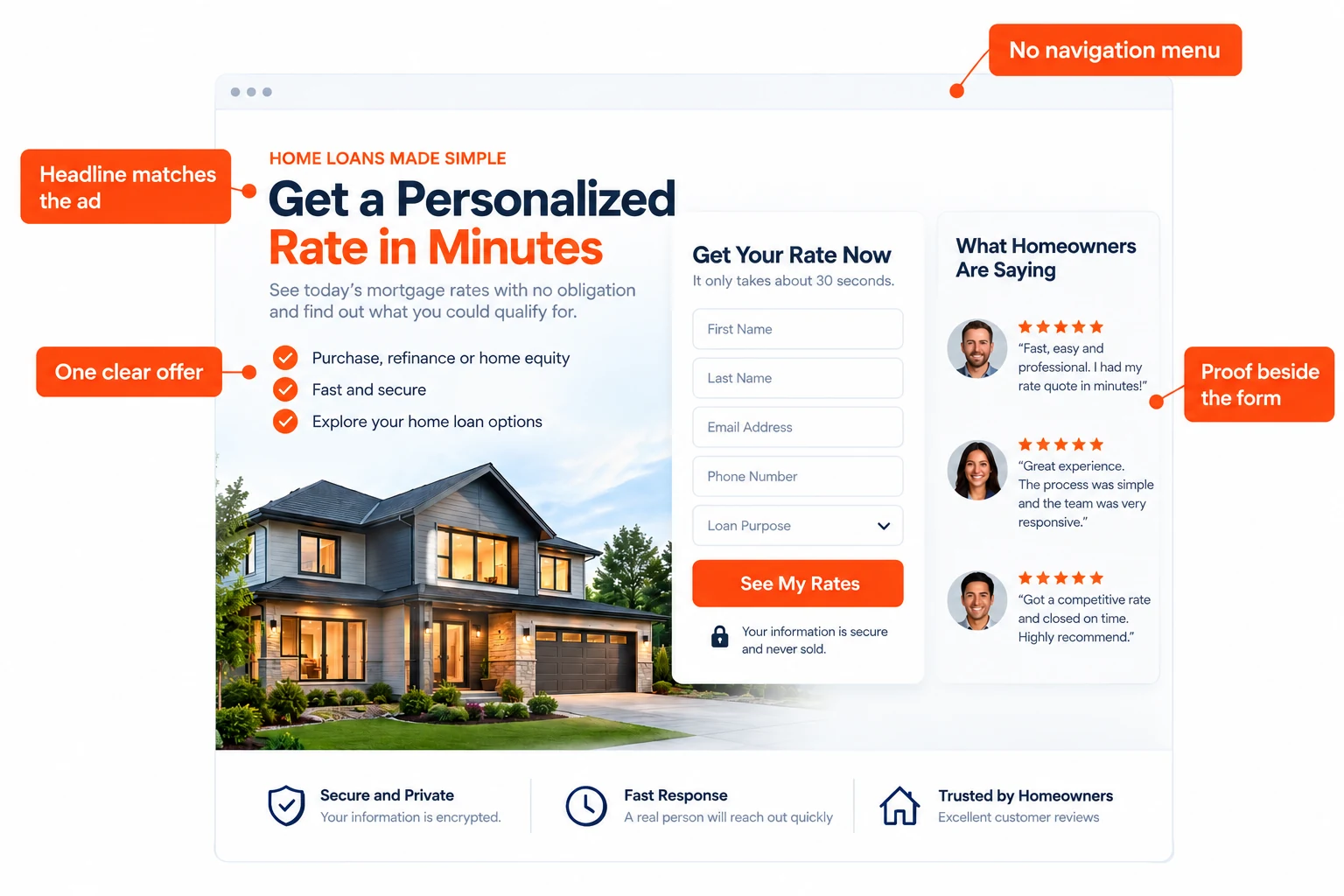
Most of the ideas on our marketing idea list end at a landing page. Build one per campaign, so you know which campaign produced the lead.
Disclosures every mortgage site carries
Your NMLS ID belongs on the site, and many lenders link it to NMLS Consumer Access. Most mortgage sites also carry the Equal Housing Opportunity logo or statement, plus licensing details and a privacy policy. Requirements may differ by state and by channel, so have your compliance team review the site before launch.
Check whether a template ships with these built in or leaves them to you. Some providers place them automatically. Others leave a blank footer.
What to own before you sign
- Your domain. Register it in your name. Whoever holds the registrar login controls your site and your email.
- An exit plan. Ask what you can take with you if you cancel: pages, content, images and form history.
- Template lock-in. Many template sites run only on the provider’s platform. Leaving means rebuilding.
- Where form data lands. Every form fill should post straight into your loan origination CRM, tagged by page and campaign. That is how you see which page produced a funded loan, not just a lead.