Referral partner tracking breaks on the first step: nobody records who sent the borrower. The loan closes, the agent expects credit, and the CRM shows “phone call” as the lead source. Fix that one field and most of the rest follows.
Referral partner tracking starts with what you record
Give partners their own record type, separate from borrowers. Agents, builders, CPAs and attorneys are relationships, not leads, and they should not sit in your lead queue.
Each partner record needs five things:
Type. Agent, builder, financial planner, attorney, or whatever your market produces.
Status. Where the relationship stands, from prospect to active partner.
Owner. The loan officer who holds the relationship.
How they like to hear from you. Text, email or a call.
Production. Every borrower they have sent, linked to the partner record.
Statuses matter more than they look. A partner you met last week and a partner who sent six loans this year need different attention. In Shape, partner statuses are customizable, so they can match how your shop actually builds relationships. Production history belongs on the list of what to bring to a listing agent meeting. It changes the conversation.
Referral source tracking when two agents touch the file
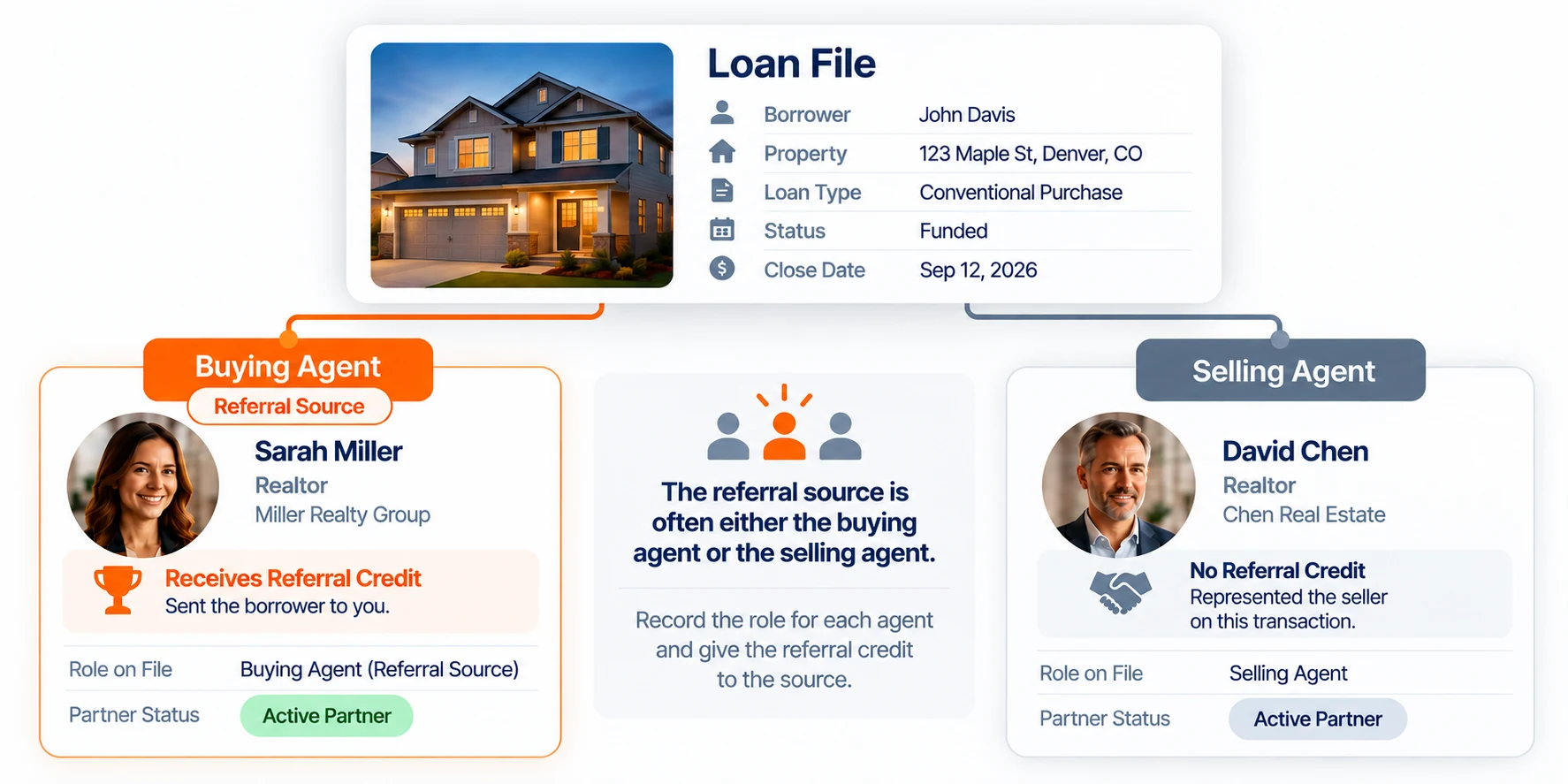
Most files involve more than one partner. The buyer’s agent sent the borrower. The listing agent is on the other side of the deal. Both matter, and only one of them referred the loan.
Record the role, not just the name. Shape’s tracking tab shows whether each partner was the referral source, the buying agent or the selling agent. Credit the referral to the source. Track the other agents on the file as relationships you are building.
That distinction is the whole point of referral source tracking. A listing agent who appears on four of your files has seen your work four times. That agent has not sent you a borrower yet, and the record should say so.
Tracking agent referrals from first contact to funded loan
Link the borrower to the partner the moment the lead is created, not at closing. A link added at closing loses everything that happened before it.
Co-branded links remove the step entirely. When a borrower comes in through a partner’s link, Shape ties the borrower to that partner automatically. The referral lands on the partner’s record with its status, created date and assigned loan officer. Open house sign-ins deserve the same treatment, and capturing open house leads covers how to get them into the CRM.
From there, the file carries the partner with it. Tracking agent referrals this way means every stage change shows up on the partner record, from application through funding.
How to measure referral partner production
Count four things per partner over twelve months: referrals, applications, funded loans and the last referral date. Funded loans are the number that matters. A partner who sends ten referrals and funds none is a time cost, not a pipeline.
This is where most loan officers fool themselves. The agents you see most are rarely the agents who send the most. Coffee meetings feel like production. The funded column usually says otherwise. Measure referral partner production by funded loans, and the list of partners worth your time gets shorter and clearer.
The date of the last referral is the early warning. A partner who sent a loan a month for a year and nothing for ninety days has a reason. Find out before someone else does.
Every referral strategy in building realtor referrals depends on these numbers. Without them, you cannot tell which partners deserve the effort.
Keeping partners informed without overstepping
Partners refer again when they hear what happened to the last borrower. A mortgage CRM tool like Shape can keep linked partners updated automatically as a file moves. Partners can also get a lite login that shows their own referral activity, so they stop calling to ask.
Two lines need your counsel’s view. What you share about a borrower’s file with a partner may be a privacy question. Anything of value given in exchange for referrals may raise a question under RESPA Section 8. Tracking who sends you business is a different thing from paying for it.
Track referral partners in your CRM, not a spreadsheet
A spreadsheet can list partners, but referral partner tracking needs more than a list. It cannot link a partner to a borrower and follow the file to funding. Someone has to update it by hand, and nobody does after the third busy week.
To track referral partners in your CRM, the link has to run both ways. Open the borrower and you see who referred them. Open the partner and you see every borrower they have sent, with status and loan officer. Shape exports that as a referral tracking report, so the funded-loan view is a click rather than a project.
That two-way link is the test for any mortgage CRM. If the vendor demo cannot show a partner’s funded loans on one screen, keep looking. We apply that test in the best mortgage CRMs reviewed.
Frequently asked questions
How often should a loan officer review referral partner production?+Monthly for active partners, quarterly for everyone else. Monthly catches the partner who went quiet while there is still time to ask why. Quarterly is enough to spot a new agent starting to send business. Review by funded loans first, then by referrals sent.
Should a referral partner count if they never send a borrower directly?+Track them, but do not count them as a referral source. Agents who appear only on the other side of your deals are relationships you are building. Some become referral partners. Keeping them in a separate status shows you which ones are ready for that conversation.
Kevin Benner is the Chief Revenue Officer at Shape Software, where he leads revenue, marketing, and customer growth. He brings over 23 years of experience in mortgage lead generation and sales technology.
Social media approval software for loan officers decides one thing: whether compliance sees a post before the public does. Every product in this category answers that question one of two ways. Some stop a post until someone approves it. Others find posts after they go live and flag the problems. Pick the wrong kind, and […]
A text message cadence fails when the texts stop arriving, not when the copy is weak. Carriers filter numbers they do not trust. Borrowers block numbers that text too often. Regulators set hours and opt-out rules. A mortgage text message cadence has to clear all three before timing or wording matters. Four ways a text […]
Direct mail wins or loses on the list, and the rate environment decides how good the list can be. Mortgage direct mail marketing works for acquisition and for retention, in the right market. A mortgage direct mail campaign is mostly a data decision. The design matters less than anyone selling design will tell you. How […]