Individual originators are going to build their own Google Business Profile whether you plan for it or not. People move too often in this business for anyone to leave their personal search presence tied to an employer. Treat that as a given, not a decision.
The actual question for a Google Business Profile for mortgage brokers is narrower. Does the brokerage or branch hold a profile of its own, separate from the people producing under it?
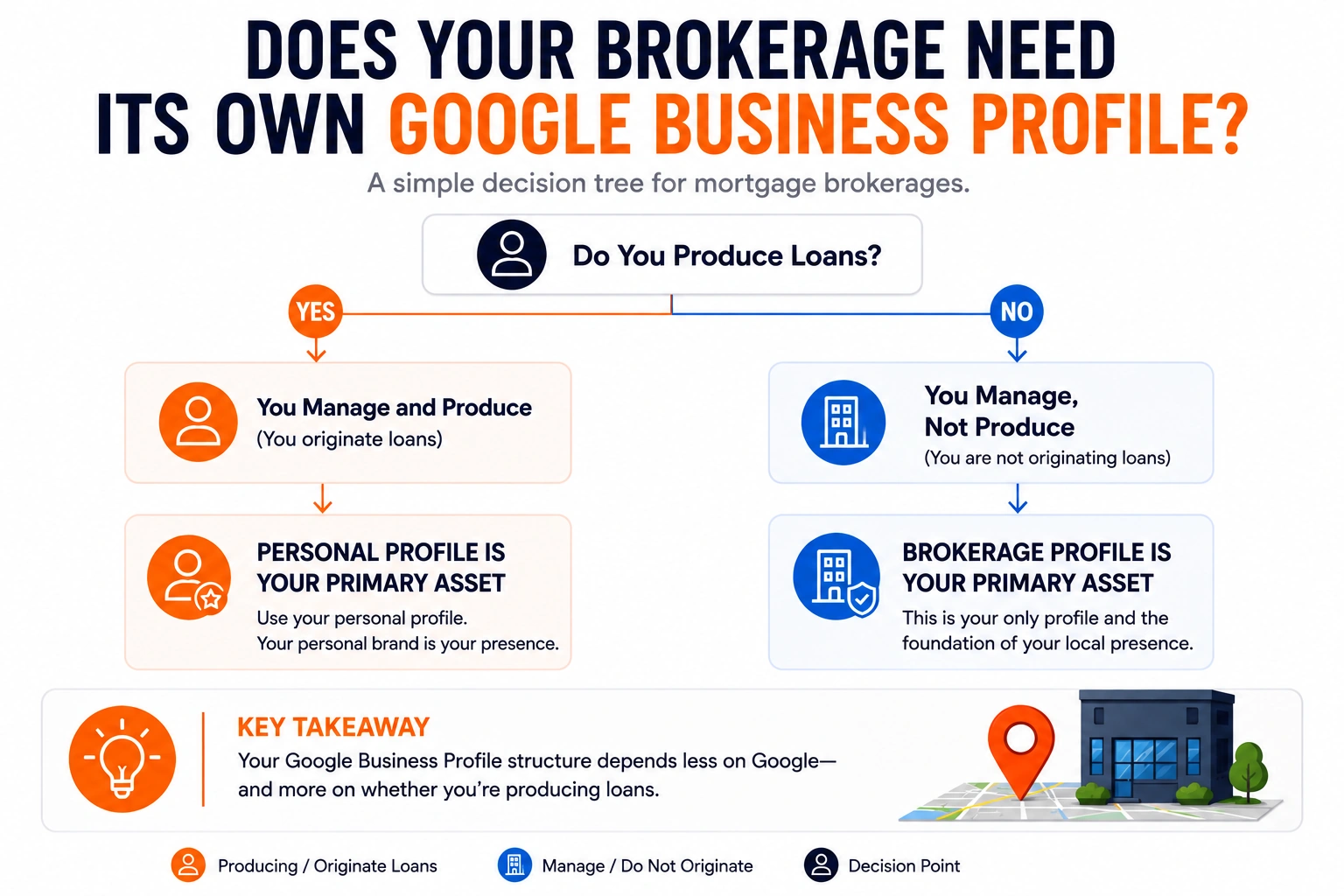
The answer turns on one thing: whether you produce.
Google Business Profile is one piece of a wider local strategy. For the full picture, start with our guide to local SEO for mortgage brokers.
Does your brokerage have a profile of its own?
Answer one question first. Do you produce, or do you only manage?
That answer usually tells you what your brokerage profile already looks like, whether or not anyone set it up deliberately.
If you manage and do not originate
The brokerage profile is your only profile.
You are not taking borrower calls, so you have no personal practitioner profile and no reason to build one. Whatever presence your business has in local search is the brokerage listing, or it is nothing.
That makes it worth real attention. Every other profile at your address belongs to someone who can leave. Their reviews and local visibility go with them. A borrower searching your company name should find the company, not whichever producer ranks that week.
The brokerage profile is the only asset in this picture that is actually yours.
If you produce
Your brokerage almost certainly already has a profile. It is yours.
Producing owners usually name their personal profile with the DBA rather than just their own name. Brand and person end up in the same listing. That is not an accident or a shortcut. In the market your name and the brand are the same thing.
So the question is not whether the brokerage has a presence. It has one. The question is whether you want a second, separate profile for the brand.
Two reasons you might:
Succession. If you plan to sell, retire, or step back from production, the brand needs a listing that does not depend on your name. Build it before you need it.
Scale. Past roughly five originators, a shop whose search result is the owner’s face reads as a solo operation. At some point the brand has to outgrow the person.
Two reasons you might not. It is more upkeep. And review volume splits across two profiles instead of compounding in one.
The honest default for a Google Business Profile for mortgage brokers. A producing owner with fewer than five originators should run one profile carrying the DBA. Everyone else needs a separate brokerage profile. Revisit the moment you stop producing or pass five producers, whichever comes first.
One caveat on the producing case. Google’s naming guidance changes depending on how many public-facing practitioners work at a location. A DBA-named owner profile sitting alongside several originator profiles is exactly the configuration that guidance addresses. The next section covers it.
Practitioner listings: what everyone is already doing
Search any mid-size market and the pattern is everywhere. “Ken Center at One Mortgage.” Then “AJ Martin at One Mortgage.” Same address. Same company website. Different phone numbers. This is not a loophole people are quietly exploiting. It has a name.
Google’s guidelines describe an individual practitioner as a public-facing professional, who normally has their own customer base. The examples Google gives include financial planners and insurance or real estate agents. A practitioner should create their own profile if they work in a public-facing role. They also need to be reachable directly at the verified location during stated hours.
That last criterion is why those profiles carry different phone numbers. It is not decoration. It is the thing being demonstrated.
So the honest answer is that individual originator profiles are a recognized structure. Not a risk you are quietly taking. Two details are worth getting right, and most shops get one of them wrong.
The naming convention most brokerages get backwards
Google’s guidance splits on how many public-facing practitioners work at the location.
Say a practitioner is one of several at a location. Google says the organization should hold its own profile for that location. The practitioner’s profile title should then contain only the practitioner’s name, without the organization’s name.
Now say a practitioner is the only public-facing one at a branded location. Google says it is better to share one profile with the organization. The format Google gives is [brand or company]: [practitioner name].
Read those together and the common pattern inverts. “Ken Center at One Mortgage” matches what Google describes for a solo practitioner at a branded location. Two people using that format at one address is the configuration the guidance addresses differently.
Widespread practice is not the same as compliant practice. We are not going to tell you what Google will do about yours. But if you are setting this up now, following the guidance as written costs nothing. A suspension later costs a great deal.
The eligibility question nobody asks
Google’s guidelines also state that sales associates and lead generation agents for corporations are not individual practitioners. They are not eligible for a Business Profile.
That sentence is where mortgage gets interesting. An independent broker with their own book is plainly a public-facing professional. A newly licensed originator working leads handed to them by the shop is closer to the other description. Most originators sit somewhere between, and Google does not adjudicate the middle in advance.
Three things to settle before you create a second profile at one address:
Can each originator genuinely be reached at that location during posted hours, on their own line?
Are you using the naming format that matches your practitioner count, per the guidance above?
Does the brokerage itself hold a separate profile for the location?
The name field causes more suspensions than any other part of the profile.
Google says your name should reflect the real-world name customers know you by. That means the name used consistently on your storefront, website, and stationery. Google also states that unnecessary additions to the business name are not permitted and can result in suspension.
For mortgage brokers, three specific tensions come out of that.
Your DBA versus your legal entity. If you operate as a DBA and every sign, business card, and website says the DBA, that is your real-world name. If the DBA exists only on paper, it is not.
Your NMLS number. Brokers frequently want it in the name field, sometimes because they believe a state rule requires it. Check what your state actually requires and where it requires it. A licensing disclosure obligation on your website is not automatically an instruction about a Google profile field, and the two can conflict.
Keywords. “Smith Mortgage” is a name. “Smith Mortgage Best FHA VA Rates Phoenix” is the thing that gets profiles suspended. The temptation is understandable and the downside is losing the profile.
One more worth knowing. Google’s guidelines treat a business that changes its name without meeting their criteria as a new business. The existing profile gets marked closed and a new one created. That resets everything you built. Get the name right the first time.
A mortgage broker Google Business Profile lives on reviews
Most brokers think about reviews as a local SEO input. For an owner they are also an asset with a location, and the location decides who keeps them.
Reviews on the brokerage profile stay when a producer leaves. Reviews on that producer’s own profile leave with them, along with the borrowers who found them through it.
That is the argument for holding a brokerage profile even when it feels redundant. Every review your originators collect is a reputation you are renting. The brokerage profile is the only one you own.
Your producers know this too. Someone who understands the dynamic may push for their own profile precisely because it travels with them. Have that conversation deliberately, not during an exit interview.
Whichever structure you choose, volume is what makes it work. A profile with six reviews does not compete with one that has sixty. Getting there takes a system, not occasional asking. In practice that system is a CRM. The best mortgage CRM fires a review request automatically the moment a loan funds, which is how sixty happens instead of six. We covered building Google review volume separately.
Setup and optimization, briefly
Most advice on how to optimize a Google Business Profile for mortgage is generic. Google documents the basics well, so this stays short and covers only what differs for a brokerage.
Claim or create the profile. Choose a category that describes what you actually do. Google asks for categories that are specific and representative of the core business. It warns against using them as keywords. Add the address, or set a service area if you serve clients across a region without a walk-in office. Verify. Add hours, a local phone number, and photos of the actual office and actual people.
Two things brokers routinely skip that are worth the time.
The services section. List loan products as services: FHA, VA, jumbo, non-QM, whatever you actually originate. It is one of the few places where specificity helps without risking the name field.
The Q&A section. You can seed it yourself. Answer the questions borrowers actually ask before a competitor’s answer or a stranger’s guess fills the space.
Monthly upkeep, and who owns it
A profile nobody touches decays. Posts go stale, hours go wrong at holidays, and unanswered questions sit in public.
The work is roughly two hours a month:
Two posts, tied to something real. A rate change, a closing, a program update.
Fresh photos.
Answer every new review, positive and negative.
Answer every new question.
Set holiday hours before the holiday.
Assign it to one person by name. Shared ownership of a Google profile means no ownership. If you have an operations coordinator, this belongs to them. If you do not, it belongs to you, on a recurring calendar block.
Negative reviews need a defined response, not an improvised one. In this industry a bad review is often about a decline or a rate. The wrong reply adds a compliance problem to a reputation problem. Our scripts for responding to a bad review cover how to answer without escalating or disclosing anything you should not.
Local search is one channel among several. For where it fits against referral, social, and database marketing, see our roundup of the best marketing ideas for LOs.
Frequently Asked Questions
Can each loan officer at a brokerage have their own Google Business Profile?+Yes, and most already do. Google’s guidelines describe individual practitioner profiles for public-facing professionals with their own customer base. Financial planners and insurance or real estate agents appear as examples. A licensed originator with their own clients and their own direct line meets those criteria. The line Google draws is at sales associates and lead generation agents for corporations. That is a different role from a producing originator. Shape’s view is that eligibility is rarely the real issue. Naming is, and the correct format depends on how many public-facing practitioners work at your location.
Is a Google Business Profile for mortgage companies different from other local businesses?+The mechanics are the same. The structural question is not. Most local businesses have one operator at one address. A brokerage has several licensed originators under one roof. That raises a decision other categories never face: one profile or several. Shape’s view is that this decision should be settled before setup, not after.
Can I put my NMLS number in my Google Business Profile name?+Google’s guidelines say the name should match your real-world business name and that unnecessary additions can result in suspension. Whether an NMLS number counts as part of your real-world name depends on how you present the business everywhere else. Check your state licensing requirements for where disclosures must appear. Confirm against Google’s guidelines before adding anything to the name field.
How should a practitioner profile be named at a mortgage brokerage?+It depends on how many public-facing practitioners work at that location. Google’s guidance splits on the count. Where a practitioner is one of several at a location, their profile should carry only their name. The organization holds a separate profile for the location. Where a practitioner is the only public-facing one at a branded location, Google describes sharing one profile. The format given is [brand or company]: [practitioner name]. Shape recommends confirming your count before naming anything.
What happens to Google reviews when a loan officer leaves my brokerage?+Reviews on the brokerage profile stay with the brokerage. Reviews on an individual originator’s profile leave with that originator. Shape recommends deciding this deliberately when you structure your profiles, rather than discovering it during a departure.
Kevin Benner is the Chief Revenue Officer at Shape Software, where he leads revenue, marketing, and customer growth. He brings over 23 years of experience in mortgage lead generation and sales technology.
Direct mail wins or loses on the list, and the rate environment decides how good the list can be. Mortgage direct mail marketing works for acquisition and for retention, in the right market. A mortgage direct mail campaign is mostly a data decision. The design matters less than anyone selling design will tell you. How […]
Your past client is not forgetting you. They are refinancing before you thought they would. Client retention for loan officers gets taught on a purchase cycle of five to seven years. Send a newsletter, mail a card, call at the anniversary, stay top of mind until they move house. Client retention gets treated as a […]
The referral ask almost always comes too late, and usually arrives bundled with a review request that competes with it. Those are two different asks and they belong at two different moments. Get the order wrong and you get neither. That is why most loan officers fail to turn closings into referrals. Why Loan Officers […]