Meta is the easiest way to put a mortgage offer in front of a million people. It is also the easiest way to fill a pipeline with leads who never meant to talk to you. Which one you get depends on three things: who sees the ad, what it says, and how fast someone calls.
This guide covers Facebook ads for mortgage loan officers running their own campaigns. Facebook ads for mortgage brokers follow the same rules. If a marketing team runs yours, hand them the rules section and keep the follow-up section for yourself.
What Meta’s Special Ad Category changes for mortgage Facebook ads
Every mortgage Facebook ad runs under Meta’s Special Ad Category. Mortgage ads can fall under housing and under financial products and services, the category that replaced “credit” in January 2025. Declare the categories that apply, then check Meta’s current guidance, because the list has changed before.
The category strips out most of the targeting a normal advertiser uses. Meta’s developer documentation spells it out:
Targeting option
Under Special Ad Category
Age
Fixed at 18 to 65+
Gender
Cannot be chosen
Location
Must cover at least a 15-mile radius in the US. No ZIP code targeting, no location exclusions
Demographic and behavior targeting
Not permitted
Excluding interests or detailed targeting
Not permitted
Lookalike audiences
Unavailable
Custom audiences
Allowed, once Meta confirms the list is eligible
The practical result is a broad audience. Your ad will reach people outside your market and outside your price range. Near a state line, the 15-mile floor also carries it into states you are not licensed in. The offer and the creative have to do the filtering the targeting used to do.
Start with an audience that already knows you
If you are new to Meta ads, do not start with a broad campaign. Start with people who already know you.
A past-customer list is the strongest audience you own. These borrowers closed with you, know your name and answer your calls. An ad that reaches them is a reminder, not a cold pitch. Meta checks a customer list for eligibility before a Special Ad Category campaign can use it, so upload it early.
Your own website visitors are the next ring out. They found you once and left without filling a form.
Broad campaigns come later, once you know which offer works and your follow-up can handle the volume. Running broad first is how a new advertiser ends up with a full inbox and an empty calendar.
What the ad itself can say
Special Ad Category controls who sees the ad. It does not review what the ad says, and Meta approving an ad is not a compliance review.
Rates and payments
A rate or payment in the ad copy can trigger extra disclosures under Regulation Z. Our breakdown of which words trip a disclosure in a rate ad covers the specific terms. The simpler path is a rate-free ad that sends the click to a page with room for the disclosures.
Words and images
Fair lending rules may apply to the wording and imagery of an ad, not only to who sees it. An ad that implies who the loan is for can create the same problem as targeting that excludes people.
Your identity
State rules on NMLS IDs and company names in ads may apply to Facebook as they do to a flyer. The 2013 FFIEC social media guidance treats an electronic ad like any other under Truth in Lending.
Run each of these past your compliance team or counsel. Shape’s position is simple: no mortgage ad goes live unreviewed.
Facebook ads for mortgage leads: lead form or landing page
Meta gives you two ways to collect a lead. Each one trades volume against intent.
Meta lead form
Your own landing page
What the borrower does
Taps a form prefilled from their profile, without leaving Facebook
Clicks through and fills in your form
Volume
Higher
Lower
Intent
Lower. Easy to submit without reading
Higher. They chose to leave the app
What you control
The questions you add
The page, the copy, the disclosures and the tracking
Getting it into Shape
Posts into Shape as a lead
Posts into Shape as a lead
A lead form wins on volume and loses on intent. The prefilled fields make it a two-tap decision, so plenty of people submit without knowing what they asked for. Add one or two questions that take a moment of thought, such as purchase or refinance, and timeline. A little friction filters out the curious.
A landing page wins on intent and costs you volume. It also gives you room for the disclosures a rate offer needs. If your offer carries a number, send the click to a page.
Getting the lead out of Meta
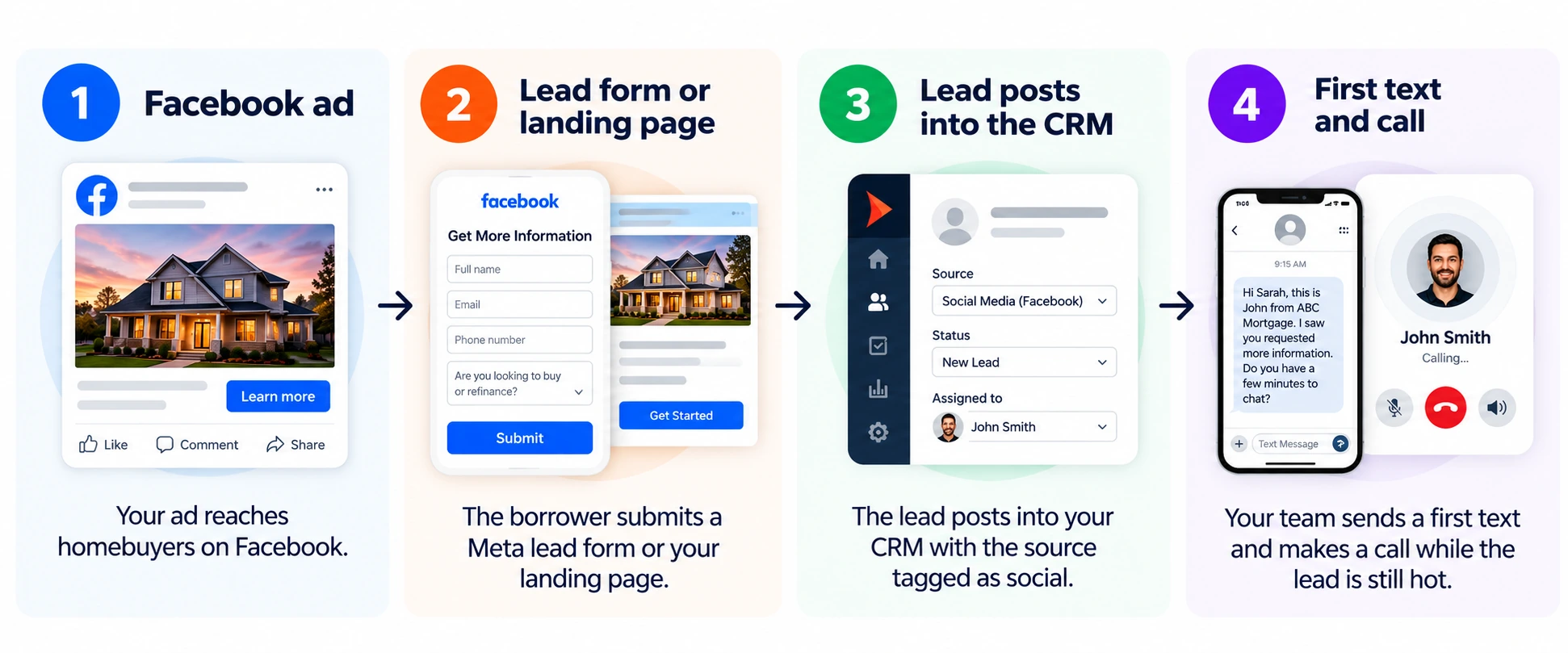
A lead that sits in Meta’s form library is a lead nobody is calling. It needs to land where your team works, the moment it is submitted. For Facebook ads for mortgage lenders with several loan officers, it also needs to reach the right one.
There are three routes. A native integration posts the lead straight into your CRM. A connector or webhook does the same through a middle step. A manual download of a CSV file is the third, and it means somebody remembers to do it.
In Shape, Facebook leads post in as leads from either a Meta lead form or your own landing page. From there they route like any other inbound lead. That is where automated borrower follow-up tools earn their keep. The first text goes out while the borrower still remembers tapping the ad.
The first call decides whether the ad paid
A Facebook lead is the coldest inbound lead a loan officer gets. The borrower did not search for you. They tapped a form between videos.
That makes speed worth more here, not less. Call within minutes and you are the person who answered their question. Call tomorrow and you are a stranger asking about a form they forgot.
The first call also does the jobs the targeting can’t. Confirm the property is in a state you are licensed in, because the radius does not stop at the border. Confirm they meant purchase or refinance. Confirm the timeline is real. Some leads will fail one of those. Better to learn it on the first call than the fifth.
If the follow-up is not ready, Facebook is the wrong channel this quarter. Deciding which ad platform fits your shop starts with how fast you can work what it sends you.
Measuring Facebook ads for mortgage loan officers on funded loans
Meta optimizes toward whatever you tell it counts as success. Tell it a form fill is success and it finds more form fillers. Many of them never pick up.
Send the real outcome back instead. Meta’s Conversions API takes events from your CRM, such as an application or a funded loan. The campaign then learns from borrowers who closed. The setup mirrors offline conversion tracking on Google, covered in our guide to Google Ads for mortgage brokers.
Judge the campaign on cost per funded loan. Cost per lead flatters Facebook, because lead forms produce cheap leads in volume.
Facebook ads are one channel among many. The rest of the marketing plays for loan officers cost time instead of ad spend. Most of them feed the same past-customer audience you started with.
Figures we did not use: the Webtonic “60+ performance benchmarks” page for mortgage Meta ads. It names no primary source for its figures. Unsourced lead-form cost comparisons that circulate on vendor blogs.
Frequently asked questions
Can mortgage loan officers run Facebook ads?+Yes. Loan officers and brokers can run Facebook ads. Every mortgage ad has to be declared under Meta’s Special Ad Category. That fixes age at 18 to 65+ and removes gender, ZIP and lookalike targeting. It also sets a 15-mile minimum radius in the US. The ad copy may also carry disclosure obligations, so have compliance review it before it runs.
What is Meta’s Special Ad Category for mortgage ads?+It is the set of rules Meta applies to housing ads and to financial products and services ads. Mortgage ads can fall under both. It limits targeting so ads cannot be aimed by age, gender, ZIP code or demographics, and it removes lookalike audiences. Custom audiences, such as an eligible past-customer list, are still allowed.
Are Facebook lead ads worth it for mortgage?+They can be, if the audience is warm and the follow-up is fast. Lead forms produce volume at low intent, because the borrower submits a prefilled form without leaving the app. Start with past customers and add a qualifying question or two. Call within minutes, and judge results on cost per funded loan, not cost per lead.
Do Facebook ads for mortgage loan officers need disclosures?+They may. A rate, payment or other loan term in the ad can trigger disclosures under Regulation Z. State rules on NMLS IDs may also apply. One common approach is to keep numbers off the ad and put them on the landing page. Your compliance team or counsel should review each ad before it runs.
Kevin Benner is the Chief Revenue Officer at Shape Software, where he leads revenue, marketing, and customer growth. He brings over 23 years of experience in mortgage lead generation and sales technology.
A one-person brokerage can now reach the same feed as Rocket or loanDepot. That is the real change social media brought to mortgage. A national lender buys attention with ad budgets and brand campaigns. On social, a broker or loan officer earns it with a face, a voice and a weekly habit. That is what […]
LinkedIn for loan officers is a referral and reputation channel, not a lead machine. Set the profile up once, then give it 30 minutes every week. The consistency is what pays, not the exact routine. Every post clears compliance first, and every new connection lands in your CRM. What LinkedIn for loan officers actually does […]
Social media approval software for loan officers decides one thing: whether compliance sees a post before the public does. Every product in this category answers that question one of two ways. Some stop a post until someone approves it. Others find posts after they go live and flag the problems. Pick the wrong kind, and […]