Mortgage Sales Training Programs: What Changes Production
Mortgage sales training programs only pay off if the skill shows up on the next hundred calls. Most programs end at a certificate. The real test is whether contact rate, conversion and pull-through move, and whether they stay moved a quarter later.
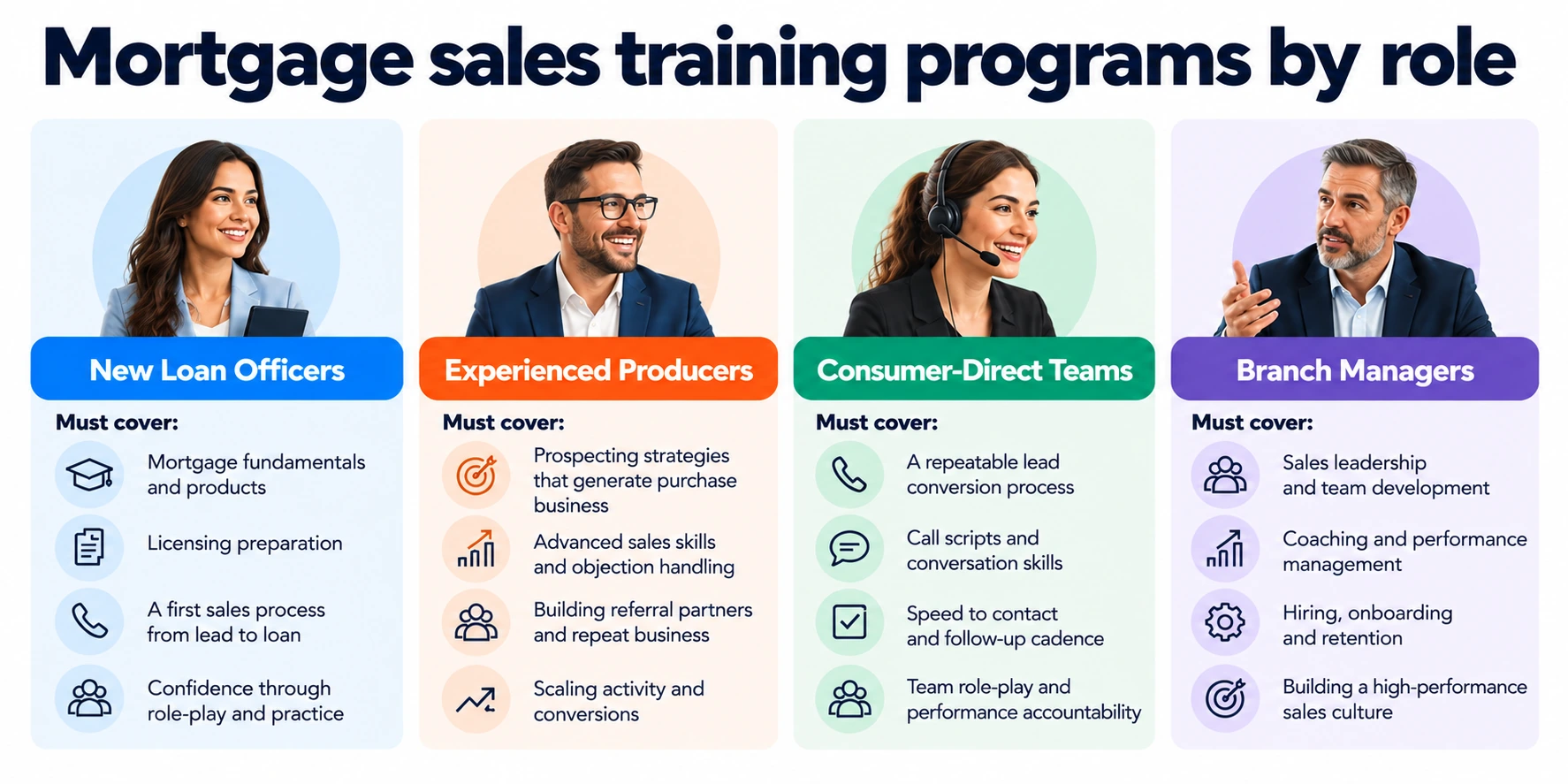
Mortgage sales training programs by role
The first mistake is buying one program for everyone. A new loan officer, a producer chasing purchase business and a consumer-direct floor need different things.
- New loan officers need mortgage fundamentals, licensing preparation and a first sales process. XINNIX runs a track for them. Southwestern Consulting’s Elevate program is a six-month live virtual course for loan officers in their first six months.
- Experienced producers need prospecting and purchase growth, not product basics. XINNIX sells separate tracks for experienced and top-producing loan officers.
- Consumer-direct and call center teams need a repeatable lead conversion process. XINNIX has a dedicated program built around one.
- Branch managers need leadership and sales management, which is a different curriculum again.
For a single skill, low-cost on-demand courses exist. Morty sells short sales and marketing courses for loan officers. OnCourse Learning pairs licensing and continuing education with sales training through a partnership with Mortgage Champions.
Training builds the skill, coaching holds the person
Training teaches a skill to a group. Coaching holds one person accountable to it over months. Most teams need the first before the second is worth paying for.
For one-to-one programs with named coaches, the question is which coaching program fits your team. This page covers courses and team programs.
Mortgage sales training courses: live, on-demand or blended
Live training gives interaction. A loan officer can ask the question that matters to their market, and role-play gets real feedback. The cost is scheduling. Producers miss sessions when the phone rings.
On-demand training reaches everyone, and it can be refreshed. It loses the practice. Watching a video about objections does not prepare anyone for the borrower who says the rate is too high.
Blended programs try to get both: on-demand lessons, then live practice on the material. For most teams that is the right default. Practice is where a loan officer learns they cannot yet handle the objection they just watched.
Judge mortgage sales training by what changes
Ask any provider three questions before signing. What changed for teams like yours? What happens after the last session? How does the material fit the CRM your team works in? A provider without answers is selling attendance.
Before the program starts, record a baseline for each loan officer:
- Contact rate on new leads
- Conversion from conversation to application
- Pull-through from application to funding
- Daily activity: attempts, conversations, appointments
Measure the same numbers 30, 60 and 90 days after. Hours completed and certificates earned are inputs, not results. If none of the numbers moved, the program did not work for your team, whatever the attendance sheet says.
Keeping that measurement running after day 90 is why call review belongs on the CRM shortlist for loan officers.
Why loan officer sales training fades
A workshop teaches a cadence on Thursday. By the next month, half the team is back to old habits. Nobody forgot the material. The system around them never changed, so the new behavior had nothing holding it in place.
Loan officer sales training sticks when the CRM carries it. The cadence from the course becomes the tasks on the loan officer’s list each day. The talk tracks live in the record as loan officer call scripts, not in a binder.
Then the calls get reviewed. Shape’s AI Insights scores calls, and its advanced version uses custom-trained agents. Those agents review and score each call against your own coaching program. A manager sees which skills are not sticking, by loan officer, without listening to every recording. That is the job of mortgage tech for loan officers: holding the habit after the trainer leaves.
What the manager owns after the program ends
Mortgage sales training programs end. The reinforcement is the manager’s job, and it is most of the return.
Set one metric per loan officer to move. Review scored calls weekly, and pick the two calls worth discussing. Repeat the hardest module a month later. A practical rhythm for managing loan officers makes reinforcement part of the week rather than an extra meeting.
Frequently asked questions
Can a CRM replace mortgage sales training?+
No. Training builds the skill: how to open a call, handle an objection, ask for the application. A CRM holds the habit once the skill exists. It schedules the cadence, keeps the scripts on the record and shows where calls fall short. Buy the training for the skill and the system for the follow-through.
Should new loan officers take sales training before they are licensed?+
Many lenders run both together. Their entry programs combine classroom fundamentals, licensing preparation and sales skills. Sales fundamentals can start before the license arrives. Originating loans cannot. Where that line sits in your state is a question for your compliance team.
Is self-teaching enough, or should loan officers pay for training?+
Self-teaching works for knowledge: products, guidelines, how a program prices. It breaks down on skills that need practice and feedback, like handling an objection live. A loan officer can read every script and still freeze on the call. Pay for training when the gap is a skill, not information, and someone will practice with your team.
How much do mortgage sales training programs cost?+
Prices run from inexpensive on-demand courses to multi-month programs with live sessions. The fee is the smaller number. A program that changes nothing in contact rate or pull-through is expensive at any price. One that lifts conversion pays for itself in a few loans. Judge the cost against what moves, not against the cheapest option.