Paid Advertising for Loan Officers: Which Channel, and What to Set Up First
There are three ways to get a mortgage lead and paid is the one people run worst.
Free and owned channels cost you time. Vendor leads cost money and arrive shared, so several lenders hold the same record. Paid traffic costs money and arrives exclusive, and you carry all of the conversion risk.
That third one is where most originators lose money, and almost never because the ads were bad. They spent before the tracking existed, so they never found out which clicks turned into loans.
This page is the decision layer. Which channel, what each one restricts, and what has to be in place first. Where paid sits against the other two is covered in ways to generate mortgage leads.
Set the Tracking Up Before You Spend Anything
Two tracking jobs, and the whole category treats them as one.
UTMs report to you
Source, medium, campaign, term and content, appended to your landing page URL and written onto the lead record.
That is how you answer which campaign produced a funded loan, and which keyword inside it. It works on any platform. Shape captures all of those values on a lead generated from paid ads. The report then lives where the pipeline lives, not in a spreadsheet somebody rebuilds monthly.
That is the whole reason to run mortgage lead tracking software rather than a form that emails you.
The Google Click ID reports to Google
The GCLID is a different thing doing a different job. Google appends it to the click. Handing it back with an outcome is how Google learns which click produced a loan.
UTMs cannot do this. Google will not accept a campaign name as proof of conversion.
Get this wrong and here is what happens. You feed Google form fills, because that is the only conversion it can see. Google gets very good at buying you cheap form fills. Cheap form fills are the worst leads on the internet. Your cost per lead falls every month and your cost per funded loan climbs.
Shape can push conversion data out by webhook, and by flat file where you are capturing the GCLID. What happens on the Google side after that depends on your own setup.
You cannot fix this retroactively
The GCLID arrives as a URL parameter on the click. It has to be written into a hidden field on your form at that moment and stored on the record.
If it was not captured then, there is nothing to send back later. No CRM repairs it. No agency recovers it. The click is gone.
That is the single most expensive mistake in this category and it takes about twenty minutes to prevent.
The Four Tools, and What Each One Is Actually For
Everyone running paid ends up in these four. They do not all do what people assume.
Google Tag Manager is the deployment layer. It is where the hidden GCLID field and the conversion tags actually get implemented. Nothing above happens without it.
Google Analytics is the measurement layer. Attribution, path, assisted conversions.
Search Console and Bing Webmaster Tools report no paid clicks at all. They are organic tools. Paid data lives in Google Ads and Microsoft Advertising. Guides that list all four as ad-tracking tools are wrong, and several do.
They still matter here, for three reasons.
Pulling long-tail keywords out of Search Console
Keyword Planner rounds, groups and suppresses low-volume terms. The long tail either does not appear or reads as zero.
Search Console shows the actual strings people typed to reach you, with real impression counts. That is validated demand from real humans, free, first-party, and not available anywhere else. Take those strings into paid as exact match.
Bing Webmaster Tools does the same job on the Microsoft side.
What your own brand data says before you run a brand campaign
Your export tells you your brand query volume, the variants people use, and the misspellings.
Almost nobody looks at the misspellings. They are the keyword list. A brand campaign that only buys your correctly spelled name is buying the easy half.
The terms you should not buy
If you hold a term at position 2 organically, paying for that click buys traffic you already have.
The inverse is the real play. A term with volume sitting at position 20 is where paid covers the gap while the organic page climbs. Read it at query level, not on an average position, or the whole picture blurs.
Choosing a Channel, and Why You Should Run One
Most originators should run one channel properly rather than four badly.
A small budget spread across four platforms produces four datasets too thin to learn from. You cannot tell whether a channel failed or whether you never gave it enough to find out.
Paid is one part of a larger picture rather than a plan on its own. The loan officer marketing playbook covers the rest of it.
Which one depends less on the platform than on you. Direct response and relationship building are two different businesses. What top producers do differently is mostly about picking one and running it unchanged.
What Each Channel Actually Costs You in Constraints
Every platform takes something away. The restrictions decide the channel more than the features do.
| Channel | Best for | What it restricts | Where licensing gets handled |
|---|---|---|---|
| Google Search | High intent, borrowers ready now | Highest CPCs in the category | In targeting |
| Microsoft Advertising | Cheaper clicks, older desktop audience | Much lower volume | In targeting |
| Meta | Reach, and retargeting your own site traffic | Special Ad Category strips most targeting | Downstream only |
| YouTube | Local awareness and brand | No intent signal in the click | In targeting |
| Direct mail | Past clients, serviced loans, geographic farming | Slow, and no click data at all | By list selection |
Two of those rows need explaining, because they are the ones that surprise people.
Meta puts mortgage in a Special Ad Category, twice. Credit and Housing both apply. Declaring it is mandatory, and Meta’s classifiers detect the category from imagery alone, so a for-sale sign puts you there whether you declare or not.
What it strips: age and gender targeting, and ZIP targeting. Detailed targeting on personal attributes goes too, including income, education, relationship status and parental status. Location carries a 15-mile minimum radius.
No lookalikes is the one that hurts. Building an audience from your funded-loan list is the most-used tactic on the platform. It is not available to you, and Special Ad Audiences were removed alongside lookalikes rather than offered as a replacement.
Direct mail’s trigger play moved rather than died. The Homebuyers Privacy Protection Act, Public Law 119-36, amended the Fair Credit Reporting Act effective March 4 2026. Buying triggers on consumers you have no relationship with is over.
What remains is your own book. Deals you previously closed, and loans you actively service. When a trigger fires on one of those, you can still act on it.
That is a better audience than the one that went away. Mailing a stranger because their credit was pulled was always the coldest version of this. Mailing a past borrower is warm, permitted, and converts on a relationship you already have.
Every direct mail guide still describing the old version is stale, and most of them are.
The Licensing Problem Lands in a Different Place on Each Channel
You can only lend where you are licensed. Every channel handles that differently and one of them cannot handle it at all.
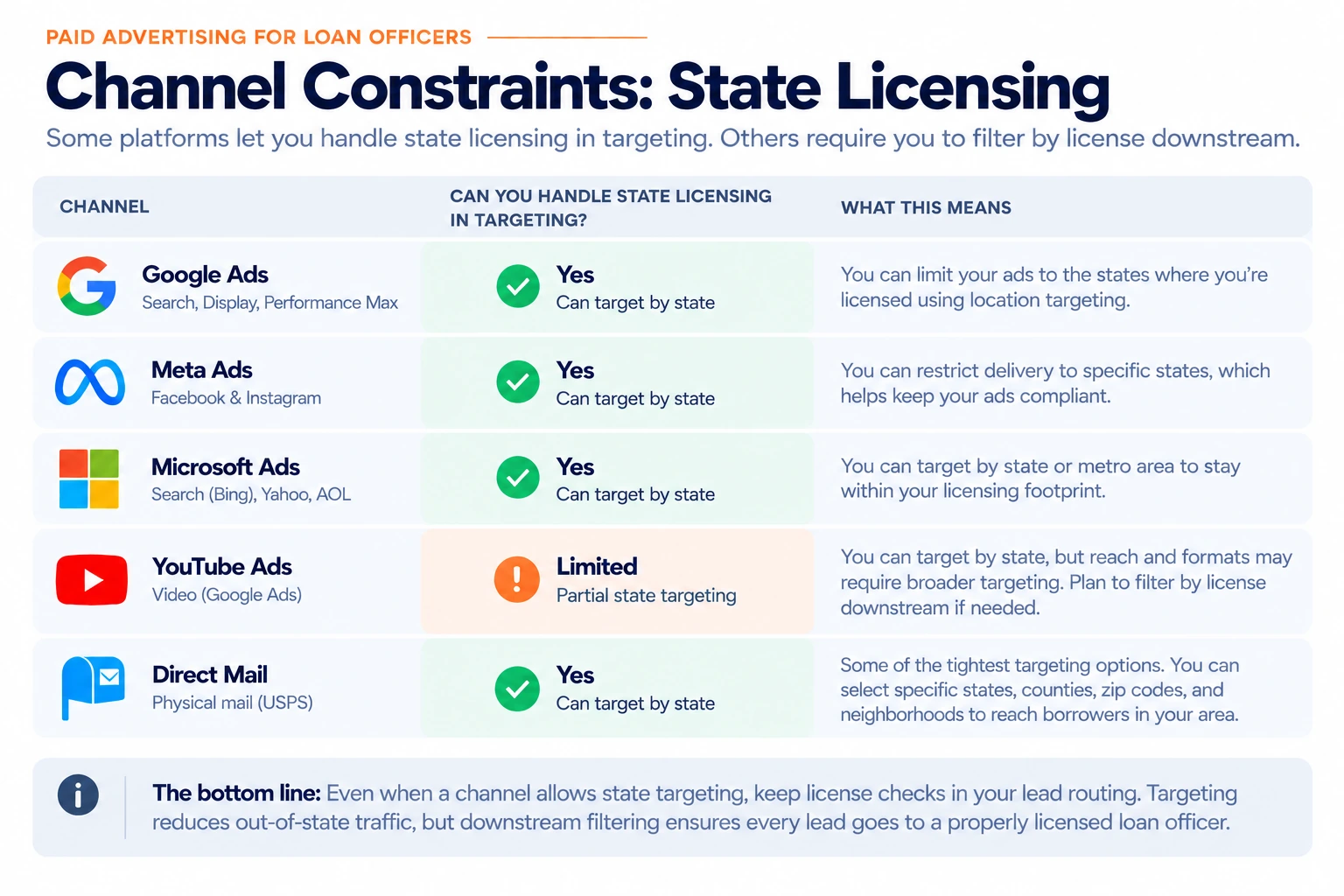
On Google and Microsoft it is a targeting setting. Restrict to the states you hold, and you stop paying for clicks you cannot serve.
On Meta you cannot. The 15-mile minimum radius does not respect state lines. From Media that circle reaches Delaware and New Jersey. You are compelled to pay for impressions in states you may not be licensed in. No setting tightens it.
So on Meta the licensing filter moves downstream. It gets handled by whoever answers, and by the routing rules underneath them, rather than in the campaign. Plan for that before you run the first ad, not after the first out-of-state lead arrives.
What to Measure
One number decides whether a channel works. Cost per funded loan.
Cost per lead is the number every platform shows you and it is the one that misleads. A $25 lead that never answers costs more than a $150 lead that closes.
Two intermediates worth tracking by channel. Contact rate, meaning whether you reached a human. And the gap between time to first attempt and time to first conversation.
What normal looks like varies enormously by source, and lead conversion rates by source has the ranges.
One thing to know before you plan the Google side. On May 15 2026 Google announced that from June 15 2026 the Google Ads API stops accepting new adopters of offline conversion imports, including enhanced conversions for leads. Anyone whose developer token had not imported an offline conversion between December 2025 and May 2026 receives an allowlisting error. The Data Manager API is the route forward.
The restriction is on the API. A CSV upload through the Google Ads interface is not the API and is unaffected. For a solo originator or a small shop, that is the route that still works. Nobody writes about it, because it is not a service anyone can sell you.
When to Hire This Out
Running paid search properly is a job, not a task. If nobody in your shop will own it weekly, an agency is the honest answer.
Three things to keep regardless of who runs it.
Your tracking. The GCLID capture and the UTM structure live on your side. An agency that owns your measurement owns your ability to leave.
Your data. Lead records, conversion history, and the list of what converted. That is yours.
Your account. Ads run inside your own Google and Meta accounts with the agency granted access, not inside theirs.
An agency that will not agree to those three is selling you dependence rather than advertising.
Frequently Asked Questions
What should a loan officer set up before running ads?+
Tracking, and it takes about twenty minutes. Capture the Google Click ID in a hidden form field so click data reaches your CRM. Set a consistent UTM structure so you can report by campaign and keyword.
Neither can be added retroactively. Without them you can measure cost per lead and never cost per funded loan.
Which ad platform is best for loan officers?+
The one you will run properly for ninety days. Google Search has the highest intent and the highest cost. Microsoft Advertising is cheaper with far less volume. Meta reaches more people and strips most targeting under its Special Ad Category.
A small budget across four platforms produces four datasets too thin to learn from.
Can you target only the states you are licensed in?+
On Google and Microsoft, yes, and you should. On Meta, no. Housing and credit ads carry a 15-mile minimum radius that ignores state lines. A campaign near a border reaches states you may not hold.
On Meta the licensing check has to happen when somebody answers rather than in the campaign.
Are trigger leads still usable for direct mail?+
On your own book, yes. The Homebuyers Privacy Protection Act amended the Fair Credit Reporting Act effective March 4 2026. It ended trigger purchases on consumers you have no relationship with.
Deals you closed and loans you service stay usable within the statutory exceptions. That audience was always the one worth mailing.
How do you know if mortgage ads are working?+
Cost per funded loan by channel, not cost per lead. Every platform reports cost per lead because it is the number they can see.
Track contact rate as the intermediate, since a channel producing unreachable leads looks cheap right up until you count closings.